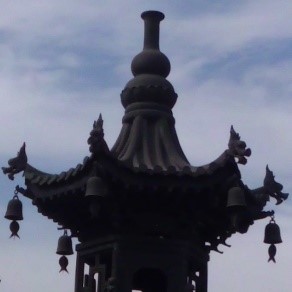
The image above shows the Big Wild Goose Pagoda in Xian, China. I love it because it represents the soul’s return to heaven when the time comes. There is no distinction between men and women, skin color, or other outward traits that define us because, in the end, we are all the same, just as we were at the beginning. If we have lived the life we are meant to live, we will leave this world singing with the tolling of bells signifying a life well-lived.
For whom the bell tolls – the bells toll for thee phrase was popularized by Earnest Hemingway. John Dunn’s phrase that “No man is an island, entire of itself; every man is a piece of the continent, a part of the main. I like John Donne’s phrase “For whom the bell tolls” that comes from his “Devotions upon Emergent Occasions”, specifically Meditation XVII. The central message is that all humans are interconnected; a death diminishes everyone, as humanity is a collective whole. Donne uses geographical imagery, comparing people to islands and the sea to death, to emphasize this interconnectedness and the shared human experience. The tolling bell symbolizes the inevitability of death affecting everyone.
In my previous post, I discussed humanity’s quest for self-discovery, emphasizing how our thoughts and actions reflect the way we choose to live. Through the self-expression of ideas, we ultimately shape and define who we are, and importantly who we are meant to yet become. The contemporary Buddhist view of that was demonstrated by the reply given by the Dalai Lama, when asked during a visit to Northern Ireland how the warring Protestants and Catholics could co-exist: “Remember we are all one – all the same”. Donne seems to be agreeing and saying that whatever affects one affects us all. This is highlighted by the famous ‘no man is an island’ line at the beginning of the ‘for whom the bells tolls’ paragraph.
Ernest Hemingway helped to make the phrase commonplace in the language when he chose to use the quotation for the title of his 1940-published book about the Spanish Civil War. Hemingway refers back to ‘for whom the bell tolls’ and to ‘no man is an island’ to demonstrate and examine his feelings of solidarity with the allied groups fighting the fascists. There was a strong feeling amongst many intellectuals around the world at the time that it was a moral duty to fight fascism, which they feared may take root world-wide if not checked. This view was given voice later in the well-known poem First They Came for the Jews, attributed to Pastor Martin Niemöller:
First they came for the Jews
and I did not speak out
because I was not a Jew.Then they came for the Communists
and I did not speak out
because I was not a Communist.Then they came for the trade unionists
and I did not speak out
because I was not a trade unionist.Then they came for me
and there was no one left to speak out for me.
My travels with Lieh Tzu / Interpolations along the Way
Chapter Four – Confucius
60. Sing only joyous Songs as I go
What is the proper way to live and die? Who can know? Who can say? To be born normally, coming from nowhere is the Way.

The bell tolls for thee
When a man follows a course consistent with life and lives so that although he dies when his term is up, he does not perish before his time, this is normal; to follow a course consistent with life and perish before his time is misfortune.
To die normally in accordance with your manner in life is also the Way. When a man follows a course which leads to death and dies so that he perishes by his own fault even before his term is up, this is also normal; to live after following a course which leads to death is good luck.
Therefore, to be born relying on nothing is called the Way, and to live out your term depending on the Way is called normal. Death which depends on your manner of life is also called the Way, and premature death which depends on the Way is also called normal.
You must remember that life is simply a corridor with many paths to choose from and death but a door to a new beginning.

If one can live his life in accordance with the Way of Virtue, or the Tao, then surely only good can follow. If one has lived his life in pursuit of knowing the Way, he can look to the door singing. If one dies through misfortune, there is much sadness. But then ordinary people sing when anyone is born and cry when anyone dies.
Always remember that to be born normally, coming from nowhere is the Way. Just as to die normally in accordance with your matter in life is also the Way.
Seek only what lies within yourself, fine‑tuning your way and prepare to return to be born again. With no sorrow in death. With those you have left behind, only singing joyously along with you as you go. 3/16/95
Number sixty of one hundred fifty-eight entries.
Leave a Reply