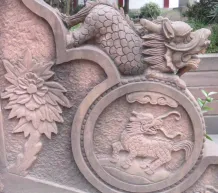
When I wrote the entry below, I was still in Massachusetts and would be moving to Boynton Beach in Florida in a few weeks in April 1995. I had been offered the job as the Assistant Planner for the city and Marie, and I were getting ready to move. All the stories were written as described by their dates, but none of the pictures shown here were added until years later, after I had traveled to China over the subsequent years.
The concept of uncovering hidden talents we might possess was something I had yet to realize. I had never really written anything or even tried until I got what felt like a wake-up call a little over two years earlier, and now I’m writing about Lieh Tzu and Confucius. The stories from Lieh Tzu seemed to be teaching me the Way of the Tao, and I was following and putting them into my own words without hesitation.
In my first book about the I Ching and an introduction to Taoism, I wrote about Chuang Tzu and how the Perfected Man lives his life. As if in a trance, he exists beyond the dust and grime of the world. At times appearing to be without a sense of direction, he wanders about; his job is tending to nothing. To what is called, ‘Action with inaction, growing something, but not supervising or controlling it.’ As I weave the tales of Lieh Tzu and share the wisdom of Chuang Tzu, I gain deeper insights into the path unfolding before me.
Insights are meant to be lived, taking years to truly understand by embodying their meaning in daily life, reflecting the core of Taoist teachings. Offering this commentary holds significance for those seeking beyond the present, serving as an invitation to observe the natural behavior or conduct of the highest kind of person.
This chapter titled Confucius seemed to narrate the story in a way that resonated with me, especially as I was preparing to transition to Boynton Beach in just a few weeks and found myself writing more deeply while getting ready to leave Massachusetts. It felt as though I wasn’t just telling the story, but in a way, becoming the story as it flowed through me. Later, I would be reminded that “what I write is who I am to become”. It was never a question of doubting the authenticity of the story yet to unfold, just to keep writing and the story would tell itself.
There was definitely a shift happening. I didn’t question it; I had simply discovered this hidden talent for writing and telling stories about Eastern philosophy and ancient China—the I Ching, Taoism, and Confucius.
At the time, I had no clue what lay ahead, only that I was meant to step forward into the unknown. Physically, that meant Florida, but in my mind, it was to be a journey to ancient China.
My travels with Lieh Tzu / Interpolations along the Way
Chapter Four – Confucius
62. Exposing Talent
While Teng Hsi, who prepared the law code of the State of Cheng, was traveling  through the city he chanced upon Pei Feng and others who were followers of Lieh Tzu and happened to be in town for the day.
Trying to impress those around him, Teng Hsi looked around and asked: “What would you say if I make the fellow coming forward dance for you.” They all responded that it would please them.
Teng Hsi then asked Pai Feng: “Do you know the difference between being kept like a parent supported by his sons and being kept like a dog? Such creatures as dogs and pigs are kept by man and cannot keep themselves, the effort of man keeps these animals and uses them for his own ends.

If people like you are well‑fed and comfortably clothed, you owe it to the administration. Herded together young and old as though you were animals for the sty or the kitchen how do you differ from the dogs and the pigs?”
Another disciple of Lieh Tzu came forward and asked: “Have you not heard of the skilled men in Ch’i and Lu? Some are clever at working with clay or wood, others with metal or leather; some are good singers and musicians, others good  scribes and diviners; some know how to command armies, others to manage ancestral shrines; there is no shortage of any kind of talent. But they cannot give each other positions or tell each other what to do; the men who give them positions lack their knowledge, the men who tell them what to do lack their abilities, yet by these their knowledge and abilities are employed. It is we who employ you administrators; what have you to be conceited about?”
Teng Hsi could only withdraw in embarrassment. Comparing the honest craftsmanship of the artisans to that less than a man while saying they owe it all to the goodness of the State is foolish. Who can be made wiser and who can be the fool? 3/17/95
Number sixty-two of one hundred fifty-eight entries.
Leave a Reply