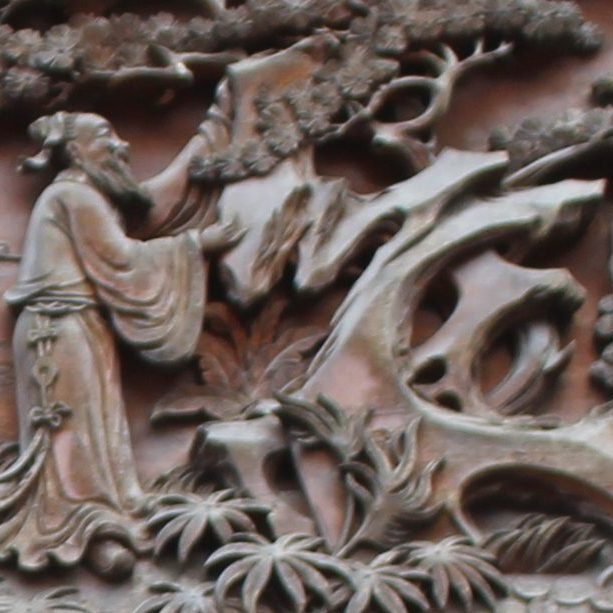
I love the idea that the “Zen mind” encourages us to fully embrace the present moment and nothing else. It’s about having the courage to be here now, focusing on the experience of enlightenment, and returning to our breath without placing divinity above the simple, everyday miracles around us.
I think I mentioned in an earlier entry that Albert Einstein expressed doubt about the limits of linear thought, believing that conclusions reached solely through logic were devoid of any real meaning. Even if we try to define what reality is, it’s our intuition that plays a vital role in shaping our thoughts. Our intuition, or our inward knowing, is what tells us who we are that shows and teaches us what’s best for us in the long run.
We don’t often stop to consider that our intuition might be more important than just what we derive from logic. Now, in the age of AI, artificial intelligence is quickly taking the place of human intuitive thinking, as it can identify the best set of options for any situation beyond what the human mind can imagine based on past events and possible future outcomes. Think about that for a moment. When Taoism encourages us to think and act beyond rigid principles, it’s about responding to the needs of the present moment while, as Confucius might put it, holding on to our virtue as everything around us is never meant to stay the same and keeps changing.
It feels like we’re nearing a point of what could be called a “fundamental unity” or “cosmic symmetry” that’s almost beyond description. That change is in the air. At times, this can spark fear of the unknown, challenging the things we assume or take for granted. As Emerson wrote, it’s “the wise silence, the universal beauty, to which every part and particle is equally related to the eternal One”.  To what we call in the East the Tao, and to the West God.
 To that profound silence we see when observing the universe and myriad galaxies from the Hubble telescope and other means. To what we are learning from quantum mechanics and physics that serve to remind us of the infinite possibilities that exist in all things, especially us.
What we see and understand as Heaven is universal, speaking equally to all things, calling to the place where our spirit longs to return.
I like to think of this light as always present, like unseen stars at noon that we know exist, offering comfort in what can’t be seen. It’s the light within everything in nature, what Emerson called our own innate nature or spirit, speaking to the  purpose that gives life its meaning. And finally, to the ancient Greek philosopher Democritus, who said, “Nothing exists but atoms and the void”.
This void lies at the heart of Eastern thought and teachings—not as emptiness or absence, but as the uncreated essence that comes before all creation, the timeless potential of everything. With this we discover there’s more to ourselves than we realize when we open our eyes to what remains unseen, maybe for the very first time.
My travels with Lieh Tzu / Interpolations along the Way
Chapter Eight – Explaining Conjunctions
137. Questioning Heaven’s Generosity
A wealthy man of Chou had thoughts of going on a great journey. Before departing, he wanted to ensure his safe passage before he left by offering sacrifices to the god of the road and prepared a feast for a thousand of his closest friends. As he looked out over the festivities, while the fifth course of fish and fowl was being served, he graciously looked out among all his guests and said:
“How generous heaven is to mankind! It provides the five grains and nourishes the fish and fowl for the use of men.”
All his guests of course agreed as they sat eating and drinking from the largess of the wealthy man except for one young boy who saw the ruse, and while only twelve, was known to be wise beyond his years. In fact, the Pao family had great hopes for their young son and hoped that by bringing him to such as august gathering could show him off as one who would be perfect to be groomed for great things. In recognizing the boy’s talent, the family had always encouraged him to not hesitate to speak his mind freely.
As all the guests were nodding in agreement and echoing the sentiment expressed by their host, the boy could not refrain from speaking up and came forward to say the following to the large crowd that was assembled and spoke directly to his host:
“It is not as your lordship says. The myriad things between heaven and earth, born in the same way as we are, do not differ from us in kind.  One kind is no nobler than another; it is simply that the stronger and cleverer rule the weaker and sillier.
Things take it in turn to eat each other, but they are not bred for each other’s sake, men take the things that are edible and eat them, but how can it be claimed that heaven bred them originally for the sake of man? Besides, mosquitoes and gnats bite our skin, tigers and wolves eat our flesh; did heaven originally breed man for the sake of tigers and wolves?”
While everyone was shocked at the indiscretion to their host, their host knew his trip should be postponed until he had an opportunity to question this young boy on his own. He asked the family of the young boy if he could ask him why he should come forward to question him and his authority in front of all those he had assembled. He was the richest man in the region and did not take the slight lightly. To their horror, the Pao family, who were simply lower-class merchants from a neighboring community, were afraid that the boy, who they saw as their future security, may now instead be their downfall and quickly agreed.
The boy came forward showing no remorse for his audacity and caught the man off guard by his self‑assurance. As all the dishes were now being cleared away and the other guests were all leaving, looking back over their shoulders, their host knew he must find the proper way to deal with this twelve-year-old.
If the boy just didn’t look on knowingly as if he knew what he had said to be true. The lord started by saying that from those assembled he was the richest. He knew the boy to be his family’s pride and joy and that he was surprised that as smart as he was, he would attempt to embarrass him at his farewell banquet.
The boy responded that it was not his purpose. That he had simply responded to the untruth he had stated in his toast. That being that of heaven’s generosity to mankind and the purported purpose of the fish and fowl, and by their association all living creatures being here to be used by man. I simply stated that this was not true and cited examples to prove my point. If you or your guests were offended, I am truly sorry. That was not my intent. The host motioned to the boy’s parents to take him away. He then laughed at the boy who had shown no fear and knew they would cross paths again. 9/4/95
Number one hundred fifty-four of one hundred fifty-eight entries.
Leave a Reply