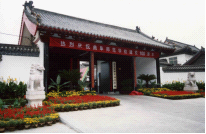
The picture above is of the Queli Hotel that is adjacent to the Confucius Temple and Mansion inside the wall of the old city. I stayed here the first dozen or so trips to Qufu. In the early days, before the construction of the hotel visitors would stay in rooms set inside the Confucius Mansion next door. To the north was the Confucius Temple and to the west was the Confucius School where I was to later teach English.
What pushes us to escape the monotony of daily life, to step off the treadmill or rise from the couch in search of something greater? How do we begin to see beyond the illusion of a life with no clear purpose, apart from death and whatever follows? Yet, we come to realize that the structure and discipline we embrace shape the path we walk. Where we falter is what Buddhists and Taoists have reminded us for centuries: we run into trouble when we place our future in the attachments we choose to hold onto. What does letting go reveal, and to what reality does illusion eventually guide us?
Why is finding the silent moments in our lives so essential? Could it be that living in the moment, free from distractions, allows us to hear and then adjust to the memories that guide us toward our greatest potential? When the small voice within us falls silent, we are reminded that, over eons, humanity has discovered that listening in the silence is the essence of meditation and prayer.
Over time, when our minds become clear, it can feel like a jolt, waking us from a deep sleep. What is it that clears away the attachments and things we cling to in the present, which we think define us but are really just illusions? Often, it comes with the suddenness of an alarm clock, signaling that it’s time to wake up.
What was the final acknowledgement that I was forever to be become a part of who I have always been was our trip to Urumqi, to adopt our daughter Emily in October 1999. We stopped in Qufu for the first time to meet with friends I had made on the internet. Over the next twenty-five years I would make over forty trips… yes forty, that was to include teaching at the school founded by and for the descendants of Confucius. But on that trip, we stayed at the Queli Hotel next to the Confucius Mansion, Temple, and Confucius school I was to teach at beginning in 2011 more than ten years later.
I woke up early in the hotel and felt the urge to take a walk outside. Around 5AM, it was still dark, but the streetlights illuminated the streets and buildings. There was a strange presence, a sense of déjà vu, as if I had been here before. The wall around the old city was a replica of one built long before the time of Confucius but looked familiar. Looking up at the buildings and stars that morning, I felt like I was on a path toward fulfilling my endeavors and ultimate destiny. It seemed I had walked the same streets many times, just as Confucius had over 2,500 years earlier. That I was to walk in the footsteps of Confucius and others I had met and come away now with my own stories to tell.
Some might read this and say, “Dan, you have a vivid imagination, perhaps even suffer from an illusion.” Something I was to write about over the years to come. How do we separate illusion for reality? Isn’t that the gist or the main or essential part of following Lieh Tzu now? When I wrote the entry below, over four years before my initial trip to Qufu, I had never even heard of Qufu or Confucius, except for the common lexicon “Confucius says…”.
The word epiphany comes to mind, often defined as a manifestation of a divine or supernatural presence or a moment of sudden realization or insight. I believe I experienced one during my first of many trips to Qufu.
My travels with Lieh Tzu / Interpolations along the Way
Chapter 3 – King Mu of Zhou
39. The magic of Lao Tzu or rediscovering the Magic
Traveling with Lieh Tzu, you are reminded to remember the magic of Lao Tzu. As he  rode westward into eternity to become one with the wind and discover the highest clouds where only dragons fly.
Lao Tzu tells us: “The breath of all that lives, the appearance of all that has taken shape is illusion.
What is begun by the creative process and changed by yin and yang, is said to be born and to die; things which, already shaped, are displaced, and replaced by a comprehension of numbers and understanding of change are said to be transformed, to be illusions of magic.
The skill of the Creator is inscrutable, his achievement profound, so that it is long before his work completes its term and comes to an end. The skill of the magician working on the shapes of things is obvious but his achievement shallow, so that his work is extinguished as soon as it is conjured up. It is when you realize that the illusions and transformations of magic are no different from birth and death that it becomes worthwhile to study magic. If you and I are also illusion, what can there be to study?”
Keeping company with dragons to reflect and rediscover the magic found in all things is difficult and arduous at best. If you and I and all we see and do are simply an illusion, then why go to the trouble? As all outcomes can only come out as the same. As you travel home and begin to ponder at great length, you start by putting into practice what you have now learned.
You are soon able to appear and disappear at will, exchange the four seasons, call up thunder in winter, create ice in summer, make flying things run and running things fly. However, you soon discover that it is better to put aside conjuring tools and concentrate solely on the magic found in what is created by nature.
Is not Lao Tzu simply reminding us to identify what is real and unreal? That all there is to know is the magic waiting within you to come forward to find. Find a place of quiet solitude and listen to what comes forth. If all is the same yet an illusion, then are we not all the creation of magic? 2/6/95
Number thirty-nine of one hundred fifty-eight entries.
Leave a Reply