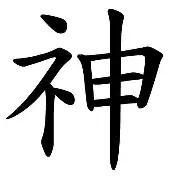
Understanding the roles of both the sage and spirit means staying open to different perspectives, as what draws us shapes who we are and the path we take. Staying open to different approaches to spiritual growth doesn’t mean letting go of what we know or once valued. Spirit builds on both past and present to guide us toward our greatest endeavors and future destiny. To what the Chinese call shen in the symbol above and as described below.

Learning the role of spirit is essential to knowing who we have been and are still yet to become. A book, something I have sincerely appreciated over the years is called “The Way of the White Clouds”, by Lama Anagarika Govinda, who has helped me to free my mind of needless clutter.
It can really be any source that helps guide us toward understanding how living beings come into existence, and how they take on new forms and conditions based on their natural or learned tendencies.
By exploring our subconscious desires and the conscious actions they inspire, we can trace them back to their roots. It’s through letting go that we gain a more cosmic perspective of our journey, allowing us to see our path with both meaning and value. What the sage is conveying is asking us, “Ok, where do I begin or more truthfully continue this trek into the unknown”.
Letting go of rigid opinions and prejudices, along with the unnecessary memories that tie us to the past and block fresh perspectives on present problems, is essential.
Taoism and Lao Tzu
Lao Tzu talks about the sage taking no action thus nothing is not done. On the surface, this seems like something that doesn’t make sense, or is incongruent, meaning it lacks consistency or harmony. The Tao Te Ching in chapter/verse sixty-four begins by saying that it’s easy to rule while it is peaceful and it’s easy to plan before something arrives. In practical terms, the sage sees the Tao shaping the universe, with yin and yang transforming it and acknowledging we each have a role to play.


The sage becomes like a shen, or spirit, recognizing that it’s easy to break things while they are still fragile and to disperse when they are small.
Taking the form of the dragon and acting to shape or bring order before anything even exists, as though living beyond thought, aligned with what we perceive as divine order.
It’s like you have to wrap your mind around this idea before you can go there or continue. No longer just reading and writing the words inspired by the ancients but truly becoming one with the eternal through them.
The first meaning of shen refers to deities which are intimately involved in the affairs of the world, even to spirits of those who you have known through eternity, and as dead ancestors. Spirits generate entities like rivers, mountains, thunder, and stars even mapping the cosmos as they go.

A second meaning of shen refers to the human spirit or psyche that is seen in the body as luster or vigor and in the mind as vitality and enthusiasm; it is the basic power or agency within humans that accounts for life, and in order to further life to its fullest potential, the spirit (Shen) is transformed to actualize our potential.
The earliest known discourse on shen in the medical context is found in the Huangdi Neijing Lingshu. The document that comes down to us today is believed to have originated during the Han Dynasty, perhaps around 100 B.C.
Lao Tzu helped make sense of it all, showing the way five hundred years earlier and highlighting its connection to our innate nature and the world around us.

It’s like having a personal take on what’s called wu wei. When you view wu wei as not acting, it becomes a form of living meditation—remaining present in the world, yet feeling almost ethereal, as if part of the cosmos mentioned above.
It’s about seeing ourselves beyond the present moment and choosing to move in that direction. It follows the idea that the person of Tao never acts with their ego in tow, yet nothing important is left undone.
Not-acting isn’t the same as doing nothing. It’s about letting go of ego and personal agenda or will and instead living through the spirit and the Tao. True achievement comes only from this way of being.
When you rely on force, it will eventually backfire, turning into the opposite of what you intended and leading to failure every time. This is beyond even religion. You can follow another path and still know the Way of Virtue. Acceptance of someone else’s journey is as essential as the key to our own awakening.
Lao Tzu’s chapter/verse sixty-four talks about how a giant tree starts from a tiny shoot and the tallest tower rises from a basket of dirt. The highest terrace and a thousand-mile journey begin right at our feet. It makes you think our mind works this way too. I believe our eyes don’t deceive us either.
Lao Tzu says, “To act is to fail, and to control is to lose; therefore, the sage does not act and thus does not fail.” It’s when we start thinking and acting from the spirit, rather than through our physical senses, that our confusion begins to fade. By rising above our human weaknesses, we can begin to discover the true meaning of freedom.

Ho-Shang Kung, a Taoist master who lived in a hut by the Yellow River, composed a commentary on the Lao Tzu for Emperor Wen (179–156 BC) and tells us,
“Others seek the ornamental. The sage seeks the simple. Others seek form. The sage seeks Virtue. Others seek facts and skills. The sage studies what is natural. Others study how to govern the world. The sage seeks how to govern himself and how to uphold the truth of the Way.”
The book on the left is Two Visions of the Way. I’ve used it as a reference for over ten years. It’s great source material for both Wang Pi and Ho-Shang Kung. For any serious study of Chinese history and philosophy, and especially Lao Tzu’s Tao Te Ching this book is a must have… I highly recommend it.
Lao Tzu tells us that the sage does not act and as a result he doesn’t lose things. Staying authentic from start to finish, he cares just as much at the end as he did at the beginning, which ensures success. The sage learns to master his desires, avoiding what is hard to obtain, and studies what others overlook. He turns toward what is ignored and chooses to help all things follow their natural course, daring not to interfere.
Before we go on with Verse number 64 of 81, it’s worth noting that the title of the book we’re adding commentary to—Lao Tzu’s Tao Te Ching—is my own version, titled “Thoughts on Becoming a Sage: The Guidebook to Leading a Virtuous Life”. It’s important to note that Lao Tzu wrote the Tao Te Ching in the sixth century BC, while I wrote mine in May and June of 2000 and published it in China in 2006.
Verse 64 – Finding everything too easy
The sage knows that doing what comes naturally is not work. Therefore, he works without really working.

He acts without really acting, thereby not exhausting himself and tastes without really tasting the true meaning of the Tao through meditation. He goes forth knowing that rather we are great or small, many or few it is important to repay any slight or wrong with virtue.
What the world considers hard the sage considers easy. Just as what the world considers easy the sage considers hard. How can that be so?
If one can plan for the hard when it is easy and work on the great when it is small, the hardest task in the world becomes easy. The greatest goal in the world begins, or becomes small.
Because the sage never acts he achieves great things. He responds to others knowing instinctively that he who quickly agrees is seldom trusted and those who make it all look easy finds the way hard. Therefore the sage travels in virtue making everything appear hard, while he himself finds nothing hard.
64. 万事皆易
圣人知道,捡大自然的便宜不是工作。因此,他做事并非真的做事,他行动不是真的行动,这样

他不至于精疲力尽。他通过斡旋,品尝到没有真正品尝到道的真义。他明白不管我们是伟大还是渺小,多抑或是少,重要的是要补偿对大德所犯下的大小过失。
世人认为难的事情,圣人却认为容易。世人认为容易的事情,圣人却认为难。为什么会如此?如果一个人把易事当难事,小事当大事,这样世界上就无难事,伟大出于平凡。
圣人从来就不装作他干了什么伟大的事情。他心里明白,那些不假思索就附和他的人,很少是可以信赖的。那些把事情看得太简单的人,会明白道之艰难。因此,圣人载德而行,世上万事看来艰难之事,圣人却认为容易。
Leave a Reply