Taoism and Lao Tzu
Lao Tzu says, “The sage is good at saving /yet he abandons no one / thus the good instruct the bad /the bad learn from the good”.

To float above it all as though on a cloud just passing by. To be riding on the wind again with Lieh Tzu. Writing as though you have seen it all before. Only going now as if there is nothing new under the sun.
Only to look down now as though everything you encounter begins and ends with a clean slate. As though you were never really here but are present just the same.
In chapter/verse sixty-three Lao Tzu tells us that we are to act without acting, and to work without working. To look to the universe with endeavors that serve without concern for how your affairs or presence will be seen by others.

To look for flavor in what has no flavor. To regard the small as large and the few as many and to always repay resentment and wrong with kindness and virtue. To plan for the difficult and hard when it is easy. Seeing the big picture as something great while appreciating the moments when it was still small and simple. In your travels, you’ve often found that the most difficult challenges you’ve faced began with goals that seemed easy at first.
You’re reminded once again that you’ve seen it all before—big things always start small. You laugh, knowing the sage never seeks greatness or tries to do great things, yet somehow achieves them. You recall that those who agree too easily can rarely be trusted, and those who make everything seem simple often find challenges as if everything were hard.

Therefore, the sage regards everything to be hard and thus nothing is difficult or hard. Remembering the lessons from Chuang Tzu, his wisdom speaks to each of us as individuals, encouraging us to see the relativity of values and avoid clinging to conventional ideas.
Everything he teaches is meant to break us free from rigid thinking and open minds to wider perspectives. Along the path you now walk, dragons have appeared as guides, showing the way of immortals who escape the mundane life of the merely mortal world.

To ride the wind again with Lieh Tzu and others, embracing an effortless existence, free movement, and natural spontaneity.
To value the principle of emptiness, creating an inner void—a space in our hearts—by letting go of compulsive labeling, greedy desires, and allowing spontaneous action to flow with the Way of Virtue.
Taking on the role of the storyteller who inspires all to return to their origin, to nature’s source, and to the flow of the Way. With words and images in rhythm with the world, flowing in and out of time and space, as he is seen above the clouds forever embracing the Way.
Verse 63 – Becoming a sanctuary to all you meet

The sage acknowledges and understands that there is nothing that is not in keeping with the Tao.
Especially true is that the Tao resides in each of us. Thus, in showing the way the sage is good at saving and directing those around him, while abandoning no one. Since the sage in essence is simply the embodiment of the Tao, abandoning or leaving behind another person could or would never enter his mind.
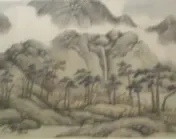
The sage’s surroundings are illustrative of how he sees his place in the ten thousand things. As though he is seen creating a sanctuary that reflects his innermost sense of who he is yet to become.
Kind and reflective, still yet expansive, he competes with no one, and no one competes with him. His strengths and weaknesses have become razor sharp as he uses them to cut through what is perceived to be truth and falsehood. While he remains on the edge pushing others to places they would not otherwise go, he leaves no foothold for those who would follow except by accepting and following the Tao.
When he himself becomes the sanctuary for others to take refuge and follow, finding the comfort only found in the expression of the Tao, he is reminded that he who searches will find it and those who don’t only escape to wait until another day.
63. 做众人的庇护处
圣人承认并且明白,世间万物无不与道保持一致,特别是道与我们每一个人同在。因此,圣人讲

道,善于拯救和指导他身边的人,而不会抛弃任何一个人。因为圣人是道的化身,他从来就没有想过抛弃或丢下一个人。
圣人所处的环境反映了他如何看待他在万物中的地位。圣人营造了一个反映他未知的内心世界的庇护处。他友善,多思和豪爽,与世无争,也无人与他竞争。他的优缺点已变成一把锋利的刀,可以用来识别真假。他急于把人们推向他们从来没有去过的地方。除了接受和跟随道之外,众人别无选择。
当圣人成为别人躲避和追随的庇护处时,人们在这里找到只有从道中才能找到的安慰。寻道的人将会得道,不寻道的人只好逃出去等候另一天的到来。
Leave a Reply