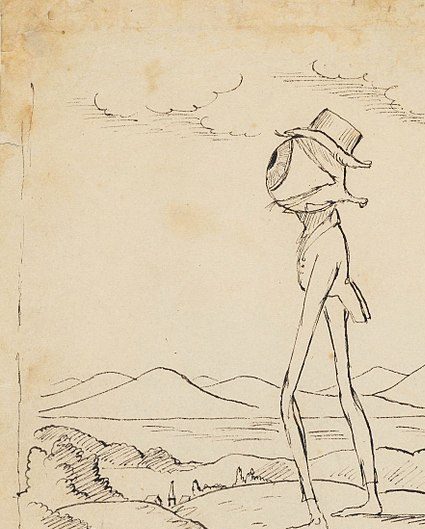
In Emerson’s essay Nature, the metaphor stands for a view of life that is absorbent rather than reflective and therefore takes in all that nature has to offer without bias or contradiction. Emerson intends that the individual become one with nature, and the manner of the transparent eyeball is an approach to achieving it.
Persistence and patience seem to be the most telling attributes we can discover along the way. Little things found along the way meaning little turning big if left to their own devises. Letting our emotions carry us to what we think we need or want, often leading us to value things outside us instead of staying within the strength of the virtue found from within. Unknowingly, we spend a lifetime homing in on what is valuable to our inner growth with what is yet to be revealed as much greater than what we see in the present. The story below is a great lesson of someone trying to follow a path they think they need to succeed only to find that failure can lead us to find the attributes that we already possess that leads to ultimate success. The story of Pu Songling, I’ll relay in a little bit, relays this very well, but first…
We’ve all been there. Pouring ourselves into something we think will lead to success only to find failure instead. Was it failure or simply pursuing the wrong path. Looking to someone else’s success gives us hope to maybe we can follow similar pursuits only to find unhappiness when we don’t find it answers our inner definition of who we are meant to yet become. Ralph Waldo Emerson, one of my most favorite writers who developed the ideas of what would become transcendentalism, spoke of finding nature’s attributes within us that would carry us to who we are meant to become. Emerson’s contribution to universal understanding as to how we are to transcend who we think we are into something or someone beyond our imagination. He opened the door for generations that would follow telling us that it would be our inner knowing of our own nature that would lead to our highest endeavor and ultimate destiny.
In his essay Nature, the metaphor stands for a view of life that is absorbent rather than reflective and therefore takes in all that nature has to offer without bias or contradiction. Emerson intends that the individual become one with nature, and the manner of the transparent eyeball is an approach to achieving it. What we do is meant to serve as a vehicle that helps to take us there. Emerson’s writing and his magazine called “The Eye”, provided universal glimpses or views of what people knew at the time. He wrote about various topics including those from Indigenous peoples to Eastern philosophy including Buddhism and Taoism teaching others to transcend who they thought they were to something or someone greater. That human nature was the same the world over and we are meant to become transcendent ourselves.
Pu Songling was born into a poor merchant family in Zibo, Shandong Province (June 1640 – February 1715). He was a Chinese writer during the Qing dynasty, best known as the author of Strange Tales from a Chinese Studio. At the age of 18, he received the Xiucai degree in the Imperial examination. It was not until he was 71 that he was awarded the Gongsheng “(“tribute student”) degree for his achievement in literature rather than for passing the Imperial exam. The point being was that he tried unsuccessfully to pursue passing the examination his entire life, but in failure, his writing acumen let to great fame. My daughter Katie and I visited his home in Zibo in 2012. It is now a tribute to his contribution to Chinese culture.
Voices of the Dragon Part 2 Number 10
Taking to the Foothills
Finding and continually maintaining one’s energy and renewal is essential in following the right path along the journey.

As a beacon of light always answering the ultimate question asked along the way. Is the path taken the correct one and is the shortest and easiest route necessarily the proper one?
Standing on the mountain ridge studying the overwhelming panorama to be followed, two discernible paths are seen. One through traveling below where the terrain looks easy and knowledge of the way is easily defined. The other route through low foothills showing no clear signs of passage with zigzags the order of the day.
Following the path through the valley is not necessarily the best way to proceed.

Renewal comes with the challenge found along the wayside. What will be learned in pursuing the easy way? The purpose of the journey is to continually question one’s motives and direction. Being willing and able to make mistakes, laugh at yourself and learn from your own foibles and forgetfulness. Take to the high road through the foothills. Leaving the low road through the valley for those ill-prepared to find the peace and harmony to be found in enduring a little hardship along the way.
The purpose of the journey is choices to be made and knowing that you have made the right one. (The above dedicated to the memory of Pu Songling from Zibo, a fellow writer who found his own way). 4/14/94
Leave a Reply