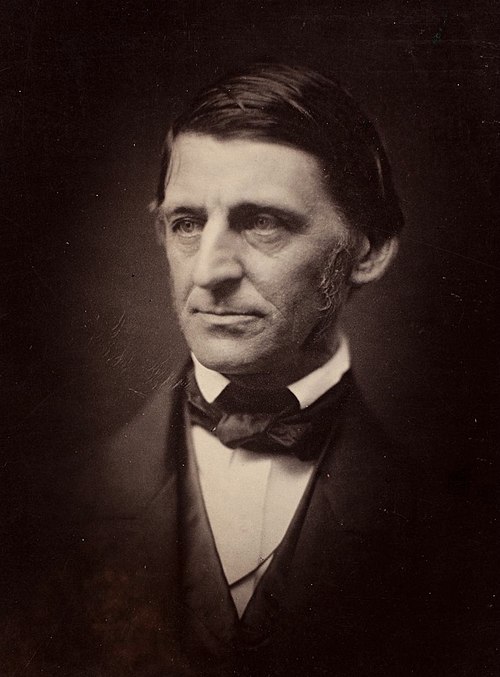
“The Supreme Critic on the errors of the past and the present, and the only prophet of that which must be, is that great nature in which we rest, as the earth lies in the soft arms of the atmosphere; that Unity, that Over-Soul, within which every man’s particular being is contained and made one with all other; that common heart…” Ralph Waldo Emerson.
 “The Over-Soul” is a profound essay by Ralph Waldo Emerson that explores the concept of a universal spirit connecting all living beings, emphasizing individualism and the interconnectedness of humanity. Emerson introduces the idea of the over-soul, as the metaphysical force that unites all existence. He suggests that this spirit is the source of all creativity, wisdom, and virtue, rising above individual identities and experiences. He believes there’s a bond between souls that exists through our shared spirit.
This connection of spirit, affirms the bond between individual souls and the over-soul, suggesting that while each person has a unique identity, they are all part of a greater universal whole. This interconnectedness means that understanding oneself is key to recognizing our role in the grand cosmic scheme. It was this idea that was rooted in the idea that all things found in nature are transcendent, that we are tied to improving ourselves through mutual vibrations that tied all things together as one.
Emerson’s influence was key in reshaping how we view ourselves and our ultimate role in nature. He developed what came to be known as transcendental philosophy, which evolved into what we now call “transcendentalism.” This movement emphasized intuition, individual experience, and the inherent goodness of people and nature. What I appreciate most about Emerson’s teachings is his concept of the “over-soul,” which I think of as the universal spirit—a way to reach a higher level of consciousness and gain a deeper understanding of our purpose.
What I like most about the contributions of Emerson is his being influenced by Eastern philosophy and religions. Being open to what we don’t know that contributes to our knowledge and wisdom that serve to connect us to OUR ULTIMATE PATH. Emerson was especially influenced by the Vedanta, Hindu teachings that connected his own ideas to Hinduism and Buddhism.
He also studied the I Ching, Taoism. and the virtue expressed by the teachings of Confucius. He was also influenced of the Indigenous teachings of America, especially the Iroquois confederacy. To what Emerson saw as what transcends the individual is our ability to see beyond us to our higher selves as concepts of unity and the divine found in these traditions.

All this details Emerson’s views on spirituality and our relationship to the nature around us. He gave hundreds of speeches in his lifetime telling people that we are to look beyond the material world to the deeper connection that bind all living beings. His influence cannot be overstated and illustrates how our thoughts can transcend us.
His writings influence Tolstoy, who influenced Gandhi when he was imprisoned in South Africa, who influenced Martin Luther King Jr., who saw beyond the mountaintop experience, finally to “the good trouble” of John Lewis.
In “The Over-Soul”, Emerson shares an inspiring vision of a universal spirit that links all living things, encouraging people to look inward and understand their role in the grand web of life. This essay stands as a key piece of the transcendentalism philosophy and still speaks to those searching for deeper meaning in spirituality and connection.
Leave a Reply