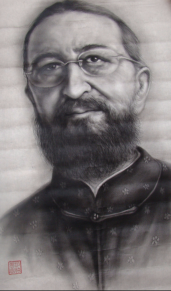
The above picture is me as the teacher in China. My Chinese name is Kongdan given to me by friends in Qufu over twenty years ago. (Kong is the Confucius family name) How I came up with the name “The Kongdan Foundation” a few years later. The picture yesterday could be called Lieh Tzu’s everyday man. Today’s picture would follow the idea of Chuang Tzu’s Perfected Man as a teacher. While far from perfect, I simply aspire to go wherever it is that my writing is meant to take me, preferably to be seen again dancing in the clouds once again with dragons…
The third, fourth, and fifth paragraphs of the first entry of the I Ching reads:
“Don’t look for me where you have found me before.
You will not see me where you have seen me before.
Dancing in the clouds with the immortals is where I am to be found.
 In later paragraphs…
Cloud dancing across the sky in easy. Living with dragons is not.
A group of dragons are seen riding the clouds disappearing through the sky.
As we disappear, I look back and see dragons resting on clouds dwelling in the sky”.
An original composition and interpretation of the Chinese Classic the I Ching (HEAVEN / Heaven over Heaven), 2/3/1994. From the book An American Journey through the I Ching and Beyond that was published in China in 2004.
One of the reasons I enjoy writing so much is that I like to put a title to what I have written that tries to capture or encapsulate what it means in a short phrase or sentence. What that means internally is that you are not writing something that exists beyond yourself, but simply an extension. What I discovered through my writing back more than thirty years ago that I am now adding commentary, was the line that said, “What you write is who you are to become”. that totally was an epiphany. or manifestation. That everything I was to read and then write in my own words meant the wisdom and thoughts of the ancients was meant to pass through me and that I was to express them as though they have always been my mentors Lieh, Chuang, and Lao Tzu. And importantly exist in my memories but have been forgotten.
If something like this occurs as though a dream, do we write it off as though it is unreal, or do we follow with every fabric of what began as sudden, intuitive perception of or insight into the reality or essential meaning of something, usually initiated by some simple, homely, or commonplace occurrence or experience? The only question can be “do we stay where are, or travel on the winds of dragons, who are your mentors and are here to remind and teach you the path you are meant to travel”.
Remember that what you are reading now below as “My travels with Lieh Tzu” was written more than thirty years ago. The story below has a special meaning because as it relays in the title. “Who can be Abnormal” that seems appropriate today.
My friends in Qufu often asked why I hadn’t written a book about Confucius, given that I lived and taught in his hometown and that I was given the name Kongdan. As I walked through the streets of the Old Town where I lived, I frequently found myself reflecting on “following the footsteps of Confucius.” It was like I was home again and would continue to return here in the future. I was never ready to begin writing about Confucius because I had the sense that I would always be returning in the future. That there was no need to tell the story because in a way I had become the story myself. The story being autobiographical it has no ending.
My travels with Lieh Tzu / Interpolations along the Way
Chapter 3 – King Mu of Zhou
46. Who can be Abnormal?
There was a man called Dang Pang who was clever as a child but suffered from an abnormality when he grew up.

Scenes from Shaolin Temple south of Luoyang
When he heard singing, he thought it was weeping. When he saw white, he thought it was black; fragrant smells he disliked, sweet tastes he thought bitter, wrong actions he thought right. Whatever thoughts came into his mind, of heaven and earth, water and fire, heat and cold, he always turned everything to its opposite. Out of tune with the reality of others around him.
Searching for help the man’s father came upon Lao Tzu and told him of his son’s symptoms. Lao Tzu responded how could the father know that his son was abnormal?
Asking: “How do you know that that your son is abnormal? Nowadays everyone in the world is deluded about right and wrong and confused about benefit and harm. Because so many people share this sickness, no one knows that it is a sickness. Besides, one man’s abnormality is not enough to overturn his family, one family to overturn the neighborhood, one neighborhood to overturn the world.
 If the entire world were abnormal, how could abnormality overturn it? Supposing the minds of everyone in the world were like your son’s, then on the contrary it is you who would be abnormal. Joy and sorrow, music and beauty, smells, and tastes, right and wrong, who can straighten them out?
I am not even sure that these words of mine are not abnormal. Let alone the words of the Confucians that you are seeking who are the most abnormal of all. Who am I or they to cure another’s abnormality. Return home instead of wasting your money!”
In whose eyes can we be abnormal or otherwise? What makes someone who sees things differently than the rest of us less secure? Except for how the rest of us see him, who cannot be right made for him secure in his nature. Regardless of how the world sees him. 3/1/95
Number forty-six of one hundred fifty-eight entries.
Leave a Reply