Number 77
Oct 4 – 5, 2018 Xian and Huayin
Xi’an was and is no different from all ancient cities in China, in that there were three constants that brought order to people’s lives. First, a wall around the city to protect against intruders, and both a drum and bell tower to tell us it’s time to get up in the morning or retire at night. To tell us of coming danger and then when it is all clear. Beijing still has their ancient drum and bell towers. The wall around Beijing was removed when Mao came in in 1949.
In Qufu, a replica of exact dimensions of the  ancient wall was re-constructed several years ago. While living within the wall in Qufu, I could step out onto Guluo Street from my apartment, look to my right and on a clear day see the ancient drum tower built in the Ming dynasty a couple blocks away. The bell tower was just around the corner. I could close my eyes and imagine the bell or drum tolling for me.
Why bring this to light now… this bit of trivia? If you are safe and the structure you need to get on with your life is apparent, you can do so without worry. It’s what we unconsciously do… we look for and spend time creating our environment and structure to take us there. It is the sanctuary we create from within that saves us. The ancients knew this as how we connect with the sun, moon, stars, and nature. That connection was the I Ching and knowing you can tell what comes out of something by knowing what went in (cause and effect).
Who are we, but an extension of these – here now to expand the universe by and through our talents for and by beneficial means. To live in a place where our own permanence and enlightenment becomes a foregone conclusion. That we each have a purpose. It’s what the ancient shaman long past told us about the connection, how a confluence appears, and that we are one with it to discover and find within ourselves. As we travel over the next horizon, perhaps to our own Shangri La. To something we simply forgot already resides within us.
In Xi’an, Mingcheng Wall is located in the downtown area of Xian, Shaanxi Province.  It is the largest and most preserved ancient city wall in China. The wall is 18 meters high, the top width is 12-14 meters, the bottom width is 15-18 meters, the outline is closed rectangle, and the circumference is 13.74 kilometers.
People in the city walls are used to call the ancient city, covering an area of 11.32 square kilometers. The famous Xi’an Bell and Drum Tower is located in the center of the ancient city. There are four main gates of Xi’an City Wall: Changle Gate (East Gate), Yongning Gate (South Gate), Anding Gate (West Gate), and Anyuan Gate (North Gate). These four gates are also the original gates of the ancient city wall. Since the beginning of the Republic of China, a number of city gates have been newly opened for the convenience of access to the ancient city. So far, there are 18 gates in the Xi’an city wall.
I am walking parts of the wall here in Xian later this afternoon, to contemplate this 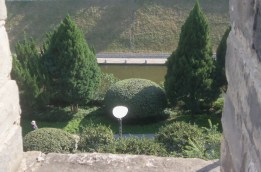 idea of living in a place where our own enlightenment becomes a foregone conclusion, yes, it is a state of mind and living in the presence. And reminded of water surrounding the wall as extra line of defense. The water also provided drinking water for the inhabitants inside the wall.
First, a review of my journey thus far before heading tomorrow for Hua Mountain, Chengdu, and Tibet. All three to taking my spirit to places I’ve been waiting or longing for. As if a quiet comfort and excitement is just around the corner and I am ready for it.
But first three highlights thus far. It’s as if there is nothing new and nothings changed except faces in the crowds. I have to admit, I only give Confucius a cursory view here, but in fairness I have visited, lived and worked in Qufu over half of the past twenty years… I am Kongdan. Confucius contribution has been providing a sense of benevolence, structure, and virtue to Chinese culture and society for 2500 years. And equally important to me was “the first Sage”. The Duke of Zhou commonly known as Ji Dan, who resided here in Qufu five hundred years before Confucius who codified what was to become the “Book of Rites”.
Think about that. Add to that Taoism and Lao and Chuang Tzu and you have the connection to the shaman, I Ching, your environment, nature and understanding you are one with all… everything. There is no separation. We saw this on Songshan Mountain where Emperor Wuding came and announced that China’s past, present, and future depended on reliance on all three.
That there was a confluence between Confucius, Taoism, and Buddhism. Then to Longman Grottoes and the Big Wild Goose Pagoda here in Xian, where Buddhism could take you there as your ultimate self. That it is in becoming universal you are one with it all and there is nothing to fear.
Getting to Huayin and Huashan Mountain
After checking out of the Han Tan Hostel, I made it by taxi to the bus station to go to Huashan Mountain and the Huashan Lanyue Youth Hostel. After a harrowing experience at the bus station where there were three options, first the bus loop for local stops, the train station, and some distance away the station I needed, I got a ticket and headed for the mountain.
After a two hour bus ride we arrived and I got to my hostel. The proprietor, Ms. Yan, was great. She booked me for two nights (tonight Friday night and Monday night October 8th. She also reserved a bed for me at the East Peak Hotel at the top of the mountain for tomorrow night Oct 6 and Sunday, October 7th…
I’ll have two chances at seeing the sunrise from the highest peak. Awesome. Tomorrow (Saturday morning) at 7 AM I begin with breakfast here at hostel / then go to the Huashan Visitors Center a few blocks away to 1) purchase my mountain and cable car tickets, then 2) buy bus ticket for 40 minute ride to the cable car. 3) Take the Western Cable way to the West Peak of mountain. 4) Walk up the mountain to 5) the East Peak Hotel where I will walk among all the peaks and stay Saturday and Sunday nights and see the sunrise. 6) On Monday I will make my way back down the mountain to, 7) where I will take the bus back to hotel where I will spend Monday night. 8) On Tuesday, October 9th, I will take the fast train (thanks Maria) back to Xian and go by fast train later that evening to Chengdu. That’s it – sounds like a plan.
Unfortunately, I will not be taking my computer to the summit. It’s too heavy and I have many steps to climb. But I will be taking lots notes and pictures. When I get to my next stop in Chengdu I will spend a day updating my mountain travels.
My initial thoughts before climbing the mountain
Just a little about Huashan Mountain and why I am here. So hard to express in words before making what is for me a lifetime achievement. As one who is a Taoist through and through, coming here is like the passageway on the mountain called Jinsuo Pass that serves as the hub of the East, West, North and South Peaks. I will crossover the pass this weekend. It is literally referred as “the Gateway to Heaven”. No kidding. The near and distant peaks seeming to reach beyond the sky. The peaks appear through the clouds as if visionary – as if all-knowing. I think this lends attraction to the Taoist nature seeing nature as all-encompassing with clouds as the ultimate benchmark between heaven and earth. The seasons on the mountain appearing as a baptism of man’s spirit and place, as if here there is an experience of immortality. As you go up there is a sense that the pine trees are walking in the clouds. As if being present, using your breath as an anchor to the present moment, to cultivate ease and well-being, as you climb the mountain.
The ultimate for me is that the spirit of the dragon lives here as if rising above the clouds finding time glittering in the sun. It is as if there is no end to it. You can sense the spirit of the mountain joining as one with the sun, moon, and stars. The wind becoming music to your ears. As if time has carved memories into your heart and you have come to sing. Adjusting your temperament to what is your ultimate endeavor as your destiny becomes assured. The mountain becoming nothing more than a reminder of your own never-ending conversation with nature and time. Walking up the path, climbing perilous peaks, seeing the sunrise, you are made whole once again. You have found the reason for the journey.
What remains constant here is the mountain, pine trees, and clouds. Ah the clouds. When I first began writing all those years ago, the dragons, my mentors called me “Cloud Dancing”. As if my highest endeavor now lies before me. Having dialogue with dragons is perilous at best. Always testing your mettle and simply asking are you ready and worthy. What is it we are here to do but to make the pledge to become our true selves and stay emboldened in the presence of our peers. As if we come to the mountain and entertain the peak to make a clear sound across heaven. The mountain’s role to show us piousness and to what lies ahead for us. Knowing the Tao, we find the way along the footpath to the top and the sunrise, and hope, that awaits us.
The night before and I wonder “do I make the climb up the thousand-foot precipice, and in doing so whatever fear that remains just evaporates like fog in the rising sun.” As if among the floating clouds and mist your mind opens and you no longer feel a separation as you become one with them. You have come home. Leaving behind a smile, a knowing, your own claim to the presence you now understand and become one with. The mountain here but a haven, a paradise for Taoism where immortality reigns supreme as your spirit is seen riding the endless sky…
I haven’t taken a step up the mountain yet – ask me again why I’m here.
As I complete my own version of Lao Tzu’s Tao Te Ching that I wrote in May/June 2000 and my book, Thoughts on becoming a Sage, The Guidebook for leading a virtuous Life, on this journey, I am asked to tell… just who was this Lao Tzu and why is  he so important? I know I spoke of this last time, but some may have missed so it bears repeating. Lao Tzu’s Tao Te Ching was the culmination of thousands of years of philosophical thought of what was to become Taoism thanks in part to copies found in tombs of those who were buried with copies of it in China. There are 81 verses in the Tao Te Ching. Verse 81 appear below. Verses 1 through 80 were seen here on my most recent posts. I complete this journey through Lao Tzu ( with verses 80 and 81) from the top of Huashan Mountain made famous as a respite by Lao and his Furnace.
Ultimately, it is what the sage has learned and then in turn taught others along the way that guides us. The commentaries below are meant to be read as a discussion between Lao Tzu and those interested who have thought deeply about the text itself. The quotes below and references to their authors are from Red Pine’s, Lao Tzu’s Taoteching.
Thoughts on becoming a Sage
Verse 78 – Remaining in High Style
Remaining satisfied with just what you have as you are content to live as the extension of the Tao which has become the reflection of who and where you are.

Living within the Tao, the sage soon becomes aware that he is nothing more than an extension of what occurs in nature. Enabling all to come forward to find their true place, not as the substitute for their action, but as one who empowers others to see beyond themselves as the sage stays in the background doing nothing.
Envisioning a place where there are tools that remain unused, where people have no need to move far afield, are easy with death and where it takes them, with places to go but no reason to travel, and defenses in place but no reason to defend them. Satisfied with the fruits of their labor and content with where they find themselves as they go restfully to sleep each night. Content with their homes and happy with their customs as they know the taste of the Tao and remain adorned with virtue. Even though others may live close by they have no reason to visit as all they need, they already have.
Su Ch’e says,
“What is true is real and nothing more. Hence it isn’t beautiful. What is beautiful is pleasing to look at but nothing more. Hence it isn’t true. Those who focus on goodness don’t try to be eloquent, and those who focus on eloquence aren’t good. Those who have one thing that links everything together have no need of learning. Those who keep learning don’t understand the Tao. The sage holds onto the one and accumulates nothing”.
Chuang Tzu says,
“When Lao Tan and Yin Hsi heard of people who considered accumulation as deficiency, they were delighted’ (33.5).
Wu Ch’eng says,
“Help is the opposite of harm. Where there is help, there must be harm. But when Heaven helps, it doesn’t harm. because it helps without helping. Action is the start of struggle. Where there is action, there must be struggle. But when the sage acts, he doesn’t struggle, because he acts without acting.”
Number 78
Oct 6 – 8, 2018 / Huashan Mountain and the Jintian Taoist Palace
Today, (Saturday morning) at 7 AM I begin with breakfast here at Huashan Lotus House International Youth Hostel / then go to  the Huashan Visitors Center a few blocks away to 1) purchase my mountain and cable car tickets, then 2) buy bus ticket for 40-minute ride to the cable car. 3) Take the Western Cable way to the West Peak of mountain. 4) Walk up the mountain to 5) the East Peak Hotel where I will walk among all the peaks and stay Saturday and Sunday nights and see the sunrise. 6) On Monday I will make my way back down the mountain to, 7) where I will take the bus back to hotel where I will spend Monday night. 8) On Tuesday, October 9th, I will take the fast train (thanks Maria) back to Xian and go by fast train later that evening to Chengdu. That’s it – sounds like a plan.
Unfortunately, I will not be taking my computer to the summit. It’s too heavy and I have too many steps to climb. But I will be taking lots of notes and pictures. When I get to my next stop in Chengdu I will spend a day updating my mountain travels. But for now, I will leave you will one of the first things I wrote back in February 1994.
Inner Chapters (The I Ching)
1. Cloud Dancing
From the clouds dragons appear to those who have prepared. To the I Ching,  heaven is to found residing with dwellings of dragons who roam the sky resting in the clouds.
Do not look for me where you have found me before. You will not see me where you have seen me before. Dancing in the clouds with the immortals is where I am to be found.
To be seen with dragons. Cavorting above it all. Beyond earthly endeavors. A strong personality who with compassion and caring succeeds by seeing his destiny in the clouds.
Finding the Tao, finding oneness and finding myself floating across the sky with chi. Cloud Dancing across the sky is easy – living with dragons is not. A group of dragons are seen riding the clouds disappearing through the sky. As we disappear, I look back and see dragons resting on clouds dwelling in the sky. An original composition and interpretation of the Chinese Classic the I Ching (1 HEAVEN / Heaven over Heaven). 2/3/94
And now I am here. As I was leaving the mountain today (Monday, October 8th – my birthday), I was followed down a long pathway by two small bluebirds. They seemed to be trying to get my ear saying come back – come back. The pine trees, the mountain vistas, even the walkways leading up and down steep paths all seemed to say – why were you gone so long.
After three days on the mountain, I return refreshed and invigorated, and feel I  have walked for days (I have) up and down the five peaks of Huashan Mountain. From the initial bus ride and cable car that took me to the top, I had a feeling of being overwhelmed by the majesty of the mountains, pine trees, and nature. It is easy to see why Huashan is considered one on the five greatest mountains in China next to the Yellow River here in central China.
Coming to Huashan Mountain is for me in many ways a homecoming. It is famous  for Taoist retreats and ancient sages who came to visit and stayed. It is easy to see why. I stayed at the East Peak Hotel for two nights in a room for ten people (five bunk beds). My new friend Pablo from Chile slept
  in a tent outside. On both days in the early morning, it registered 10 to 15 degrees Celsius on both October 7 and 8 on the East Peak, also known as the Morning Sun Peak, and the hotel adjacent to the premier place on the mountain known as Mr. Yang’s Tower. I climbed twice on both days to see the sunrise.


The makeup of the mountain is very interesting in the there are five peaks of  interest with many stops on the way to each of the peaks. I took a bus then a cable car to the top then traversed the five peaks while I was there. My friend Pablo actually walked up from the base of the mountain. The entrance at the base was only a few blocks from where I was staying. I chose the bus and cable instead. Saving my energy for when I got there. As mentioned earlier, traveling during the holiday was not a good idea. The mountain was crowded and made it difficult to get pictures and find a quiet place off the beaten path. I will return again in the future when not so busy.
Several areas caught my attention. First was the Blast Furnace, on a small peak to the west of the summit of the South Peak that is by tradition, the place where Lao 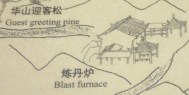 Tzu was to have
  made pills for immortality. There is a legend that says the monkey king was shut in the furnace for wrecking to much havoc in heaven.
Also by tradition, there are many man-made caves at Mt. Huashan. According to historical records more than seventy were created by a Taoist priest Ze Zhizhen for the purpose of providing other monks a secluded place to practice asceticism and understand Taoism. One in particular was called “the seeking quietness cave.”
Also on the South Peak is the Jinsuo Pass. Not far from the Central Peak, also known as the Jade Maiden Peak. Jinsuo  has great significance in Taoist history as
  being called The Heavenly Gate. It sits close to the center of the four peaks near the top of the mountain. As if the dragons purposely designed a place where there was no going back. What got my attention was I was descending a section of steps after going downwards through The Heavenly
  Gate, and after a couple hundred steps retraced my path back through the gate as if I had returned to earth and seen “human nature” and felt I was ready to return home to be with dragons once again. It makes me recall a story I wrote years ago in “My Travels with Lieh Tzu” as follows that sound too familiar. I find that physically, I may come down to adjust my light to the vagaries of humanity, but returning to be with dragons will always be my coming home.
A Visit with Old Friends
Remaining as one with the universe. One’s instincts in constant tune with your surroundings. The only secrets worth telling remaining those that remain non‑contending. Staying in the background as the ever‑knowing sage. As you have seen it all before, is not your time better spent seeking the wisdom and knowledge you find in conversing with your old friends that you have recently re‑discovered. As you have been away for a millennia but have now come home again. Everyone, Lieh, Chuang, Lao and all the others waiting to hear why you have been away for so long. Or then again, was it only for just an instant?
You explain that you have been exploring human nature and trying to understand how people through the ages could become so confused and off‑centered. That those you have come across are vain in the prime of their beauty and remain impetuous in their strength. That they are quick to tell others how to live without due consideration of how they should do so themselves. That all those you have come across seem lost in their own attachments. They remain inept in their attempts to find the Way, and even more so when they think they have. There remains this constant sense of need to remain proud and impetuous so that it remains difficult to impart and relay the true essence and goodness needed to preserve humanity. Instead of remaining as one with nature, they seem intent on destroying it. Finally, they must constantly be reminded of who they ultimately are to become and need someone or something to keep them steady.
As you finish your account, knowing glances abound as others have come and gone and relayed similar stories. All want to know if you are planning to stay with your old friends or return to your writing in hopes that perhaps one in a thousand may to come forward to learn the proper way. You are amused in that it is known that the sage gives his work to others so that his own power does not diminish as he grows old. Otherwise grappling with confusion when his own knowledge runs out.
 Back home after a thousand years and the only question that remains is when you leave again. 8/5/95
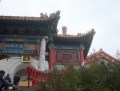
Finally, of great interest was the Jintian Palace. I had a chance to speak to a couple of the monks here and take several pictures seen below.






As I complete my own version of Lao Tzu’s Tao Te Ching that I wrote in May/June 2000 and my book, Thoughts on becoming a Sage, The Guidebook for leading a virtuous Life, on this journey, I am asked to tell… just who was this Lao Tzu and why is he so important? I know I spoke of this last time, but some may have missed so it bears repeating. Lao Tzu’s Tao Te Ching was the culmination of thousands of years of philosophical thought of what was to become Taoism thanks in part to copies found in tombs of those who were buried with copies of it in China. There are 81 verses in the Tao Te Ching. The Epilogue, final entry, appears below. Verses 1 through 81 were seen here on my most recent posts.
Ultimately, it is what the sage has learned and then in turn taught others along the way that guides us. The commentaries below are meant to be read as a discussion between Lao Tzu and those interested who have thought deeply about the text itself.
Thoughts on becoming a Sage
Epilogue – Preparing to return to utter Spontaneity.
Simplicity, detachment, and virtue, the three anchors that through the ages have separated the sage from the rest of the world. Emulating the Tao, he recalls what came first, what remains empty and forever still.
The journey with Lao Tzu simply the process of coming forward to know the way of the sage is to act without struggle. Everything coming forward to greet him to convey what was before him from the beginning. That in the end he accumulates nothing assured that the more he does for others the greater his own abundance and that the way of heaven is to help without harming. Knowing this the sage finds his journeys complete. Preparing to return to the utter spontaneity found as one in complete harmony with the universe, the Tao Te Ching now completed.
As he prepares to depart up the familiar path to meditate in his garden pavilion seeking refuge to contemplate how far he has come, the sage is reminiscent about times spent with Lao, Chuang, and Lieh even Confucius, Mencius and all the others, he is confident that another step has now been completed.
His thoughts on becoming a sage now complete, he now thrives on virtue secure at his passing.




Number 79
Tuesday, October 9th I left Huashan Mountain (Huayin) for Xi’an then on to Chengdu…
On the mountain I was reminded that eternity may seem remote, but it is  here, right now in every precious moment, and you are one with it all, with nature. We are not here just to observe our life and the beauty that surrounds us. But to be reminded that it is all simply an extension of ourselves and the steps we are here to follow and take ourselves, to our responsibility to and for nature, and in turn the universe.
That your world is your sanctuary. We should all become Taoists at heart. The mountain itself, the pine trees, the birds singing their song of joy and eternal wisdom just for you – always in rhythm praising what lies below and the skies above. It’s easy to see how eons ago others saw the mountain as the gateway to heaven. That you are free and immortal as you are. If a sabbatical has something to do with finding your life’s work, I think I have come on this journey to re-enforce the one thing I am good at… to remember and write about things long forgotten by others. Maybe here just to remind us to pay attention to the details of our lives and where they may lead.
Su Ch’e says,
“Lao Tzu lived during the decline of the Chou, when artifice flourished and customs suffered, and he wished to restore its virtue through doing nothing. Hence at the end of his book he wishes he had a small state to try this on. But he never got his wish.”
Perfecting the Art of Doing Nothing
If living in retirement is a state of mind… then let mine be here in Chengdu. Life is like Chuang Tzu’s butterfly dream. Are we awake or living a dream – and can it have mattered in the end? I’m beginning to understand the true meaning of wu wei. Finding and living in the state of virtue and being present… i.e., awake. It seems as though my entire life has fit the scope of Taoist thought as almost everything I’ve  ever done has amounted to nothing, except for my family and friends who I care for. It seems I’ve been more successful than I thought. Perhaps just waiting for my highest endeavor to find me and to follow it. It’s time to let living in the state of virtue reign supreme. Simply to let your innate nature come through as you live what the Tao has taught you. So here I am talking about Taoism, and here with the Buddha. Or even follow the development of Chan Buddhism in China that found the best of both (Buddhism and Taoism), as if “Finding the right Shoes”. Maybe even best expressed by what I wrote all those years ago… Perhaps even better said by doing nothing.
Finding the right Shoes
Father and son, tradition and innovation. Old ways and new things. Knowing patterns of one’s life brings purpose. Finding purpose through another man’s eyes is not easy. Conflict arises. Immortality is questioned but always prevails.

Finding one’s sense of purpose can not be left to earthly whim. Finding purpose in greater things allows one to escape from individual concern. Following footsteps may be old-fashioned, however those steps are honed in tradition and value. Keeping to the right path is knowing how to find yourself in shoes that fit.
Tradition teaches that structure brings continuity. With continuity comes focus, focus brings clarity and with clarity one can find understanding in all things. Understanding patterns of one’s life brings integrity.
Well worn shoes may require soles, though once repaired the same shoes still can be left to fit the right feet. Find happiness and security in tradition and be eternally rewarded. Ancestors past and spirits yet to come will know comfort through your steps. Seek your own standards yet remain ever diligent. Remember from where you came and seek your own immortality.
An original composition and interpretation of the Chinese Classic the I Ching (18 WORK / Mountain over Wind). 2/13/94
One thing for certain I know about myself – is I hate, abhor… anyplace where contention is present. It makes me wonder why, or how, I was interested in politics whatsoever. Except maybe to show the intent of heaven that reflects the best of all concerned. Maybe the world and even I are not quite ready for that yet. Ah – finding myself again on the mountain… or better yet the tea house on the lake at People’s Park in Chengdu once again away from contention and ego.
Wednesday morning I find myself at the Flipflop Hostel. This is my fourth visit to Chengdu and third to the Flipflop. Seeing a few of my students, re-visiting ancient sites and new ones I haven’t see for a while is like coming home. Some things are meant to be unexplainable I think, only felt from the heart. As if living the dream of your highest aspiration and then it becoming you. For me it’s going to those places that inspire me. Ultimately getting to the place that where I am is not as important as the memories I have gained from where and who I have been in history. As if here now only to be  continually inspired. Most importantly the only question remaining is – am I being true to my authentic self?
My friend Pablo from Chile I met at the mountain has joined me here in Chengdu at the Flipflop. It sounds like Pablo and I are headed today by fast train to the Leshon Buddha… stay tuned.
The Leshan Giant Buddha was impressive as it looked down on the convergence of two rivers. Legend has it that he was placed here to stop the flooding that caused so much havoc. The Leshan Giant Buddha is a 71-meter (233 feet) tall stone statue, built between 713 and 803, depicting Maitreya. It is carved out of a cliff face of Cretaceous red bed sandstone that lies at the confluence of the Min River and Dadu River in the southern part of Sichuan province in China, near  the city of Leshan. The stone sculpture faces Mount Emei, with the rivers flowing below its feet. They say it did help with flooding… for a while, but man continued to build.
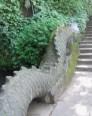
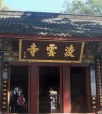
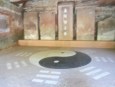
In addition to the Buddha, I was most impressed by the Lingyan Temple adjacent to it, and especially the Cave of I  Ching. I have much to write here later when I have time. The pictures I took here were amazing. Adjacent to the temple is the Lingbao Pagoda.
I am continually struck by this idea of convergence of energies directed at the ultimate – where we fit in the universe. That regardless of our, what may be called  philosophical or religious leanings, there is no separation between us and all that there is now, has, or will be. How can something be good for me and bad for everyone and everything else?
Seeing this engraving of Lao Tzu here at the cave at the Lingyan Buddhist Temple heralding the I Ching says it all. This picture and it’s location here was worth the cost of the trip and I am not in Tibet yet. I think this expresses better than I could why my own Kongdan Foundation I began more than ten years ago is so important to me. It allows my the opportunity to express where I have been and illustrate the best way for me to take the next step enmeshed with the Tao.






It’s as if it’s all here. I spent about an hour last night with Yak, the tour operator here at Flipflop (its Thursday morning here), discussing all this and showing him my  pictures and website.
He was curious as to my take on Tibetan Buddhism after all I has done chronicling Buddhism in China over many years. His background was in ancient Chinese pottery and porcelain no less. He had spend time at the famous Jingdezhen kiln in south Jiangxi Province. (The picture here was made famous as an example of their work. It’s one I took at the British Museum in London in 2012). Anyway, visiting the famous kiln is definitely on my bucket list for my next trip to China. And Yak, who spent several years in school there, has agreed to accompany me when I go.
Well, it’s Thursday (Oct 11) and calendar says I’m supposed to go with Pablo to Qingyang Mountain today but am delayed due to errands he is doing. It’s over a hour away by train to the north of Chengdu  and we’re running out of time to get there
  and back today… well we didn’t make it. We went to the Qingyang Taoist Temple, Kuan Alley for lunch, then I went to People’s Park Heming Teahouse before returning to the hostel. The teahouse was built in the 1920’s and is known as having the longest history of tea houses in Chengdu.
I made another visit to one of my favorite places in Chengdu with my friend Pablo today, the Qingyang Taoist Temple. I think if I lived here in Chengdu, I would visit at least once or twice a week. I few pictures are below:


Tonight I signed my “Tibet contract”… two pages requiring my signature. I have to leave for the Chengdu airport at 4:20 AM Sunday morning. I hope I don’t oversleep.