Number 71
Sept 26, 2018 Luoyang cont’d… Buddhist White Horse & Zushi Taoist Temples
Below are additional pictures and comments for Luoyang. It rained and was heavily overcast today in Luoyang. Not a good day to be outside again but a good day to update and  work on pictures. I paid for the Tibet tour this morning. Now I can take care of airfare to Lhasa and return afterwards to Beijing.
To the left, is a map of how Buddhism came from India to China showing the routes via the silk road (in red), and the blue to Chang’an (Xi’an) and Luoyang. This area in northern India southwest of Tibet is still the central foundational location for what is considered as Tibetan Buddhism. Once the weather clears up, I hope to go the Long Men Grottoes and Shaolin Temple before heading to Xian next Monday. Their pictures will appear here as well. In the afternoon I decided to take a walk and get a foot bath, then walking further I came across Zushi Temple, dedicated to Lao Tzu. A brief description and a few pictures from the Buddhist White Horse Temple are below…


It is as though now that I have entered this journey, there is an acknowledgment that there is no turning back to the person I was before I left. I’ve been gone for only a week, and it seems so long ago. I have always been enamored with the stars and cosmos… what is seen as universal. It makes sense now that what is changeless and immortal is not your mind/body, but rather the Mind that is shared by all existence. Stillness that never ceases because it never becomes more than the present. It simply is. I think this is helpful in releasing ego that then dissolves into nothing. It is here that we can enter the mystic nature of who we are. A commonality that enhances… as if a cosmic field of vision that becomes you. I know that’s all pretty deep, but going there is what literally helps me to focus and see beyond myself.
It is where my Taoist beginnings are taking me now that means I must get my “mind right”. As if living a dream as the dream becomes me. All else falling away, this re-enforcement of Buddhist and Taoist thought moving me fearlessly as Van Morrison would say….”Into the Mystic”.
As if on que, I found the Zushi Taoist Temple, dedicated to Lao Tzu just around the corner from where I am staying. It was constructed in the late Yuan and early Ming dynasties. According to the inscription the temple underwent frequent renovations during the reigns of Hongzhi, Kangxi, Yongchan, Qianlong, and Jiaqing up to the period of the Republic of China.


Number 72
Sept 27, 2018 – Luoyang to Songyang Temple and Songshan Ramblings of an unknown sage
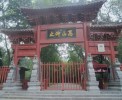
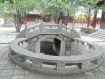
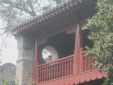
As if expected, serendipity came along to change my plans that would take me to Songshan Mountain and the famous Shaolin Temple about an hour and a half away.  He came in the form of a professional film maker who was staying at my hostel and planned to stop there on his way back to Shanghai. He invited me to come along so I changed my plans. I left my suitcase and computer at hostel gathered things for my backpack and away we went… I never learned the name of the city we were going to; it didn’t seem important. (I will text him later) We were going to the Songshan Mountain Area that included the
  Songyang Temple we would visit later this afternoon after arriving (pictures here today are from the temple). On Friday, climb one of the mountains we intended to climb and the Shaolin Temple and Pagoda Forest at
  its base. And on Saturday climb to the summit of a second mountain that was adjacent to the first (we didn’t go because the tram was broken). More on all that beginning tomorrow. First, to clarify, I do not write under some false illusion of one day being published. I write simply for my own enjoyment and enlightenment because it is my writing that takes me there. If others choose to come along for the ride… you are welcome.
Today on the bus to I wasn’t sure where, I couldn’t help but think of our divine  presence and what that means for ourselves and others. Changing from within first to the alignment with the universe we came in with and the things we am here to work on or correct this time. As if a piece of the star I am from.. to simply come into focus and let my light shine. Moving to who I am supposed to be. Simply to find and go with the flow I have always known with no pre-conceived intent or outcome and let the spirit of the Tao (the universe) guide me. First of all, it is not for me to write
  down someone else’s impressions (i.e., that found in google, etc.,) – but to add my own take on the environment I find. Everything is context. My travels in China are not simply going to these places for pictures. It is in keeping with a personal journey whose purpose has not been fully revealed as yet. It is my reflecting what I see with what I write and with what I already know. As if leaving behind and much as I take. As if I am seeing what has changed since my last visit and writing about the antiquity that lies in each of us. As if the ancients don’t want to be forgotten, so that even their own immortality might come into question.
To let these images from the past take you there. Each with a story to tell – just  waiting to be told of when they were someone or something of importance. Something more than they are considered now. It is as if in the stillness they reside, they lie in wait for vibrations… for the storyteller. Not just being present only for your own story, but to tell the story of everything around you – with the older the story – the more there is to tell. And I don’t write fiction. With no pre-conception of where what you are here to learn may lead. As doors are waiting to open for the stories just waiting to be told. Many simply wanting to have their say.
People you meet here to take you to places you are needed – the stories are endless and your role never-ceasing. The more you write the more you need to write. You are a conveyor of ancient wisdom, use your time wisely. It makes me wonder, are we moved by “divine order”. Or are we taking and receiving “divine orders”. Who is to say?
It was here at Songshan Mountain and Shaolin Temple where so much occurred  where people came for centuries. Three religions in one body (Buddhism, Confucianism, and Taoism) were formed as what was seen as a “convergence” in this area.
Emperor Wudi and Empress Wuzetian came here to commemorate the mountain and convey its importance to this belief. As if life is about remembering who we are yet to become before we forget. Songshan Mountain has been famous as a place where people came with a desire to improve themselves and discover their inner virtue. The temple, a repository of ancient wisdom, here but a reminder that there was more to climbing mountains than the climb itself. It is the appreciation of the overwhelming outer nature you find with the mountain as you climb, just as life has its ups and downs your eyes remain on the horizon and the clouds above. I am here at one of the five most famous mountains in China. Tomorrow I climb the mountain. (I have more pictures when time allows).







#73
Sept 28, 2018 / Songshan Mountain
Sometimes it is as if you intuit, or just know that you are one with your  surroundings. Even if initially, it appears to be spontaneous, there comes a realization – the intuition that becomes knowing – it just is – as though living through and by grace. A state of grace where energy and what may be seen as precedent to your own actions. That you and you action are a small part of something much bigger. Like seeing the tip of an iceberg, not knowing what lies beneath the surface here for you to discover. As if the “I” as in you, becomes nonexistent. It is here that meditation if honed over many years can take you. It is for this; many adherents of Buddhism subscribe faithfully. To go to and for a higher truth from within. Throughout history, there has always been the premise that it is found in the silence, in solitude. It is in finding this – when you know when and how to act, there becomes a sense of what is called “non-wasted energy”
 where indecision and regrets disappear. It is here where you can begin to get a taste of transcendence. It is in this place where “lesser traits” that was you – you past – have no place to reside and have left. It is as if you have awakened from a bad dream. It is from here you can begin to count your blessings, can see your place in the universe and begin to truly find your way home… something Chuang Tzu knew so well. As if a new beginning – where “what happens in the present” is all that matters. One legend of the mountain is the Lao Tzu spent six years at Laojun Cave here on Mt Taishi writing the Tao Te Ching. I think many mountains in China would like to make the same claim.
What is a sabbatical, retreat, spiritual journey, but a catharsis, ie., renewal of energy  from within? For myself, it has always been that I have known a greater truth, as if knowing the steps of the dance. But unwilling to come forward with the discipline and patience that will take me there. There are no real excuses, virtue and sincerity are never enough. Why Confucius alone could never be the final word without Buddhism and the Tao coming into play, and it’s why I’m here. It is as though you have moved on once self-doubt is no longer a part of your demeanor. The Sacred Mountains of China are divided into several groups. The Five Great Mountains refers to five of the most renowned mountains in Chinese history, and they were the subjects of imperial pilgrimage by emperors throughout ages. They are associated with the supreme God of Heaven and the five main cosmic deities of Chinese traditional religion. The group associated with Buddhism is referred to as the Four Sacred Mountains of Buddhism, and the group associated with Taoism is referred to as the Four Sacred Mountains of Taoism. The sacred mountains have all been important destinations for pilgrimages, in Chinese known as Chaosheng, which means “paying respect to a holy mountain”.
Which brings us (me), to where I am today. To climb a mountain what else. Fate is a funny thing. I came to Songshan Mountain with the idea of climbing both peaks. Songshan Scenic Area is one of the five famous mountains in China. It is composed of Taishi Mountain and Shaoshi Mountain. This area not only boasts natural landscapes such as Sanhuangzhai and Junji Peaks, but also has a number of historical and cultural landmarks such as the world famous Shaolin Temple; the Songyang Academy, one of China’s four major Confucian academies; and the Taoist Zhongyue Temple of the Quanzhen School. The first day was simply to appreciate the surrounding nature and far away vistas of Taishi Mountain, and the  second day to climb to the peak, the top of another adjacent mountain, Shaoshi Mountain. However, the cable-car is not working on the second mountain, so we would not have time (or probably energy) to climb back down after traversing several miles of paths and trails from day one. Perhaps fate is kind after all.
Songyang Academy was one of the four greatest academies for higher education in ancient China, together with Yingtian Academy in Shangqiu of Henan, Yuelu Academy in Changsha of Hunan, and Bailudong Academy in Jiujiang of Jiangxi. The Academy was an important and unique educational organization in ancient China, somehow like today’s college. It played an important role in China’s education history and cultural transmission. Nowadays, Songyang Academy is an “example” for learning ancient academy architecture, the ancient Chinese education system and Confucianism.
On Thursday, Sept 27 we went to the Zhongyue Temple, located on Songshan Mountains in Dengfeng County, Henan Province. The temple is one of the oldest of its kind in China, originally built in the Qin Dynasty over 2,200 years ago, and moved to its present site in the Tang (618-907 AD). Although the nearby Buddhist Shaolin Monastery, with its kung fu and Chan (Zen) study, is better known and more visited, the Zhongyue Temple is arguably as good.
I like to add here what were thinking… All those centuries ago when the paths we now follow were barely, or non-existent and the journey up and back down the mountain would take several weeks perhaps a month or so. I am reminded of what I wrote in My travels with Lieh Tzu. From Chapter 1 entitled Becoming Sanctified, I wrote back in January 1995:
Becoming Sanctified
Traveling as one with the wind you become sanctified as one with Lieh Tzu. Coming out of the security you have found as the sage forever only concerned about images and things always to remain translucent. Keeping always to new heights found only in the mountain retreat where nothing is to be found but stillness.
Everything following its natural course as heaven and earth dictates. Simply coming to know the seasons and continuity found in following day and night. Spring, Summer, Autumn and Winter, growth and decay, birth and death. Man alone and in  knowing his true path. With only the sage knowing the proper sequence of events and the path that must be followed.
Man occupying the small unseemly place on the mountain’s trail as shown in the paintings of antiquity. Living only to come forward to find the true way to be found only by following the Tao. Without thought or purpose. Without choosing to be born or to die. Yet following the Way. Basing our every action on instinct and spontaneity. To distinguish between benefit and harm, understand alternative courses of action and form moral and practical courses of conduct without the need to do so.
To discard knowledge unfamiliar with the Way, cease to make distinctions, refuse to impose your will on nature. To return to the innocence found in a newborn child and allow your actions to come naturally as a part of nature itself. To reflect things like a mirror and respond as an echo without intervening thought. Perfectly concentrated and perfectly relaxed as one who finds his second nature on hands and knees pulling weeds from his garden. Cleansing one’s soul of unwanted intrusions.
Remaining fully attentive to the external situation. Responding naturally to events as they occur. Not analyzing, as if spontaneously allowing your response to just take the unified action that comes forth simply to occur. 1/10/95
From the I Ching, the essence of an eternal and internal truth that gives reason for “what do I hope to find with myself, but sincerity of purpose”. As one would climb the ridges of the mountain when not watching your step… you would contemplate…
The Ultimate Attribute
Sincerity is the ultimate commitment to nature and finding one’s purpose. The one attribute the dragons have long awaited as the true sign of the sacrifice to the never-ending journey.

Everything else simply secondary to the trust and good feelings inherently found in truly good intentions discovered only when one is sincere.
Endeavors coming easy like the morning sun with birds singing to let everyone know another day has arrived. Another chance to give everything our best effort knowing that’s all there really is to give. Keep to oneself in harmony with all things knowing that events allowed to get out of control can only lead to questioning the intent of otherwise good intentions. One’s true feeling worn on shirt sleeves for all to see makes it difficult to shelter true emotions inherently both good and bad for everyone to see again and again.
What is sincerity except a deep sense of caring and commitment of thoughts carried out through actions unthought out and unspoken. A sense of caring about the final outcome yet be determined. Yet an assured knowledge of how things will play out in the end for all to know and see.

Simply an enthusiasm for truth and a compassion for things set free to rise up as the phoenix from the ashes of desperate discontent. So simple to find, yet so difficult to keep. The attribute the dragons know without saying, so to speak. Clouds parting overhead as they peer down to make a final inspection only to find that you are well on your way.
An original composition and interpretation of the Chinese Classic the I Ching (61 SINCERITY / Wind over Lake). 3/27/94
Finally, one of my own favorites, if such a thing exists would be also from my book about the I Ching:
The Death of the Chamois
Buckskins tanning in the bright sun light brown almost white from the ram captured on the mountain’s rim only for the delicacy of its tender loins and its superior skin.

No matter the benefits, it is not the capture of game pursued over a long distance that is important. But simply the ultimate pursuit itself. As the hunter respects his prey by only taking what is necessary for his own survival, fulfillment comes with the understanding of one’s place in the universe. Not the lethal release of the arrow.
Pursuing the chamois on the sheer outcropping near the mountain’s top is as difficult as capturing the pheasant in the valley below. Both represent the ultimate challenge and losing against such an able foe is not losing but gaining the respect found to be in nature’s way. The ram only captured because its time has come.
Having overcome the chamois there is a satisfaction in knowing the ram as an equal or better in his own territory. Fully aware of his stature in his environment and what it takes to survive on top of mountains. Always to be looking down at panoramas in every direction.

A innate sense that each step on the craggy outcropping could be his last if improperly placed. However surefooted, he adeptly and safely bounds from rock to rock unconcerned and unafraid.
As a seasoned traveler coming across hunters coming down from higher elevations with their prize, you sense both elation and sadness accompanying the death of the chamois. All is well and as it should be.
An original composition and interpretation of the Chinese classic the I Ching (56 THE TRAVELER / Fire over Mountain). 3/22/94
Pictures from Songshan Mountain: