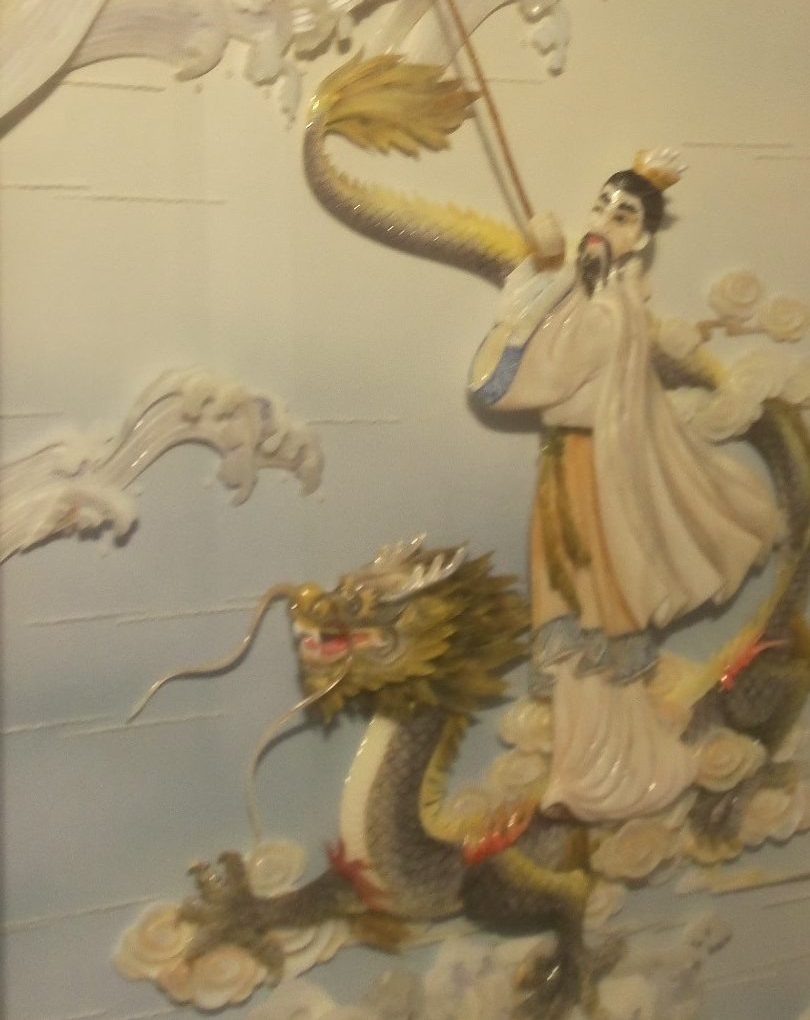
It is perhaps the sage’s bond with dragons that guides his journey through eternity. The sage above strives to achieve his highest destiny by following the path of virtue laid out before him.
I enjoy Joseph Campbell’s books, like “The Power of Myth”, which reveal how themes and symbols from ancient stories can bring meaning to birth, death, love, and war, along with the myths we continue to follow today. Sort of what I do here in “My travels with Lieh Tzu”. Taking a foundational book of Taoism and updating themes and commentary to show how we would see them today. Along with his book “The Hero with a Thousand Faces” that explores the universal structure of myths through the concept of the Hero’s Journey, encouraging us to “follow our bliss” as there are always truths to be expanded on that explain the purpose of our own journey. As the power of myth can serve to help to make us transcendent and take us there.
Campbell’s greatest strength as a storyteller was his knack for seeing beyond the surface, understanding how our history shapes who we become, who we are to associate with in history, and why it’s important. Studying history is fascinating because it helps us to grasp why events unfold the way they do and how they influence the future… And yes, history does repeat itself. His writing highlights the cultural power of myths while exposing how or why they can sometimes be useful in unraveling deception from what is considered as truthful. The power of myth is sometimes used to show the difference in truth and falsehood and why it matters to history and eternity… and us.
How do myths influence our own thinking, and what exactly are the myths we follow today? What is to be considered as real verses myth. A myth is often considered an invented story, idea, or concept that contains elements of truth—what we might call a “half-truth.” However, it serves the purpose of guiding us toward understanding and reaching an intended conclusion. How should we respond when someone describes events rooted in pure myth—as an entirely imaginary or fictitious person or thing? Saying something while being aware the opposite is true or convincing yourself the lie is true. Or when it involves an unproven or false collective belief used to justify a particular segment of society, culture, or even an institution?
It is said that if a story, whether true or not, is repeated enough, people start to believe it, sometimes turning it into a myth. But what does it mean when people believe in a myth about something false that’s presented as true, even when they know the actual truth is the opposite? What is truth’s biggest challenge when something is revealed as hypocritical? What does it mean to be a hypocrite, and why do their words or actions hold significance? How can an untrue myth come to be perceived as real when another agenda may exist.
When someone claims to have virtues, morals, or beliefs they don’t genuinely hold, especially when their actions contradict their stated principles, it shows a lack of authenticity. This also applies when they pretend to have a desirable or socially accepted attitude, while their private life, opinions, or statements conflict with their public image. Even worse is when someone chooses not to follow to where truth can only be found for and in the perfection of ourselves.
My travels with Lieh Tzu / Interpolations along the Way
Chapter Five – The Questions of T’ang
75. Extolling Myths
If it is known that the shapes and energies of things differ and are still equal by  nature, that none can take the place of another, that all are born perfect in themselves, and each is allotted all that it needs, then how can one know whether they are large, small, or short, similar, or different. Who can know? Who can say? Are stories and myths not extolling feats of great strength and travels of thousands of miles in a day the same whether they are real or imagined?
As the ancient ones of every civilization have passed on the origins of heaven and earth, are these not simply an attempt to give meaning, purpose to life, and explain that we are part of something much bigger than ourselves?
Are not heaven and earth things just as the things within them, and do not things 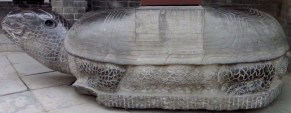 have imperfections. With Nu Kua smelting stones of all five colors to patch up the earth’s flaws and cutting off the feet of the turtle who supports its four corners. Or stories telling of a place east of the Gulf of Chihli, thousands of miles away with its bottomless valley where all the waters pour into the Milky Way.
Or the fifteen giant turtles who carry the five mountains on their lifted heads. Taking turns in three watches, each sixty thousand years long; and the immortal sages who live there. Many of the sages later to be lost when two of the mountains are roped by a giant and taken back to the Kingdom of the Dragon Earl. In God’s anger, he reduces  the size of the Earl’s kingdom and the size of its people.
Or the pumalo tree that grows in the countries of Wu and Chu. An evergreen with red fruit that remains sour and causes fits when eaten. However, when planted north of the Hui River it changes into a dwarf orange tree.
All things remaining perfect in their nature, each allotted its needs. What difference be they large, small, or short, similar, or different? What difference can there possibly be? Remaining perfect in an imperfect world. The paradox that all must encounter, all must endure. Is this not what is meant by true striving to find and know perfection only within ourselves? Is this not what the Tao teaches? 4/19/95
Number seventy-five of one hundred fifty-eight entries.
Leave a Reply