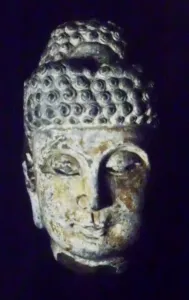
We often see ourselves thinking we are far superior to those who lived thousands of years ago. We think technological advancements put us far above those who we have followed over time. We see how civilizations rise and fall when having  reached their zenith, or height, had nowhere to travel except downward. Because they failed to go beyond who or what they thought they were or already knew.
It has always been the role of the innate wisdom of both the historian and storyteller whose purpose has been to serve to remind us of what our memories haven’t forgotten but are now often overlooked.
The over four thousand years of uninterrupted Chinese history tell a compelling story. Figures like Lieh Tzu gained significance over time, serving as a bridge that illustrates how people view themselves as the fulcrum between heaven and earth. Many have debated whether Lieh Tzu actually existed or if the writings attributed to him were simply a repository, like a bookshelf, for significant ideas of the time that couldn’t be assigned to Chuang or Lao Tzu.
This raises the question: where do we leave behind what we once considered as important and want to endure after we’re gone and does it matter? Not necessarily to bring attention to ourselves, but to what we deemed as important. The answers unfortunately are artifacts and remnants to be found in museums as all that are left to tell the story.
Why have the writings of Lieh Tzu endured for thousands of years, and why is updating them important?  Beyond merely preserving the storyteller’s memories, why should we care when popular culture dominates our thoughts? How can our eternal spirit truly define us without considering the past that has shaped our present, especially when eternity offers us another chance to change and transform? Can this be what truly lies within what we call endeavor and destiny?
For nearly two thousand years, precepts—those aspiring to become monks or priests—have studied Lieh Tzu at both Buddhist and Taoist monasteries and temples in China and Tibet.
The purpose is to explore heaven, earth, and human behavior, helping us to recognize our own personal weaknesses and learn to overcome the limitations and challenges that hinder our journey toward enlightenment.
Why they bother studying the effects of effort and fate? They learn that what truly matters is the virtue of what fills us each day and how we are to nurture our spirit, the essence we’re here to replenish.
Are we like the leaf drifting aimlessly to the ground, carried by the wind as in the movie Forrest Gump? Or is there something more to us?
My travels with Lieh Tzu / Interpolations along the Way
Chapter Six – Endeavor and Destiny
100. Where can truth lie, except within us
How do we measure the essence of completeness or deficiency within ourselves, or can we as they can only come of themselves? Is that not the initial hurtles? As we learn that there can be no effort to measure, estimate or calculate what may affect us. Does the Tao not teach us that it is only by measuring nothing that we come to measure everything, become completed and be without deficiency?
Do not those who measure benefit and harm, estimate fact and falsehood, and calculate the feelings of others lose as often as they win.
Can knowledge help to bring victory where one would otherwise lose, or does lack of knowledge bring the same results? Again, with both sides winning as often as they lose.
Therefore, is it not said:
“Life and death depend on destiny and that riches and poverty depend on the times. He who resents being cut off in his prime does not know destiny. He who resents poverty and distress does not know the times. To meet death unafraid. To live in distress without caring is to know destiny and accept what time brings.”
 Can this be what brings sense to it all? Can we be satisfied with the correctness of our own wisdom?
Can we be assured with the subtlety of our own skill?
Can we be convinced that our talents will bring us success?
Can our ego and faults be understood, making us irreproachable?
Can we not take a close look at ourselves to determine if our behavior fits the times?
While each of the above attitudes are different, are not each simply the manifestations of the destiny given to each of us? How can success be seen as success for one when it is seen as failure for another? Where can truth lie? How can wisdom by itself know when to act and when to stop? When to come forward and when to stay behind? Does not the answer lie simply within ourselves? 6/19/95
Number one hundred of one hundred fifty-eight entries.
Leave a Reply