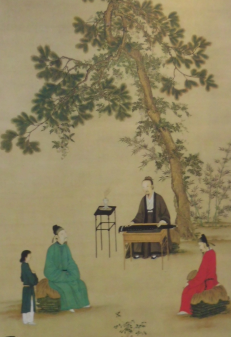
We often associate achieving our highest aspirations or “living the dream,” or perhaps “living in a dream,” with something indescribable – appreciated only in silence and through the collapse of rational thought. In ancient China, this concept was beautifully expressed by Chuang Tzu in his story of dreaming he was a butterfly. Through his writings, Chuang contributed to the understanding of the Tao, illustrating what it truly means to be a Taoist. He never defines the Tao, which I find particularly appealing, as it reflects the belief in the limits of definitions and how they can lead us astray or make us lose our way.
Even here in my own writing it is clear that I have limited ability to express anything about the Tao. Chuang Tzu expresses it best saying “I have traveled through it this way and that, but I still only know where it begins. I have roamed around as I wished within its mind-binding vastnesses. I know how to get there but I do not know where they end.” This line by Chuang is incredible because, with our current understanding of quantum physics and the seemingly infinite expanse of galaxies and the universe revealed by tools like the Hubble telescope, we can grasp concepts he could never have imagined back in 300 BC. Even today, the vastness of the Tao defies description. For writers and storytellers, this means there are always stories waiting to be told.
For Chuang Tzu, the Tao represents the ultimate reality, both in its cosmic significance and as the underlying unity of all life. It is the source that nourishes life and the destination to which it returns, embodying the very essence of existence. To understand the Tao is all things and thus is the unity and sameness of all things. When the phrase “man is but one of ten thousand things” was coined, it resonated because people could perceive and live in harmony with their connection to nature and to the stars.
With this line of thinking emerged the figure of the sage, a bearer of wisdom that transcended what was believed to be possible or known. While some knowledge would remain unknowable, there needed to be someone to pass down the universal story through generations, providing a foundation for those to come. Throughout Chinese history, claiming oneself to be a sage has always been seen as presumptuous… The paradox lies in how some people might have the wisdom of a sage yet lack the ability to truly embody it. As we look to kindred spirits who travel the universe as dragons who guide and lead the Way into eternity as we live in what may be called simply a dream.
My travels with Lieh Tzu / Interpolations along the Way
Chapter 3 – King Mu of Zhou
43. It’s my deer and I’ll cry if I want to – or one man’s Dream is another’s Reality
Gathering firewood for the stove for the next day you stumble upon a  frightened deer and kill it. Fearing someone will see the deer, you cover it ‑ later forgetting the place you have left it. Then question if you killed it at all or if you were just dreaming.
As you are coming home another man crosses your path, hears your voice, and proceeds to find the deer you left behind. When he gets home, he tells his wife that following the dream of another, he has found the deer and brought it home. The second man’s wife questions rather he read the dream of another or simply killed the deer himself and then dreamed he was reading the mind the first, since it was, he who had the deer.
Later that night you are not happy with the loss of the deer and while asleep dream of where you left it and of the man who found it. The next morning you seek out the man shown in your dream, then go to the law to contest ownership of the deer.
As justice is determined it is stated that if you really killed the deer, you were wrong to think it was a dream. If it was a dream, you are wrong to say it happened. The second man took your deer but says you shouldn’t have it. His wife says he recognized the deer as belonging to another in his dream yet denies the existence of the man who caught it. All that is obvious is that there is a deer to be split between you.
In the end, is the one who finds justice going to dream he has divided someone else’s deer? Is it not beyond one to distinguish between a dream and what occurs when one is awake? If one is to benefit from another’s dream, shouldn’t we first awaken from our own? Who can know? 2/29/95
Number forty-three of one hundred fifty-eight entries.
Leave a Reply