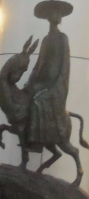
I love the picture above that I took of a statute take in Chengdu at the Du Fu’s Thatched Cottage. It reminds me of the story of Don Quixote and his quest… or as the song goes to dream the impossible dream and to fight the unbeatable foe. That what appears to be the unbeatable foe lies solely within us to conquer.
This is my Quest to follow that star,
No matter how hopeless, no matter how far,
To fight for the right
Without question or pause,
To be willing to march into hell
For a heavenly cause!
And I know, if I’ll only be true
To this glorious Quest,
That my heart will lie peaceful and calm
When I’m laid to my rest.
And the world will be better for this,
That one man, scorned and covered with scars,
Still strove, with his last ounce of courage,
To reach the unreachable stars!
Du Fu left home at the age of 20, and later he became a court official at the Tang Dynasty capital of Chang ‘an (near Xi’an). Du Fu’s civil service duties did not last long however, as he forced to flee during the An Lushan Rebellion. Du Fu experienced many difficulties during his life. He lived during turbulent times, and experienced war, separation from his family, cold, and hunger. These are all reflected in his writing. It was in Chengdu, in his small and simple hut, that Du Fu was inspired to write more than 200 poems. These poems are regarded today as masterpieces of realist poetry.
I wrote the entry below as I was beginning to study the writings of Chuang Tzu. Someone you will begin to know as we go forward. Chuang Tzu’s contribution to what was to become Taoist philosophy goes beyond measure. He took people beyond what they thought was reality to expand their sense of inner vision connecting what was – to what would later be called, or known as our heart/mind, the connection between them, and how we respond to nature and our environment. The idea that man is simply one of ten thousand things found in nature had become common knowledge or thinking at this point in ancient China. Beyond the story of the butterfly dream, Chuang Tzu’s contribution became known as aspirations to the Perfected Man, and to just what did that mean.
That our thoughts and actions should always question what is real, not real, or perhaps simply something we dreamed or imagined. He uses stories and parable and uses humor to successfully take people beyond the norm to consider possibilities they had previously considered not possible. To see beyond the face of things, and that truth and falsehood were never really the issue and could be seen as insignificant over time. I think Chuang Tzu saw things at a more cosmic, or what it meant to become universal, in both our thoughts and actions, that he too would be considered as a sage, or dragon in Chinese history.
Voices of the Dragon Part 2 Number 2
Piquing Immortality’s Interest
Passing through the door no longer able to distinguish between truth and falsehood is not enough to gain understanding.

Only when you are prepared to know the difference between truth and falsehood is non-existent can you be prepared to be asked to stay and learn.
Ridding the mind entirely of the concept of truth and falsehood allows one to begin to pique immortality’s interest. Come to understand that truth and falsehood were never the issue. That all things are equal and the same. That there is no victory to be had in taking sides.
Only then, in knowing that all sides are the same are we invited to stay as one with the universe and one day take our place with the dragons. At issue is not rather you are able to discuss the difference, but simply in knowing that the differences are the same either way. Understanding that an underlying unity exists in all things and a connectedness from which all things are derived at, are dependent and ultimately returned to begin again is the essence of all things.
As all things are possessed of both good and bad, truth and falsehood become the essential element in how each of us endeavor to know reality only for ourselves and our own non-existence.

Stay beyond description and appreciate the silence found only in coming to find your inner chi or virtue, your inherent holy spirit and self, and remain free to fly away.
An original composition written while studying Chuang Tzu from The Essence of Tao. 4/11/94
Leave a Reply