Fitting into patterns of our lives especially after you have reached a certain age is that we agree with an old adage of Taoism is says that we are to “let well enough alone or to just let things be”.  Often when I’m considering things I need or should do in my yard or garden I approach them with the idea that I’ll do it when I get around to it.
It’s like we nurture a more mellow approach to things as though we’ve seen and done it all before and truth be told, we have. In most cases, things tend to work themselves out when left alone without our interference just letting things be, and to live a life free of conflict and contention.
That there’s purpose in whatever we’re divinely inspired to do—it’s simply a matter of discovering what that is and following through. There’s so much to gain from openly exploring different paths, taking an interdisciplinary view of religion as a way to refine our inner growth, so we can align how we approach the outer world in a positive way. Not with the intent solely to convert, but to relate so we can better understand universal wisdom that resides in all people and things we find in nature. It’s why I created The Kongdan Foundation in 2006, almost twenty years ago now.
Eternal truths aren’t confined to any single belief system. We live in a world that’s always tied to growth and change, and with thoughts and actions aligning with an ever-expanding cosmic spirit, where our efforts are connected to what remains undefinable.  Undefinable for a reason, except to know that what is finite is more easily breakable and does not last as it in turn learns to bend…
It can be seen as something new emerging from the old, to the continuation of universal spirit. In recognizing this, we understand that we must change as we too are self-directed, co-creators of eternity.
There is a basic tenet of Confucius that says, “it is man who makes truth great, not truth that makes man great”. Why with having virtue and empathy for others we find in nature superior to simply a creator tied to “righteousness or to what may be singularly referred to as self-righteousness”.
Who can really say what’s right or wrong when it changes from moment to moment, like desert sand eager to shift with the wind? Swayed by whims, opinions, or so-called principles crafted by individuals, we end up shaping rules that favor one person over another. When truth becomes just an interpretation shaped by those who claim to speak for God, following Confucius feels less like practicing religion and more like embracing a guide to living with virtue along the way—and knowing when it’s best to simply let things be.
That’s why the symbolism in Confucius’ teachings on virtue and moral conduct blended so naturally with the works of Lao, Chuang, Lieh Tzu, and the sutras of Buddhism. Why almost two thousand five hundred years later we can speak of Lieh Tzu and his writing and do a commentary as to how it all applies today from the heart.
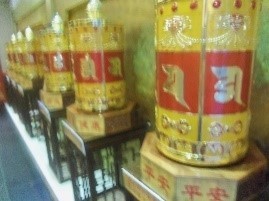
Every Buddhist spinning wheel when it is spun releases a sutra, or prayer, to the universe and cosmos for the benefit of all sentient beings.  Each one contains a different sutra, so you are spinning for everyone not simply yourself. You are also encouraged to include family and friends in your prayers. I took this picture at the Arhat Temple situated in the Yuzhong District of Chongqing, China.
It’s what they would want us to do. Why reflecting on the past and our memories becomes so important and why principles today can amount to nothing more than myths and legends if not seeded and founded on eternal truths. The teachings of Confucius and those above from 2,500 years ago remain just as relevant today and will likely continue to be so 2,500 years from now. May we always live with an understanding of what we seek, letting our actions be guided by a higher purpose, and knowing when to simply let things be.
My travels with Lieh Tzu / Interpolations along the Way
Chapter Eight – Explaining Conjunctions
120. Myths on Purpose
Reminded of what you have already written regarding myths and legends. Knowing not to take what appears on the surface, as you look to discover what is not apparent. Using examples of metaphors and images to bring everything into focus. Using the common sense of the sage to predict all action that may simply be waiting to come forth again and again.
Conscious that what now appears as truth, may in the end be nothing near the reality yet to be made clear. As we soon will learn. There was a family in Sung that was known far and wide for its virtuous conduct over many generations.  Then for no reason a black cow gave birth to a white calf. They asked Confucius about it. Confucius told them it was a fortunate omen, and they should offer it to God. A year later the father for no reason went blind. Again, the cow gave birth to a white calf and again the father ordered his son to ask Confucius. The man’s son was confused and asked:
“I don’t understand, the last time we asked Confucius you went blind”.
The man who had gone blind told his son:
“The words of the sage at first seem to defy the facts, later are seen to agree with them. We have not seen the end of this matter, ask him again”. The son reported this to Confucius as he was told to and upon the death of the second calf, he too soon became blind.
Soon afterward Chi attacked Sung and besieged the city. The people were forced to take desperate action, exchanged their children and ate them, then splitting their bones for fuel. All the able-bodied men mounted the walls to fight with more than half meeting their end. The father and son being blind, both escaped. Not long afterwards, the siege was lifted and they soon both regained their sight.
What could the story be telling us except that what may appear today as tragedy may in the end save us. If it helps us to see beyond today’s travails and give us hope for tomorrow, how could its purpose not be true? 8/14/95
Number one hundred thirty-seven of one hundred fifty-eight entries.
Leave a Reply