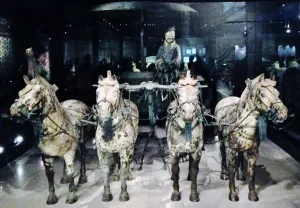
The terracotta figures in Xi’an, along with the chariot and four horses, leave a lasting impression and spark curiosity about the world they came from, and the incredible skill required to create them. One of the biggest hurdles in connecting with our past memories is how the present overshadows them. We often dismiss them as mere imagination or convince ourselves there’s no history before our current life. Developing a sense of awakening to our past can happen in a single moment or take years of convincing ourselves that there is more to us than we think, understand, or realize.
During my first trip to Xian in 2014, I reflected on how I had been visiting China since 1997.  Over those fifteen years and more than three dozen trips, I often found myself struck by the sense of returning to places I had already been. Landmarks, some hundreds or even thousands of years old, seemed to echo moments I had experienced before. This feeling occurred frequently, especially in Qufu and Shandong Province. As I traveled across China, this sense of familiarity convinced me it was more than just vivid imagination or coincidence, especially in Chengdu and Xian.
These two cities, more than anywhere outside of Qufu, captivated me and erased any doubt. Marco Polo’s visit from 1275 to 1292 seemed to crystallize my time in China. Interestingly, my connection to China seems to fade as Polo departed via the Silk Road from Xian on his journey back to Venice and Italy. It felt like I was being driven to explore places that would shed more light on and deepen the journey ahead of me. While we often speak about self-realization, so much had already unfolded. If you check the bottom of the entry below about the charioteer, you’ll notice it was written in May 1995, long before I ever imagined or considered traveling to China.
These two cities, Chengdu and Xian, will come back into focus often as I write in the future. Today, I want to briefly talk about my first visit to Xian after taking the overnight train from Chengdu in 2014. It as a hot summer day and I had an overwhelming sense of dread and chills. Some memories are best forgotten like the burning of books and burying of scholars in 213 BCE and the live burial of 460 Confucian scholars in 212 BCE ordered by Chinese emperor Qin Shi Huang, the first emperor of China in Xian.
The events were said to have destroyed philosophical treatises of the Hundred Schools of Thought along with many others.  I felt a very strong connection to many of the scholars who had died here who were forced to dig a pit then buried. Just like today, scholars and storytellers of the past were known for recounting the impact of events over time and highlighting their historical significance. Attempts by tyrants to rewrite history in their favor rarely stand the test of time.
All previous books about philosophy and history of China were attempted to be destroyed. The terra cotta warriors and chariots above were meant to greet him in the afterlife. The terra cotta was later buried, and it is said that the wooden beams holding up the earthworks were later burned and fell into the terra cotta. Why they were found in pieces. Note… The museum Qin Shi Huang built honoring himself was burned soon after his death.
Xian and Luoyang to the east had served as the end of the Silk Road for over a thousand years. It had served as the point of entry for Marco Polo, along with his father and uncle, and would be really the last they saw of China when they left for Italy in 1292. Xian was also my last stop in China in October 2018 after a visit to Lhasa, Tibet. Going forward in this story we’ll revisit Chengdu, Luoyang, and Xian many times. I hope you’ll want to tag along.
My travels with Lieh Tzu / Interpolations along the Way
Chapter Five – The Questions of T’ang
87. The Charioteer
When a young man known as Tsau Fu began practicing learning how to control a chariot and the horses that pulled it  his teacher Tai Tou paid him no mind. For three years he behaved with great humility and still his teacher told him nothing. Finally, when his behavior was straight and his mind clear, his mentor told him a version of an old poem told to him by his master that had passed down from antiquity:
“The son of a good bow maker must begin by making baskets. The son of a good blacksmith must begin by making chisels. To drive a team of horses and control a chariot you must first learn to run like me.”
Tsao Fu responded that he would obey whatever Tai Tou would command. Tai Tou then set up a row of posts whose tops were well above ground and were just large enough to stand on. They could only be reached by running in stride, not by stepping from post to post. He ran backwards and forwards stepping from one to the next without stumbling, and soon, after Tsau Fu had practiced for three days he too had the post jumping down perfect.
“How nimble you are”, said Tai Tou, “you have learned quickly. Driving a chariot is the same. You have been able to respond with your mind to what you felt on your feet. Applying this to charioteering, you must control the bridle from the point where it meets the bit and pulls tight or slacken feeling the corners of the lips; decisions must come from your heart and come naturally from your hand. What you feel with your heart will then accord with the horse’s temper. In this way you can advance and withdraw, wheel around as exactly as a compass. Take to the road on long journeys and have strength to spare, you will have mastered the chariot.”
Tsao Fu’s mentor Tai Tou continued:
“If you can respond with the bridle to what you feel in the bit, with the hand to what you feel in the bridle, with your mind to the feel in your hand, then you will see without eyes and have no need to goad; remain relaxed in mind and straight in posture, holding the six bridles without confusing them, you will place twenty four hooves precisely where you want them and swing around, advance and withdraw with perfect precision.
Only then, will you be able to drive carving a rut no wider than the chariot’s wheel, on a cliff which drops at the edge of the horse’s hoof. Never noticing that mountains and valleys are steep, and the plains and marshlands are flat, seeing them all as the same. Remember all this, as there is no more as I will have nothing more ever to say on the matter. There is nothing more to learn.”
Tsao Fu went on to become the greatest charioteer ever known. Even surpassing his Master, Tai Tau. He could handle the reins better than anyone as he knew the horse’s path before their feet treaded upon it. Just as when jumping to and fro from the posts without falling. Success was now such a part of who he had become, how could he know failure?
5/5/95
Number eighty-seven of one hundred fifty-eight entries
Leave a Reply