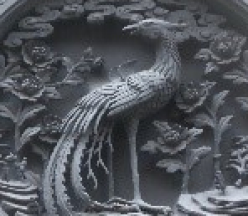
In Chinese culture, the phoenix represents virtue, grace, and an ideal of beauty and harmony. Unlike the Western image of the Phoenix rising from ashes, the Chinese version captures a deeper idea of rebirth, renewal, and the cycles of life. Ancient texts like the “Shan Hai Jing” (Classic of Mountains and Seas) describe it as a creature of wisdom and stunning beauty. Over time, the phoenix’s myth has grown, with different interpretations and regional twists adding depth to its story.
Over the centuries, the phoenix myth evolved by incorporating elements of Buddhism and Taoism, becoming a deeper and more intricate symbol of Chinese culture. Often tied to the theme of rebirth, the phoenix represents the cycle of life and its many forms. This symbolism is closely connected to beliefs in immortality and the enduring nature of the soul. The phoenix represents harmony and balance and is often paired with the dragon to represent the duality of yin and yang. Together, they embody a harmonious blend of male and female energies, which is central to Chinese cosmology. This pairing highlights the interplay of opposites and emphasizes the importance of balance in life.
The Phoenix has also inspired countless poets and writers throughout Chinese history. Its symbolism of beauty and virtue has made it a recurring theme in poetry, often used to convey ideals of love, fidelity, and the aspiration for a harmonious life. It represents grace, beauty, and the idea of rebirth and transformation. As I traveled through China over the years, the symbolism of the dragon and phoenix was everywhere. They reinforced the idea that we are more than just individuals, suggesting a deeper connection and continuity in how everything fits together within our culture.
Years ago, during several trips to France, I spent a couple of weeks wandering the streets of Paris, as though reliving history through its stunning architecture and iconic landmarks like the Arc de Triomphe, the Sorbonne, and the Louvre Museum. It’s fascinating to catch a glimpse of history and imagine what life might have been like centuries ago and to read the great writers of the day. Later, on a trip to London for a bookfair featuring one of my books, I stayed at a cozy bed and breakfast near the British Museum. I spent a lot of time at the museum exploring historical artifacts. Ultimately, it’s what we take away that spark long-forgotten memories. Whether it’s the treasures at the Smithsonian in Washington, DC, or the Monet exhibit at the Philadelphia Museum of Art, these experiences create new memories and starting points that enhance our own journey. Also, all five of the national museums in China where I took thousands of pictures.
Walking the Ring Road with the locals in Lhasa, Tibet where every step in Buddhism is sacred and questions regarding the spiritual essence of rather Buddhism is a religion or simply a way of life melt away. The temples and monasteries are like universities on par with anything found in the West. Going to over a dozen Buddhist and Taoist monasteries and temples throughout China over the years and having an appreciation for their role of Eastern philosophy and religion over the centuries. I say all this as though my “bucket list” is full. But then here I am to tell you about it all…
All of these serve as reminders of who we are beyond what we encounter daily. We are far greater than we often realize, and it’s the journey of transforming into who we’re meant to be that truly matters. The rising of our own phoenix that will define us as well.
My travels with Lieh Tzu / Interpolations along the Way
Chapter 3 – King Mu of Zhou
42. Dreams vs drudgery, who can say?
The dreams of the gate owner verses the drudgery of the gatekeeper. Who can know true peace and serenity?

Pheonix at the gate of Shanghai Royal Yangdian Taoist Temple
The gatekeeper burdened from dawn to dusk. His old and tired muscles having long ago lost their suppleness. His tasks keep him from knowing any pleasure or happiness while awake. However, while asleep each night he dreams peacefully that he is the owner of the gate. Able to determine who comes and goes with all under his control.
Someone consoled him as to the drudgery and work he did and the meagerness of any pay he received and for the lowliness of his position. He responded that by day he lived in drudgery, but by night he lived in utter joy. How could he complain?
The owner of the gate meanwhile was confused by worldly affairs.

Constantly aware of his responsibilities to and for his family fortune. He fell asleep each night fatigued. Dreaming that he was but the gatekeeper he had scolded for every conceivable task and beaten for every imaginable fault. His sleep was constant tossing and turning with no relief until he awoke each morning.
In torment he confessed to a friend his dilemma. His friend told him that with such superior rank and more property than he could ever need was he not too far above other men? Is not dreaming that you toil as a gatekeeper as he suffers complete hardship as you spend your working hours counting your fortunes, the balance that must occur with all things being equal and the same?
Recognizing his error, the gate owner eased the burden of those under him and lessened his own responsibilities which had led to his distress. In time, his dreams found comfort and the old gatekeeper suffered a little less each day. The two leaving the drudgery that kept them apart. They had finally met along the Way. 2/26/95
Number forty-two of one hundred fifty-eight entries.
Leave a Reply