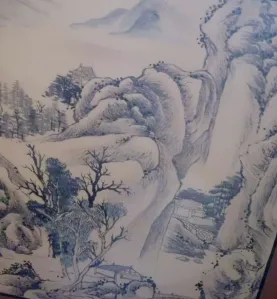
Chapter seven of My travels with Lieh Tzu deals mainly with living with the consequences of our actions. Rather we pretty much do as we please with disregard for how they impact others, and more importantly to what became known as “cause and effect” and the concept of “karma”.  That ultimately our actions do catch up with us. Even more importantly, how our actions impact the nature around us that depends on us to live as one with our environment.
With Yang Chu the opposite becomes true. That we are to live only for the enjoyment of today and not be hindered by moral conventions of the day. Arguments that ring true today more than two thousand years later. As to our own moral behavior, the entry below pretty much says it all.
This reminds me of the old saying, “Do times shape the man, or does the man shape the times?” It’s hard to say which holds true. Or to what I would add, “Is it our memories that are meant to shape the times?”
The chapter title is simply “Yang Chu.” Yang Chu, who lived around 350 BC, developed a philosophy focused on the individual, favoring a life removed from the pursuit of wealth and power.
This concept eventually merged with what became known as Taoism a couple of centuries later, emphasizing that external possessions are replaceable, but our body is not. It suggests we should avoid causing harm in the external world that could negatively affect our health and well-being, or our inner world. Lieh Tzu rejected a sense of self-aggrandizement that puts the needs solely for oneself through our ego and replaces it with how we are to match or blend the two. 
That this idea, intertwined with how we cultivate and treat ourselves, should take priority. The belief that self-cultivation is more important than any external benefit, even when it comes to gaining the throne of an empire, resonates deeply. For me, and in what I was writing below, how could you create something like that without being profoundly affected by it?
Once written and read repeatedly, it reveals how deeply these thoughts have taken root. I wasn’t just reading and interpreting the text; I was becoming what I was reading, as if the expression of the intent in a different way uncovered the depth of my own understanding.
This chapter is significant in highlighting the contrast between the legalism and moralism of the Confucians verses what eventually became known as Taoism. It poses the question: do we spend our lives seeking a good reputation and fame that outlasts our death, or do we prioritize self-cultivation and virtue, and can we do both? Confucius tried to make the argument that we could…
Over the centuries, this debate has shaped the overarching theme of how we should live. This dualism is beautifully exemplified in the chapter titled simply “Yang Chu”. I loved writing this chapter thirty years ago. It pits the essence of Taoism verses how the legalists used Confucian virtue for the own means. Little did I know at the time June 1995 that I would be teaching in Qufu at the school founded by and for the descendants of Confucius in 2011 through 2013 sixteen years later. Wow!
My travels with Lieh Tzu / Interpolations along the Way
Chapter Seven – Yang Chu
104. Explicit Impressions
Remaining as Yang Chu. Unconcerned with the constant struggle exhibited by those around you. Wealth and power as distant from your thoughts as whatever efforts that would be required to obtain them. Yet never truly take him or yourself too seriously. Only using the impressions of Yang Chu as the metaphor for life lived in the fast lane.
 Constantly reminded that possessions are replaceable while your body is not. Questioning the good of any action that would lead to the least injury to who you are to become.
Everything is different than what you have written before yet somehow the same. As if Lieh Tzu’s final word on the matter is to question any preconceived idea or notion that has brought you this far on your journey.
Bringing together many writings of the ancient contemporaries who took delight in questioning authority as the Taoist must do to get to the core of what is real, unreal and too familiar. Using Yang Chu as the symbol of behavior that can only challenge and be challenged by all the current schools of thought of the day.
What can there be except to question authority? Can the mere idea of not giving one hair on one’s head to gain a kingdom come from anyone but an amoral egotist?
 What can this obsession with saving face be when it is associated with some perceived sense of morality? Does not the Taoist remain a symbol of moderation in all things?
Balancing every alternative against its opposite and avoiding any excess that may shorten his life. Does not the Taoist laugh at social convention and either elude or adapt them to suit himself?
Lieh Tzu in the end explicitly rejecting the road to the hedonism of Yang Chu, of self-aggrandizement that puts oneself above the needs of the world and all others. Always contrasting both good and bad elements each of us must choose to follow. Seeing both, do not we fall back, decide to leave our ego behind and stay. 6/22/95
Number one hundred four of one hundred fifty-eight entries.
Leave a Reply