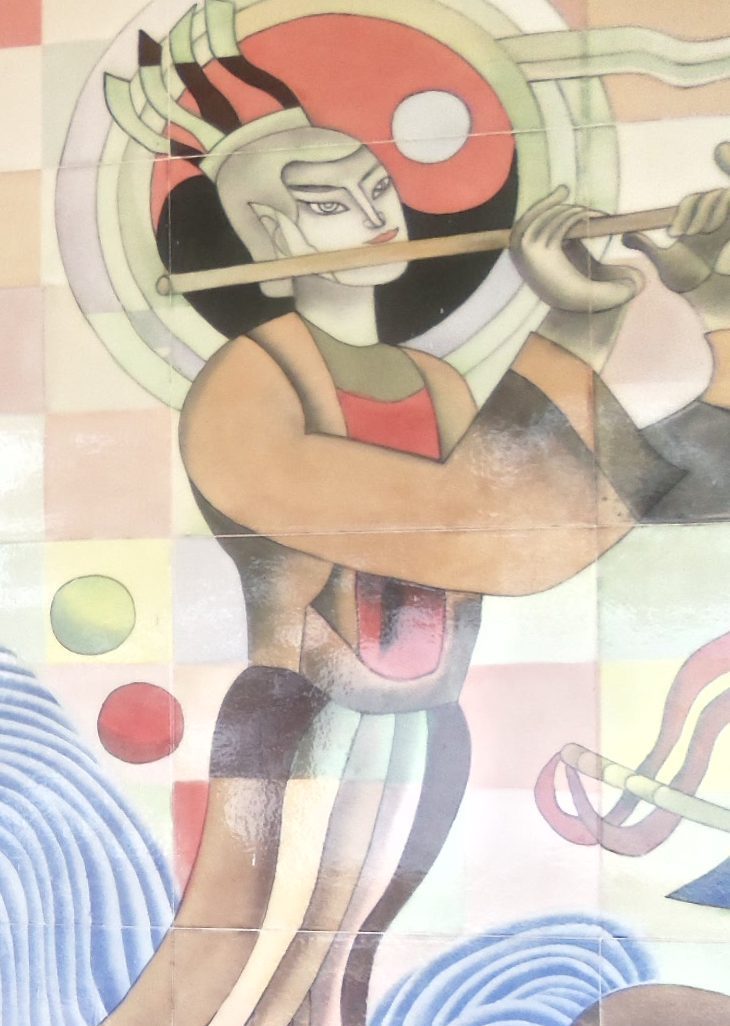
I try to think of what it would have been like to be a writer in what was considered to be the great schools of the day, or a storyteller in China during what was known as the “Warring States Period” from about 500 to 150B.C. A time when the great philosophers were competing to have a say as to how people should live without being killed for trying to do so. Tradition has it that “advisors or consultants” as we would call them now, traveled from state to state seeking employment. Something even Confucius did and was never taken seriously until over 200 years after his death.
Good advice would be considered as “music to the ears” of those hearing or receiving it. Advisors had to be cautious about the advice they gave, as it could be their last if things didn’t go as expected. Lao Tzu himself is said to have headed west, never to be seen again, out of frustration that no one took him seriously. These advisors were truly the artisans of their era.
What does the artist strive for, if not through their painting that reveals and refines their own untapped potential? Or the pianist, seeking an elusive quality in the tones and keys of the piano they long to discover.  The athlete, dedicating years of effort to stand on the Olympic podium. Countless hours of practice aimed at a singular goal, or for the writer whose Pulitzer Prize-winning work today can showcase their storytelling talent. Or the budding actor or actress hoping to be discovered while the phone never rings. Where a break might give them the chance to say “yes, I can do this”.
For some, talent comes naturally, as if they were born for the moment. For others, the talent might exist, but the opportunity to fully develop it may never come. Sometimes, the talent isn’t remarkable at first, but dedication and hard work can shape it into something extraordinary, or even not show itself until later in life… Why does one person succeed while another fails? Great success one day can turn into failure the next, while repeated failures can eventually lead to unimaginable success.
It’s often our peers who seem to decide what counts as art, what defines talent, and who has that elusive “it” factor. It feels like we just have to keep going until we get it right. Sometimes, life itself can feel the same way. That we have to go through certain lessons, experiencing and living them, to truly grasp the value of success and the consequences of failure.
Great talent often comes with the risk of even greater failure. I call it the “perseverance of spirit and ultimately our soul”. It becomes the ultimate balance of challenge and achievement that we all must face, if only to make it through another day. We live in a world of cause and effect where what we leave behind has to be fully accounted for and answered to. Where we learn not to repeat our mistakes and that education, experience, and even chance, combine to shape the reality we inhabit, pursue, and choose to follow.
My travels with Lieh Tzu / Interpolations along the Way
Chapter Five – The Questions of T’ang
82. Mastering the music of the seasons
There once was a famous musician named Hu Pa who was considered an expert at playing the lute. When he played, the birds danced, and the fishes jumped from the water with joy. A young man heard of this story and left his family to become an apprentice of the famous musician. The apprentice, whose name was Wen, practiced for three years laying his fingers on the lute’s strings to tune them, but could never finish the music that lay in front of him.  The master musician Hu Pa told him that he might as well go home. Wen put aside his lute and answered:
“It is not the strings that I cannot tune nor the piece that I cannot finish. What I have in mind is not the strings. Unless I grasp it inwardly in my heart it will not answer from the instrument outside me. That is why I dare not take out my hand to stir the strings. Let me stay a little longer and try to do better.”
Soon afterward Hu Pa asked Wen how he was doing, and Wen responded that he thought he had it.
As if the notes on the music scale were associated with the four seasons, Wen touched the Autumn note in Spring and suddenly the fruit ripened on the bushes and trees. When Autumn came, he touched the Spring string on his lute and warm breezes came gently forward and the bushes and trees burst into flower. During the Summer he touched the Winter string and frost, and snow came with the rivers and lakes abruptly freezing over. And when Winter came, he touched the summer note and the sun shone brightly melting all the ice at once. When he played all four together a fortunate wind blew, auspicious clouds drifted, the sweet dew fell, and fresh springs bubbled.
So masterful was his playing that Hu Pa responded:
“Even the music masters who can cause droughts and warm the climates of the far north can do no better. They would have to put their lutes away and follow behind you. Your heart is pure, and nature has responded and acted accordingly.” 4/26/95
Number eighty-two of one hundred fifty-eight entries
Leave a Reply