Taoism and Lao Tzu
The Taoist is always putting things together to see what arrives as virtue.  He/she looks to be seen as the realizing person, whose conduct is someone who has committed himself or herself to the Way and the process of self-realization. The basic idea is that a person uses change to follow the Tao, building power and virtue (te) to become their true self—who they are meant to be—through self-awareness and inner growth.
Here we are again trying to appreciate and understand the meaning of words we do not often use in our vocabulary. That we are to live fully as our innate nature; as a necessary or inseparable element or quality generated from within us.
This is why self-awareness imbedded in peace and harmony in an age of the reigns of the Three Sovereigns and Five Emperors more than five thousand years ago became so important as to how the early Chinese viewed themselves in history.
The point being that they exercised power so unobtrusively that the people hardly knew they were there. Into this portal the I Ching and Taoism would follow and soon afterwards Buddhism.
This knowing was repeated over the centuries as a song that went:
“Sunrise we rise/sundown we rest/we dig wells to drink/we plough fields to eat/the emperor’s might/what is it to us?” (This can be referred to as Kushihyuan serving as a cultural symbol in ancient China and a window into its old ways of life).
People learned to say that these things all happen by nature. Learning to move by what occurs through our intrinsic nature where any action by us is meant to leave no trace.
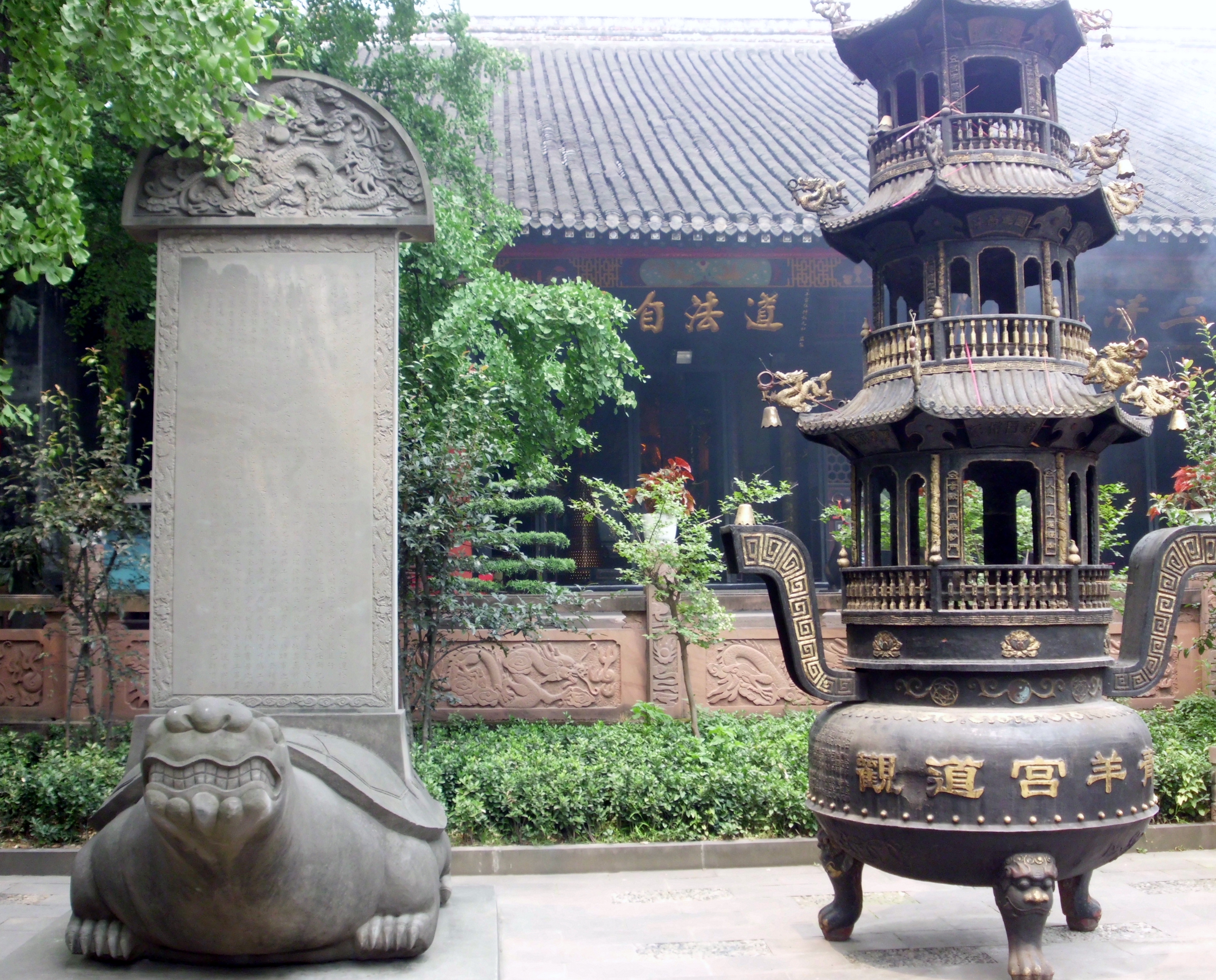
To the left is Qingyang Taoist Temple Sanqing Hall (Hall of Three Pure Ones):  The main hall dedicated to the Taoist Trinity, featuring a 9.8-meter-tall statue of Yuanshi Tianzun. I’ve been here many times over the years.
I like the words of the sage and Taoist master Huang Yuan-chi who was known as stressing the common points between Confucius and Lao Tzu, who said:
“What we do to cultivate ourselves is what we do to govern the world. And among the arts we cultivate, the most suitable of all is honesty, which is the beginning and ending of civilization.
When we embrace the truth, the world enjoys peace. When we turn our backs on the truth, the world suffers. From the times of the reigns of the Three Sovereigns and Five Emperors, this has never varied.”
Before we go on with Verse number 17 of 81, it’s worth noting that the title of the book we’re adding commentary to—Lao Tzu’s Tao Te Ching—is my own version, titled “Thoughts on Becoming a Sage: The Guidebook to Leading a Virtuous Life”. It’s important to note that Lao Tzu wrote the Tao Te Ching in the sixth century BC.
Verse 17 – Governing Wisely
Let your virtue lead the way with others convinced it is their own works that prevail.

Lasting success can only occur when those who have looked to you for guidance conclude they have championed their own cause.
What the sage does to cultivate himself is what he does to govern the world. Your greatest virtue is to initiate no action that leave traces of your presence. So that when all goes well people can feel they are responsible.
As long as people think they have achieved greatness by themselves, they have no reason to love, praise or despise anyone.
Simply unveiling the truth and contradictions to virtue will allow others to come forward and for you to remain still. Instilling peace and harmony along the way you can prepare to take them to places they would otherwise forego.
第17节 无为而治
让你的大德为众人引路,告诉他们,依靠自己的努力才能成功。只有众人的最后成功,你自己才

能成功。
圣人的修身之道如同治国。你的最大德行是无为而治。因此,当丰调雨顺,五谷丰登时,人民觉得他们才是国家的主人。
只要人民安家乐业,他们就没有理由去崇拜,去歌颂或者轻视任何人。
只要展示真理和大德,众人自然前来与你同行,你就可以保持宁静。一路上,你给众人传授宁静与和谐的理念,带领他们去寻找自己的归宿
Leave a Reply