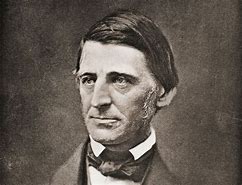
With thoughts returning to Emerson, Walt Whitman, and Eric  Butterworth’s line – “The universe is calling” asking are we listening?
Always questioning our inner most thinking of what we take for granted. A starting point I always look to is thinking about what was known and unknown at the time others may have lived.
As we learn today and can see beyond the living history both past and present, we become a benchmark. Emerson proves to be a reliable source in doing so. As though his greatest attribute was and still is making us think knowing our knowledge creates wisdom that becomes an imprint. As though vibrations corresponding with the needs of nature as our own becomes our foremost attribute.
Using our fundamental human faculties such as critical thinking, empathy, reason,  conscience, and intuition, we can capably lead our life.
We have the choice to cultivate a spirituality that does not require us to be inadequate, powerless, weak, and lacking, but one that empowers us toward empathy, strength, vitality, wholeness, and the fulfilment of our highest potentialities and possibilities.
Or what I like to refer to as our greatest endeavor and destiny.
Another Emerson quote I like is “An unnavigable sea washes with silent waves  between us and the things we aim at and converse with”.
It is like saying that we are in affect transcendent beings traveling the vibrations we create for ourselves. That it is what speaks to us, and we in turn converse with that determines our fate. And yet, in the face of this, Emerson still affirms the beauty and value of human life.
Confronting the mixed bag of human experience – what he calls “the potluck of the day”, he insists that “if we will take the good, we find, asking no questions, we shall have heaping measures”.
These are not the words of an idealistic dreamer, as Emerson has sometimes been portrayed. They are an expression of his confidence in the ability to meet and master our circumstances; they are a call for a pragmatic engagement of the world in which we find ourselves. That we can become and are the masters of our fate.
Thoughts of taking a walk at Waldon’s Pond with Walt Whitman.  Remembering in silence and meditation that our best travel is that of spirit and going there.
The sign you read upon entering:
“I went to the woods because I wanted to live deliberately. To front only the essential facts of life and see if I could learn what it had to teach and not when I came to die. Discover that I had not lived.” Thoreau.
Knowing Walter Whitman Jr. (1819-1892) is to know him as not just a poet; he was a  champion of American democracy, and a revolutionary voice in the literary landscape.
His life, marked by self-discovery, personal growth, and unwavering belief in the American spirit, unfolded like a free verse poem, leaving behind a legacy that continues to inspire and resonate.
His writing became a literary roadmap as the evolution of self with his book “Leaves of Grass”. This book was instrumental in people in the 1840’s and 1850’s and afterwards seeing our connection to nature and the wide-open spaces of America waiting to be found and explored. Combined with Emerson’s thoughts of man’s connection to nature and what was to become known as transcendentalism and westwards  expansion paved the way that sowed the seeds of American exceptionalism.
That there was something unique about the American experience. Although, some believe this uniqueness may now be called into question and has run its course.
Whitman began with journalism and short stories. However, his true calling emerged in the form of poetry. In 1855, he self-published the first edition of “Leaves of Grass”, a collection of poems that defied convention with its free verse style, earthy language, and celebration of the human body and soul. The book, initially met with criticism for its frankness and unconventional form, eventually became a landmark of American literature, hailed for its raw honesty, democratic spirit, and celebration of individual expression.
One of my own favorite entries from Leaves of Grass, is from the chapter Song of Myself, verse 50. Sometimes I like to just take a verse and think and meditate on it  as I tinker in the Spring as I am getting seeds started and young plants ready for others for the day. I have had a copy of the book for over thirty years and try to refer to it regularly. How it can influence my own original thoughts and writing. Or better said… getting my heart and mind straight, or for the better.
in me.
and sisters.
 Do you see O my brothers and sisters?
life—it is Happiness.
His legacy and influence on literature is amazing. He redefined American poetry, championed the use of free verse, and paved the way for future generations of writers to embrace individual expression and explore diverse themes. His poems continue to be read, analyzed, and celebrated for their emotional depth, philosophical musings, and celebration of the human experience. I have always looked to his writings as the ultimate free spirit and spending time with him and his writing worthwhile. You can  see why both Emerson and Thoreau became symbols of popular culture in America.
Just where do our thoughts come from? Even science shows us this now. Every atom of our body is billions of years old, both created and then recycled by the universe. Within those atoms spins energy that was unleashed by the big bang and continually emerging stars. The cosmos always close by, it lives within us. We are the universe, in human form, as returning wisdom without illusions of separateness as a part of the cosmic process.
Humans alone can unfortunately learn to separate themselves with something that  deceives them by producing a false or misleading impression of reality caused by seeing this as misguided self-interest.
While, self-interest reigns in nature, it is usually by finding complementary opposites that builds, finds, and evolves around adapting to common interests.
The essence of the nature of the universe over time, is that many of us spend our life thinking, teaching, and writing about what lies in what may be considered as common knowledge. Stretching beyond this self-interest reflecting both eternal and universal growth.
The secret being picking up pen and paper and going there defines our path and fate. Letting our thoughts take us to our highest endeavor and giving freedom to others to do  the same.
It is as though these vibrations and thoughts expressed by the storyteller and writings over eons of time, are just waiting for the proper vehicle to be expressed anew. Knowing this, how can we say what may be real or unreal, or simply fine-tuned to meet the times. Sometimes I recall Eric Butterworth’s line saying,
“The universe is calling”. Our answer should be “are we listening and going there too”.
Leave a Reply