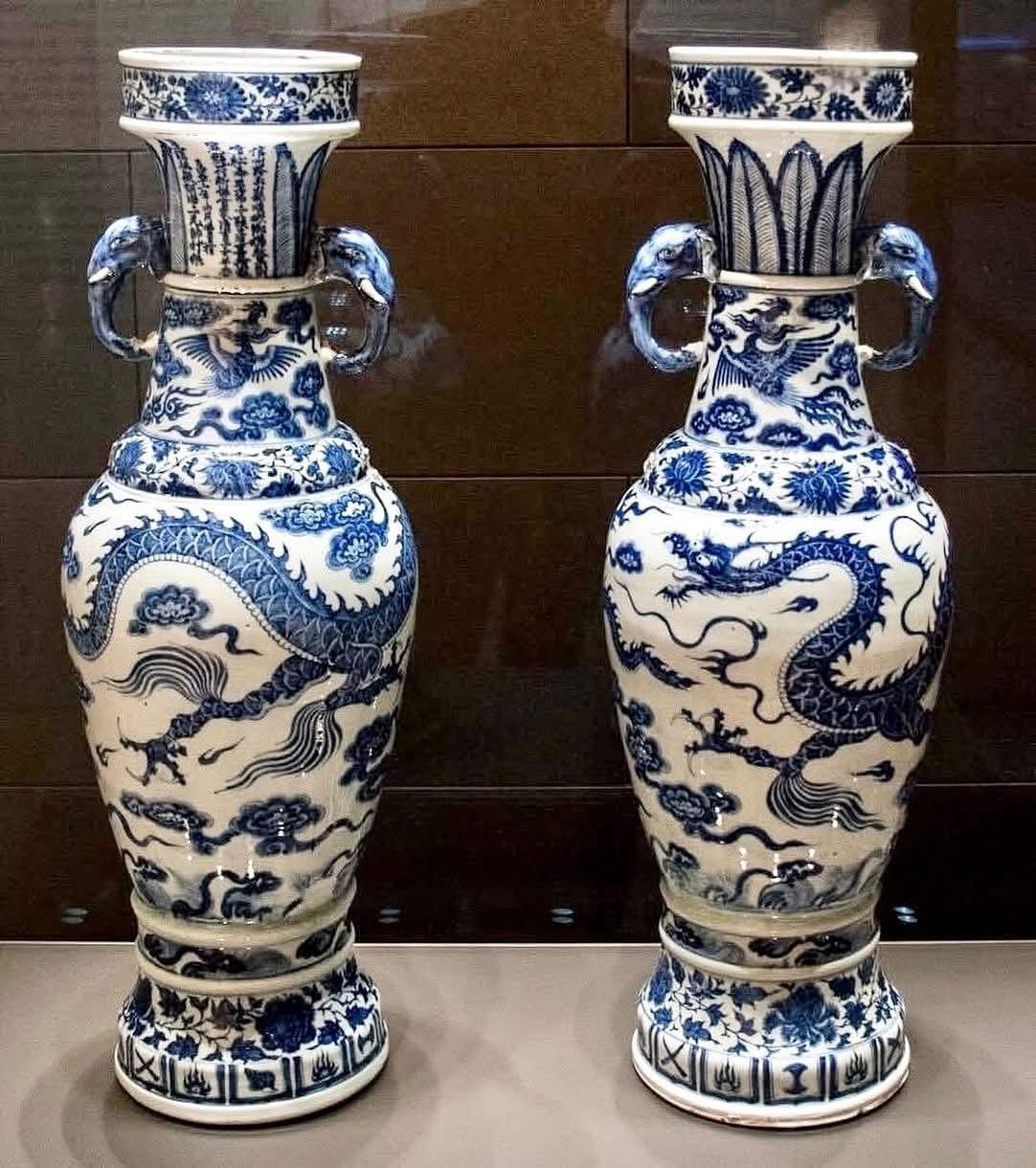
These two vases are among the most important examples of blue-and-white porcelain in existence and are probably the best-known porcelain vases in the world. Now in the British Museum. I took a picture of these two vases at the museum in April 2012 when I was in London for a bookfair with my publisher from Beijing. I took a week off from teaching in Qufu to go to the bookfair. The vases were made for the altar of a Taoist temple, and their importance lies in the dated inscriptions on one side of  their necks, above the bands of dragons. The long dedication is the earliest known on Chinese blue-and-white wares. The dedication records that in AD 1351 a man named Zhang Wenjin from Yushan county presented these two vases and an incense burner (the whereabouts of which is unknown), to a Daoist temple in Xingyuan (modern day Wuyuan county).
 their necks, above the bands of dragons. The long dedication is the earliest known on Chinese blue-and-white wares. The dedication records that in AD 1351 a man named Zhang Wenjin from Yushan county presented these two vases and an incense burner (the whereabouts of which is unknown), to a Daoist temple in Xingyuan (modern day Wuyuan county).
While I was in London I stayed at a bed and breakfast a few blocks from the museum. I think I spent as much or more time there than at the bookfair. Thier collection of Chinese porcelain is amazing. What is disappointing is that I learned that the British Museum has warehouses around London and elsewhere of what they brought from all over the world over hundreds of years that represented the history of other countries that cannot be displayed. A great deal of controversy exists now because many of these countries want their history returned in what is stored in warehouses around London.
Yushan county is in northeast Jiangxi, which lies 120 km to the southeast of Jingdezhen, where these vases were made. This inscription demonstrates that blue-and-white porcelain production was already well-established at Jingdezhen by AD 1351. Originally the vases, modelled after bronzes, had porcelain rings attached through the elephant head shaped handles. Porcelain was first produced in China around AD 600. The skillful transformation of ordinary clay into beautiful objects has captivated the imagination of people throughout history and across the globe. Chinese ceramics, by far the most advanced in the world, were made for the imperial court, the domestic market, or for export.
On my last trip to China I met someone in Chengdu whose hometown was Jingdezhen where all this porcelain was made. If I ever make it back to China going there is on my to do list.
Leave a Reply