Below is the final entry from The Book of Lieh Tzu chapter called Questions of T’ang, that appears in the manuscript “My travels with Lieh Tzu/Interpolations along the Way” that is entitled “The swords of the Yellow Emperor”. The meaning of an interpolation literally means it is “my take on things”. As the storyteller bringing thoughts forward as what would be not a straight translation, but how the story makes more sense as though it was to be told today. There are two final entries in this chapter afterwards that deal with my moving southward from Massachusetts to Florida.
The Yellow Emperor as depicted in a tomb from the mid 2nd century AD. The Yellow Emperor created and changed a great many things; he invented weapons and the well-field system; he devised upper and lower garments, and established palaces and houses. He truly was a mythological figure of ancient China. It is also said he used three different swords in delivering judgment to others…
It’s about letting go of past grievances where you felt a wrong was committed and simply moving on as you leave a lasting mark on those who committed the error in judgment. Countless books and movies have been made in China depicting the life of the Yellow Emperor and his role in history.
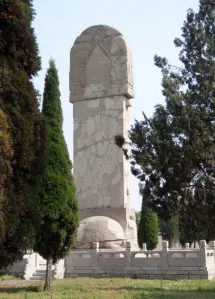
In Qufu there is a large oblique or statue, more than eighty feet tall dedicated to the memory of the Yellow Emperor that was constructed during the Song dynasty in about 800AD.
Myths formed over centuries tell of a figure who used his sword to punish the wicked and the selfish. However, the story goes deeper than just inflicting pain; it emphasizes leaving a lasting impression. Beyond the swinging of a sword, it explores human nature and how we react in moments of anger.
This is a long entry, and there is so much more to the story as we turn the page.
My travels with Lieh Tzu / Interpolations along the Way
Chapter Five – The Questions of T’ang
88. The swords of the Yellow Emperor
What is to be said of strengths and weaknesses, and who can know the difference? Holding grudges can only cloud the way. A man named Hei Luan had a grudge against Chiu Ping and killed him. The dead man’s son, Lai Ten, sought some means of avenging his father’s death. He was known for having a fierce temper but was considered a weakling. Despite his weakness, he swore he would find some way to seek revenge.
Hei Luan, on the other hand, had a very mean disposition. With the strength of a hundred men his body appeared to all to be more than human. Proud of his strength, he considered Lai Ten as nothing more than a chick or fledging, a trifle as such. Lai Ten was unsure how he would ever be able to confront such a tyrant.
A friend of Lai Ten told him of an old man who possessed the treasured swords of the Yellow Emperor he had won in a battle he had fought many years earlier. This grandfather of Kung Chou of Wei told of the story where upon having these swords a small boy could defeat a whole army. Why not go ask for them?
Lai Tan found the old gentleman and offered his wife and children to him if he could use one of the powerful swords. The old man responded that he had three swords and told Lai Ten that he could use whichever he liked. But that they could not be used to kill anyone, and that Lai must understand the function of the great swords before he would be allowed to use them, and said:
“The first is called ‘Container of Light’. Look for it and it is invisible, swing it and you cannot tell it is there. When it hits something there is no cut whatsoever. It passes right through its victim without him knowing it.
The second is called ‘Receiver of Shadows’. If you try to scrutinize it with your back to the sun in the twilight just before dawn, you may see a semblance of something, but no one can recognize its shape. When it hits something, there is a hissing sound, and it passes through its victim unharmed.
The third is called ‘Tempered by Night’. By day you see its shadow, but not its glitter. By night you see its glitter, but not its shape. When it hits something, it passes through with a tearing sound with the wound closing as soon as the blade has passed. The victim feels pain, but there is no blood on the blade.” The old man continued: “The swords of the Yellow Emperor have been in their cases for five hundred years while their seals have remained unbroken.”
Lai Ten decided to use the third one described as ‘Tempered by Night’. Then the old and frail man made him take back his wife and children, fasted with him for seven days and then presented Lai Ten with the sword. Only then did Lai return home with his family.
Lai Ten then went looking for Hei Luan with his sword in his hand at a time when he knew Hei would be lying drunk as he did each afternoon in his courtyard. Lai Ten then slashed him three times from neck to waist as Hei Luan lay still and remained unmoved during the attack. Thinking of him dead, Lai Ten quickly left and met Hei Luan’s son at the gate and slashed him three times with his invisible sword as if he was beating the air. As he dashed out Hei Luan’s son asked him why he was beating the air in such a strange manner. Lai Ten left remembering that the sword could not kill another man and wondered what good his efforts could have had.
When Hei Luan awoke, he chastised his wife for allowing him to sleep uncovered as he now had a sore throat and his waist hurt. When his son complained of Lai Ten’s visit and of his waving his hand three times in front of him and that his throat, arms, and legs hurt as well, they both knew a curse had been rightfully delivered. Lai Ten had avenged his father’s wrongful death. 5/28/95
Number eighty-eighty of one hundred fifty-eight entries
Leave a Reply