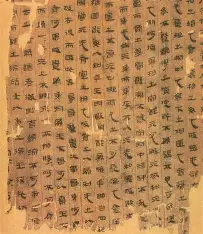
The picture above shows the famous Mawangtui text of the Tao Te Ching, discovered in a tomb dating back to 200 BC. Its discovery cleared up many uncertainties about the original text and Lao Tzu’s intended meaning.
Taoism and Lao Tzu
A good storyteller or writer knows the value of acknowledging those who have guided and supported them along the way. Giving credit to your sources and building on what they’ve contributed is just as important. When trying to give credit, it can be challenging when much of what you write is based on interpretations in another language, in this case English, from the original Chinese.
Over the more than 2500 years since the life of Lao Tzu and the Tao Te Ching, there are hundreds of translations that have attempted to say “ok, what did he really say. and the greatest difference among various editions centers not on the number of Chinese characters, but on the rendering of certain phrases and the presence or absence of certain lines”. I think this is important in the story of Lao Tzu and the influence he has had over the centuries.
Capturing and conveying the original intent of the creator has always been a challenge. Fortunately, the discovery of the Mawangtui Text, unearthed from a tomb sealed around 200 BC, has been a great help. Several other copies found from the same period make it easier to get closer to the original meaning.
What I’m writing here is my own edited version of the Tao Te Ching, a personal attempt to express what it truly means to become a sage—not to necessarily be seen as one by others, but to explore my own path toward becoming a sage, using Lao Tzu as my main inspiration. My own writing and text I feel, speak for itself.
After more than thirty years of writing and studying this philosophy, reading countless volumes, living and teaching in Qufu—the home of Confucius—and meeting scholars who share a passion for this ancient Chinese text, it feels as though these experiences have been flowing through me for decades, stirring memories both my own and those of others I’ve known across the ages.
I’ve never thought of myself as a scholar like Confucius, Lao Tzu, or Chuang Tzu’s Perfected Man, but I’ve always related to Lieh Tzu’s everyday man. My aim is simply to curate philosophy and ideas so that anyone can see themselves in them, take their own step toward virtue, and set out toward their own horizon. To write everyday with the goal of becoming a better storyteller as my friends would want their story to be told today.
Next are the Acknowledgements as they appear from my book, “Thoughts on Becoming a Sage – The Guidebook to Leading a Virtuous Life” that was published in China in 2006. The book’s contents and follow-up commentary will appear in future entries.
Acknowledgements
While there are many to thank when a book such as this is published in two languages for multiple audiences, I must first give thanks to the ultimate source for my inspiration.

Many times, I have referred to the founders of Taoism (Lao Tzu, Chuang Tzu, and Lieh Tzu) as the source of what I see as my divine guidance.
I have always felt their assuming the role of the dragon in Chinese history and culture has equated them with the deity.
Assisting and helping people to find their true path, then just as important continuing to help them along their own personal journey.
To follow the Tao, requires a strong independent belief in God. For me, this has equated into a universal sense unity where everyone everywhere has an opportunity to “find their place” in the scheme of things. This book in many ways illustrates one person’s attempts to emulate or mirror within himself these highest endeavors and destiny that may help to define an ultimate purpose. Acknowledging this higher presence in the universe, beyond any seeming religion, serves as the beginning point or benchmark necessary to finding this purpose. Doing so has assisted in building bridges and has led to breaking down barriers that might otherwise get in the way.
Two ministers have been primarily responsible for my own growth both in Florida and the western Shandong Province in China. Reverend Nancy Norman, the minister at Unity of Delray Beach, in Delray Beach, Florida and Reverend Gao Ming from Jining City, China.
I owe both a deep sense of gratitude for their inspiration and guidance. Both have helped me to see what the right thing should be in my personal journey and what my next step should be along the way. To both the members of the congregation at Unity of Delray Beach and the Christian Church Association in western Shandong Province I am grateful as well for their continuing inspiration.
My thanks to Mr. Gao Jian, a celebrated calligrapher in Jining in Shandong Province for his illustrations that appear throughout the text and a special thanks to Mr. Binhe Gu for his expert assistance in the translation of my English text to Chinese. His translation and editing of the text have assisted in making my story of the sage more understandable and readable to the Chinese audience.
To all of the above, I give my heartfelt thanks.
Leave a Reply