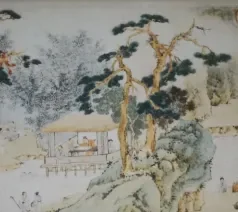
To be in meditation rising from your chair as though thousands of feet in the sky. With your mind’s eye as your guide, you travel west as though on the prevailing winds. Knowing there is nothing you have not seen before with landmarks you have always known guiding your way. Only now you travel as spirit to see what might have changed and to visit with old friends. You spot below the teahouse by the lake in People’s Park in Chengdu. Your favorite table now occupied by these friends from long ago. They sit as though waiting for your arrival. They are happy that you are updating with commentary how we met once again as kindred spirits more than thirty years ago, now seeming like a blink of your eye in time. It is as though we have known each other forever, and here we are again drinking tea at my favorite teahouse in Chengdu. It is as though I am in heaven once more.
Rather the above paragraph is real or imagined does it matter if all the characters and places described are real? If the voices are true to the story, then the described events must be true and to have occurred. Since time is relative visiting with old friends from the past can become commonplace. The point is that meditation can be used to open our hearts and mind to match our spirit and opens us to the pivot or portal I spoke of in the last entry. In a later entry we’ll learn more about Chuang Tzu’s pivot and how we can benefit from it’s usage.
Lieh Tzu was known as a wanderer of spirit rising up above the clouds to contemplate all the things between heaven and earth that man has at his disposal. That the gifts of heaven are provided by the bounty of nature. In early Chinese mythology, dragons were often depicted as deities or demi-gods. In the west we would call them angels. They were believed to have control over the weather and were associated with various elements of nature. The transformation of dragons in mythology reflects the Chinese worldview that emphasized harmony between humanity and nature. For a person to be elevated in stature to live and to be among the dragons as the sage was the highest calling a man could achieve on earth.
Throughout history, storytellers have been essential in highlighting the bond between humanity and nature, with the sage acting as messengers or deliverers of what might be seen as divine hope. For the sage to appear as a dragon riding on clouds in the sky was emblematic of the greatest, or highest role man could play on earth. Lieh Tzu was known to be able to combine various elements and tie them together with the right and true outcome. Telling how one is to share the story of the unending journey of our spirit, with a select few destined to guide humanity as mentors. This was the role Lieh Tzu embraced and recognized as his greatest purpose. Why he chose to live quietly in the country on his farm away from the distractions of others who kept coming for advise and how to live simply in, or as the embodiment of virtue. He was known to have been considered far and wide as a sage who rode on dragons on clouds in the sky.
The Book of Lieh Tzu often contemplates our spirit and the journey we are meant to take. Exploring humanity’s place at the crossroads of heaven and earth, using stories to show how heaven might view it and exploring man’s role and ultimate purpose. For a sage to rise in history and embody the role of a dragon was considered the highest aspiration, securing eternal significance. This is how the dragon came to represent the emperor, soaring above all as the supreme dragon or divine spirit, surpassing everything else.
In the end, it all turns into myths and legends, where what was once real fades into the unreal. They become stories, retold countless times, meant to be embellished, and remembered.
My travels with Lieh Tzu / Interpolations along the Way
Chapter Four – Confucius
58. Oh, How Perfect is Travel!
Why should one leave one’s doorstep to travel except to see and experience how things change? While others may travel to see different sights in various places, I am only interested in seeing how nothing ever can stay the same and discover others who know the difference.

You busy yourself with outward travel and do not know how to busy yourself with inward contemplation. By outward travel, we seek what we lack in things outside us. While by inward contemplation we find sufficiency within ourselves. The latter is perfect, while the former an imperfect kind of traveling.”
From this point on Lieh Tzu stayed home thinking that he did not understand travel. Until Hu Tzu tells him: “How perfect is travel!” In perfect travel we do not know where we are going, in perfect contemplation, we do not know what we are looking at. To travel over all things without exception, contemplate all things without exception, this is what I call travel and contemplation.”
To leave one’s seat while still sitting. To travel upwards as you look down on your room, your house, the town in which you live. As if you were a thousand feet in the air and asking yourself:
“Where do I go today! North, east, south, or west. What does it matter.”
All directions are free to you as if riding the prevailing winds to nowhere special. As everything everywhere is laid out before you. Oh! How perfect is travel!
How else could one ever say that he has seen all that there is to see, in the past having been there, in the present leaving to destinations unknown, and in the future going only where your destiny will find you? Oh, how perfect is travel! 3/15/95
Number fifty-eight of one hundred fifty-eight entries.
Leave a Reply