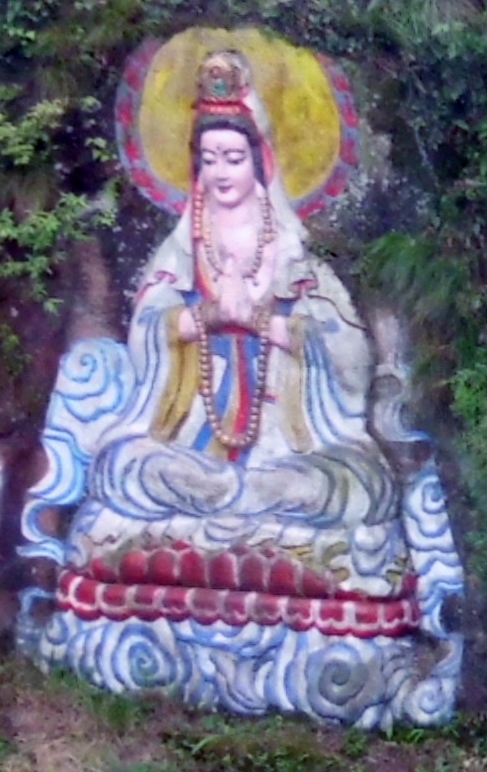
The Queen Mother of the West is a mother goddess in Chinese religion and mythology. The first historical information on her can be traced back to Shang dynasty before 1000 BC, as oracle bone inscriptions that record sacrifices to a “Western Mother”. They illustrate that she is most often associated with what was to become Taoism, as well as the beliefs that she was the dispenser of prosperity, longevity, and eternal bliss. (I took the above picture of the Queen Mother that was painted on the face of the mountain while riding on a tram up to the top of Huangshan Mountain in 2014).
Taoism and Lao Tzu
To truly appreciate the word change, we need to expand our understanding of its many meanings.  It reminds us that there are countless ways to view our mobility, the flow of life, and how we adapt to living with a fluid sense of identity. When we see spirit as creative energy and recall how the ancient sage taught what would become the Tao, we naturally think of Lao Tzu.
The world flows with the Tao, in harmony with the way of the spirit, and its strength comes from moving beyond predictable patterns. Change can happen in sudden, surprising leaps, as we’ve learned and seen lately with breakthroughs in quantum mechanics and physics.
The sage Huang Yuan-chi tells us that “we all possess something good and noble that we don’t have to seek outside ourselves, something that the glory of power or position cannot compare with. People only have to start with this and not let up”. The ancients would add, “Two or three years of hardship, ten thousand years of bliss”.
The second meaning of change has a more direct impact, reflecting a particular quality of our mind. It can be an irrational, intuitive, and spontaneous force that takes us straight to the heart of any issue or matter. When we turn to Taoism, we start with the I Ching, viewing change as transformational, whether gradual or sudden. From this, we can see that events never occur in isolation. Where key elements of cause and effect come to play.
When we think of natural disasters like erupting volcanoes, torrential rain causing floods, or hurricanes, we often can see their immediate impact on change and the environment. When something happens because of us, it’s usually a response to our actions, and the consequences are the result of what we’ve set in motion ourselves.
The Tao Te Ching teaches us to return to our innate nature and to learn to govern ourselves; to embrace the qualities we’ve always had and bring them forward—what Lao Tzu described as genuineness, sincerity, and spontaneity. It doesn’t mean bad things won’t happen, but it encourages us not to create them for ourselves or others. 
Buddhists strongly embrace the idea of impermanence, the belief that everything is temporary, always changing, and will eventually end. They see life not as something fixed, but as a constant flow shaped by cycles of birth, growth, decay, death, and rebirth.
Their teachings emphasize the ever-changing nature of existence and the certainty of change. Looking back over more than four thousand years of Eastern philosophy, you can see how different beliefs have blended together and complemented each other.
You can also see the influence of the I Ching and its ideas about cause and effect, complimentary opposites, and the impermanence of nature. By adjusting our actions to align with changes in our environment, we can understand Confucius’ view that we are not here just to shape the world around us, but to learn how to live in harmony with nature, which will guide how we choose to live.
Before we go on with Verse number 13 of 81, it’s worth noting that the title of the book we’re adding commentary to—Lao Tzu’s Tao Te Ching—is my own version, titled “Thoughts on Becoming a Sage: The Guidebook to Leading a Virtuous Life”. As referred to above, it’s important to note that Lao Tzu wrote the Tao Te Ching in the sixth century BC.
Verse 13 – Skirting Disgrace and Disaster
Be careful not to curry favor with others, as disgrace is soon to follow. Favor and honor remain external from the true path of the sage.

He prefers to cater to neither, as both remain outside and away from the path he has chosen to follow. Possessing them can only lead to disgrace and disaster.
Seek only that which lies within yourself cultivating your own innate abilities. Remain within and all will follow.
第13节 在耻辱和灾难的边缘漫游
不要曲意奉承,因为这样做耻辱很快就要降临。名利是圣人的身外之物。
圣人对名利不感兴趣,两者均与道格格不入。拥有它们只能够招来耻辱和灾难。
只寻找内在的东西,培养内在的能力,保持心灵纯净,一切都将随之而来。
Leave a Reply