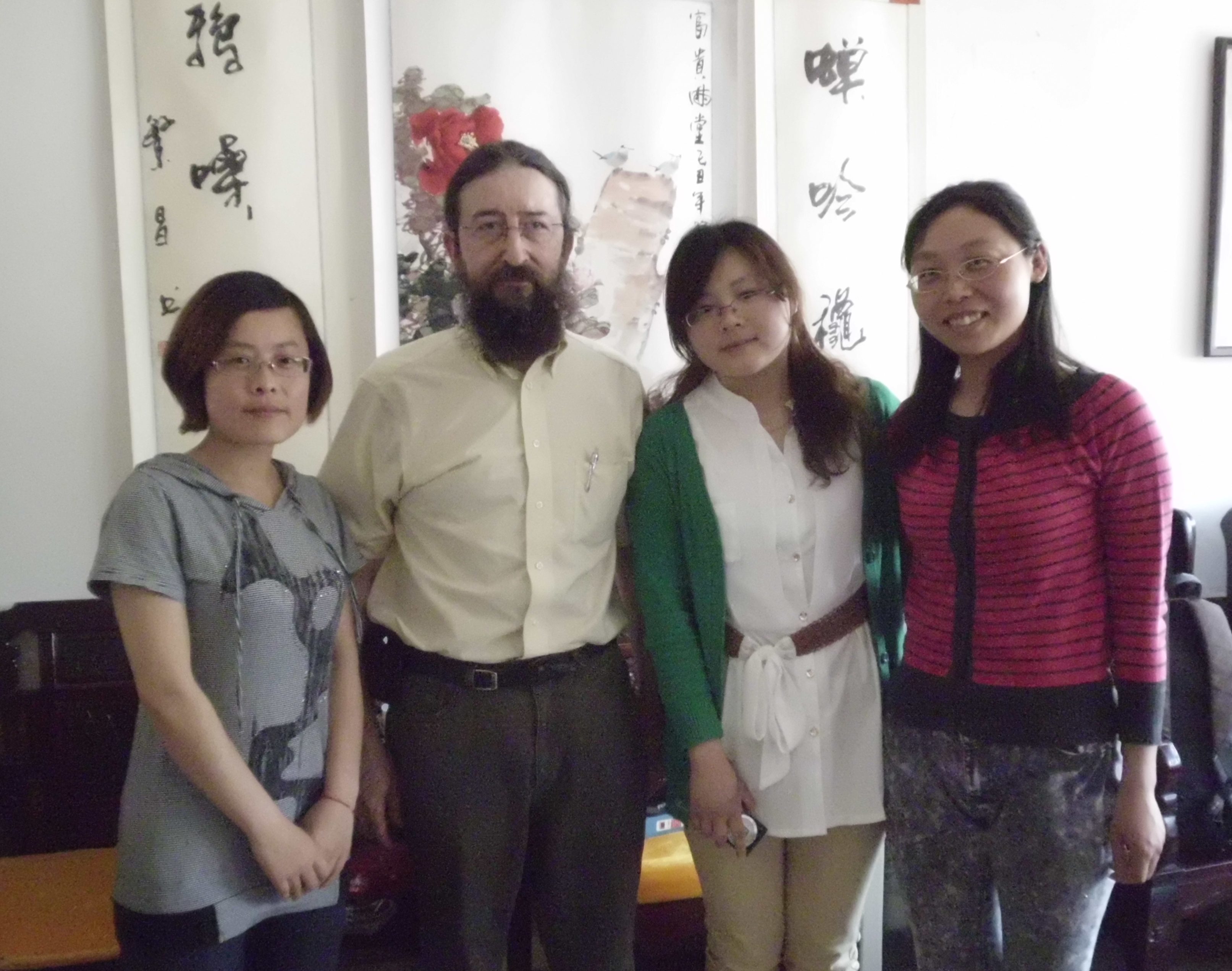
The picture above shows three of my students and me at the home of one of them in Shandong Province during my time teaching at Jining University in Qufu. Almost all of my students were to become English teachers in schools in cities and towns throughout Shandong Province. Because there were so many beyond the need for teachers, some became tour guides, airline attendants, worked in import/export businesses, and many other venues where knowing English is important. Most schools have English teachers for both middle and high school.
As a history student, I often ask myself, “What is the origin of the knowledge and wisdom we gather in our minds as a starting point? Do we allow others to shape our opinions and then adopt them, assuming their views align with our own understanding and the wisdom we rely on to guide us?” Where does the truth truly lie?
How do we define the self-awareness we’ve developed and, more importantly, the knowledge and wisdom we’ve shared over time? How can we determine if what we believe is true is actually false or genuinely valid, with virtue being the deciding factor—or does virtue even play a role?
During my twenty years of living and teaching in Qufu, the birthplace of Confucius, I often reflected on profound questions in a place where many residents claim to be his descendants. As a published author of Chinese history and philosophy, I often discussed Confucius’s historical significance with the residents of Qufu and university professors, many of whom became my colleagues once I started teaching. While traveling through cities, towns and villages in Shandong Province or visiting my college students’ homes, discussions often revolved around Confucius’s influence on their lives today. I would always begin by asking whether the enduring presence of Confucius played a central role in their own personal experiences.
I especially liked to talk to older residents who had lived through the last sixty or seventy years in China and the overwhelming changes that have occurred. The questions of self-awareness and self-knowledge were always the central point of discussion, and how Confucius teachings of benevolence and virtue continue to permeate their lives, something I’ll write about later in this chapter. It always came back to virtue that begins at home, with the teachings of Confucius the central core of what children learned in school from first grade going forward. That our memories play a central role in who we are yet to become.
During my travels in China, I noticed a shift, as it seems that sometimes popular culture had overshadowed the traditional reverence for Confucius. Whenever I had the opportunity, I would ask the same question: how do we define self-knowledge, and what role do our memories play in shaping who we are today? And what role the teachings of virtue and Confucius should play? Almost to a person the response would be that self-knowledge begins with knowing who you are and your history, and when looking beyond what they thought they knew that they would return to what they learned in grade school and Confucius. Over four thousand years of uninterrupted history in China has given them the answer, they are proud of their heritage and embrace their past as though self-awareness is a foregone conclusion.
My travels with Lieh Tzu / Interpolations along the Way
Chapter Four – Confucius
53. On Becoming a Sage
What is this thing about becoming a sage, that Confucius can discard his mind and  use his body? Or this disciple of Lao Tzu, who can look with his ears and listen with his eyes. How can we be sure this can be done and what makes them special?
Asked to clarify his feats, Lao Tzu’s disciple responds by saying that he could look and listen without using his eyes and ears, not exchange the function of each one. How can this be done? He responds that:
“My body is in accord with my mind, my mind with my energies, my energies with my spirit, my spirit with nothing. Whenever the minute thing or the faintest sound affects me, whether it is far away beyond the eight borderlands, or close at hand between my eyebrows and eyelashes, I am bound to know it.
However, I do not know whether I perceived it with the seven holes in my head and my four limbs or know it through my heart and belly and internal organs. It is simply self-knowledge.”
Is not becoming a sage simply remaining as one with all in the universe. Without conflict. With no contention between what could be considered as right and wrong. To hear without hearing. To see without seeing. To be without being. To come without going. To stay without leaving. Finding comfort solely within the details, knowing all that comes forth to be known.

What use is eyes and ears without knowing their true purpose? If one can discard either and still see and hear who needs them? If all is already known, simply waiting to come forth again and again then what difference can they possibly make?
Close your eyes and ears, take a deep breath and everything suddenly becomes clear again. 3/12/95
Number fifty-three of one hundred fifty-eight entries.
Leave a Reply