You must first learn to breathe inside the happiness of your Life
(For my friends in England, Italy, Australia, China, wherever else you may be, and of course USA, who I know will be seeing and sharing this with others… Merry Christmas/Happy Holidays. May you each know the gift of immersion and kung fu).
What is this life-long pursuit of seemingly trying to find happiness? When you reach the age of sixty-five, which I have, then the definition changes as we often ask instead… what do we have to be happy about? And what do our children (if we are fortunate to have any) who follow us, have to be happy about as well?
The cliché has always been… well if we work hard and save our money for retirement then we will have something to retire to. At least that’s what we tell our kids. Why do we have to wait to be happy? Why do we have to work hard? Why do we think making money will be the answer when what we need already resides within us? Why have we spent our whole life doing what we do and not spending our time discovering who we are? Well, we must first learn how to breathe.

That we learn that we each eventually make a conscious attempt to experience the divinity that resides within us, as we find and follow a divine light to a holy place. In Christianity it was the star of Bethlehem and the Christmas story. It is here that we ultimately come into a place of peace. It was from the time of the earliest shaman, who studied nature and the stars that we learned cause and effect, and that we were all connected to everything else. The earliest Chinese called this “the ten thousand things”. That it was in connecting to this, we found our own divinity waiting to be acknowledged, built upon, and lived for ourselves. That this Christ spirit and divine light, whatever it’s name, was to be found within each of us just as holy men and women have been telling us through the ages. That we are all universal and our consciousness, the essence of who we are, comes from the stars and that we each have work to do while we are here.
Kung Fu, Tai Chi, and Meditation
What is the meaning of kung fu… is it simply a form of martial arts… or is it so much more? Simplified for the common man/women it often becomes tai chi.
It begins with complimentary opposites (the concept of yin and yang) that exist in who we are as a person that defines balance. Calming these forces inside ourselves, so that they can be used to our best interest has been the focus of meditation for centuries.

Over time in Chinese history those opposites became referred to as crane and tiger. The most famous of these forms of physical self-defense became the shaolin martial arts form and over time became the kung fu as we know it today. This calming can also be used in finding what is called our “qi energy”, and is the basis of movements in tai chi. Tai Chi Chuan (Taijiquan) is an ancient Chinese “internal” or “soft” martial art often practiced for its health-giving and spiritual benefits; it is non-competitive and generally slow-paced. Both center around discovering and using one’s breath going forward and knowing we are all a part of something bigger than ourselves.
However, the true meaning of kung fu means “supreme skill from hard work”. Everyone has the innate ability to achieve this. The painter, calligrapher, poet, or writer, they can be said to have kung fu. Even the one who cooks or sweeps the steps – can have kung fu. Or even the modern-day insurance or car salesman, athlete, nurse, attorney, musician, etc. For the physical kung fu it takes practice, preparation and repetition until your mind is weary and your bones ache. Until you are too tired to sweat, too wasted to breathe.

This is the only way to obtain kung fu. (This explanation was assisted by the blind Taoist kung fu Master in the mini-series “Marco Polo”). In other words, it takes hard work to excel in the talents we are given. It is in this hard work we find what can be defined as happiness, or find the peace within, as we live in the eternal state of becoming closer to who we really are. Sadly, we often let others define who we are, or should become, instead of discarding those things that don’t define us. No other person can do this for us. What we should be attracted to is being with others who are “complimentary opposites” as we learn to see beyond ourselves. We become “happy” when we can identify and move in this direction. It is as Walt Disney once said… “It’s what you do with what you got”. This becomes the ultimate “work” of our lives, and kung fu… It is truly what we give, we get in return.
Much of Chuang Tzu’s writings used humor and parables contributing to this early Taoist thought of refining our innate talents and using them to enable our highest endeavor and destiny. This is epitomized by his tales of Cook Ting and the butterfly. His concept of the “perfected man”, and combining early Taoism with Buddhist sutras from India was the beginning of Chan Buddhism as he described how we made the “pivot” of living through our work. But that’s a story for another day.
This idea of mastering your innate abilities through a skill that shows, or exhibits, your talents was exemplified by the efforts of those passing the Imperial examination system. And also those who tried, but failed to pass the exam necessary to move up in society, be recognized, and worthy of getting a job in China. One’s family’s future often depended on it.

Very few could pass the exam and were bound to find another way to show their talents and skill. Just as not everyone could develop the physical skill needed to be a kung fu master in the true shaolin tradition either. But could excel in music, as a painter, or calligraphy, or writer like Pu Songling an author from Zibo in Shandong. He could never get past the first tier of the exam, but became a famous writer during the Qing Dynasty. They all could demonstrate their own kung fu. Unfortunately for China, the examination system they viewed as their biggest strength for almost two thousand years, became over time their biggest weakness. As only those who passed the Imperial examinations moved up, while others with suitable talents in other areas were discouraged.
One of the concepts of tai chi is “rooting.” It’s fairly self-explanatory: imagine roots growing out from underneath your feet. You are a part of the ground, never losing balance, focus, or your centering.

Your limbs sway like branches in the wind, never hesitating for fear or apprehension. You become rooted and with this balance you take the text step from body to mind. This balance is the epicenter of coming to terms with self. The art of tai chi is said to improve the flow of chi (qi), the traditional Chinese concept of a physically intangible energy or life force. In scientific studies, tai chi has been proven to improve a host of medical conditions including, but not limited to: muscular pain, headaches, fibromyalgia, cardiovascular problems, arthritis, multiple sclerosis, Parkinson’s, Alzheimer’s, Diabetes and ADHD. Though its low-impact workout is especially helpful to seniors, tai chi is for everyone and is deceptively simple in appearance. I try to do tai chi first thing every day. This along with a meditation practice, help us to focus on what is important in our lives and discard what is not.
The thing to keep in mind about Taoism as we continue to follow Lao Tzu’s Tao Te Ching, is that it is about an attunement with nature and when we don’t, in particular our own. Not just nature outside of us, but also the nature within us. This principle, in Chinese is called Tzu Jan, or Ziran in pinyin, and it is the principle of embodying one’s own nature.” Beyond the health benefits and stress relief, Tai Chi Chuan is also a means to tap into one’s inner self. This becomes the essence of remaining within your own virtue, of meditation, controlling your breath, and knowing happiness when you find it.
As mentioned before, I wrote my own version of Lao Tzu’s Tao Te Ching in May/June 2000 and my book, Thoughts on becoming a Sage, The Guidebook for leading a virtuous Life, was published in China in 2006. There are eighty-one verses in the Tao Te Ching, verses 13, 14 and 15 follows here. Ultimately, it is what the sage has learned and then in turn taught us along the way that guides us. The commentaries below are meant to be read as a discussion between Lao Tzu and those interested who have thought deeply about the text itself. Verse 14 below, goes a long way in revealing my own true identity. The quotes below and references to their authors are from Red Pine’s, Lao Tzu’s Taoteching.
Thoughts on becoming a Sage
Verse 13 – Skirting Disgrace and Disaster
Be careful not to curry favor with others, as disgrace is soon to follow. Favor and honor remain external from the true path of the sage.

He prefers to cater to neither, as both remain outside and away from the path he has chosen to follow. Possessing them can only lead to disgrace and disaster.
Seek only that which lies within yourself cultivating your own innate abilities. Remain within and all will follow. ##
Ho-Shang Kung says, “Those who gain favor or honor should worry about being too high, as if they are on a precipice. They should not flaunt their status or wealth. And those who lose favor and live in disgrace should worry about another disaster.
Huang Yuan-Chi says, “We all possess something good and noble that we don’t have to seek outside ourselves, something that the glory of power or position can’t compare with. People need only start with this and cultivate without letting up. The ancients said, “Two or three years of hardship, ten thousand years of bliss.”
Chuang Tzu (11.2) also speaks to this by saying “when favor and disgrace are used to praise the ruler whose self-cultivation doesn’t leave him time to meddle in the lives of his subjects.
Verse 14 – Staying behind to Impart Immortality’s Wisdom
Coming home to visit with old friends, I am made whole again. Everything there is to see I have seen and everything there is to do I have done. I am home again to rest among old friends.

Revisiting the thread that reveals my true identity, I rejoice in the oneness of the universe. I am at peace as one who has found the grace to see what I must do next in His name. Shedding my worn baggage, my friends are reminded of the light cast by my eternal coat as I sit beside them to honor our being together once again.
While most are happy to remain within the confines of enlightenment, others are a little jealous of my desire to return to the world. Where attachments hold one down and keep their owner from attaining their true identity. Just as you are reminded that your path leads back to a place where you can help others to perhaps come forth to seek their own ultimate destiny. As you leave, you catch glimpses that convey warmth and gratitude and knowledge of the ultimate paradox…
Upon my return I begin by weaving together the fabric of shreds of a vision that has yet to become reality. Knowing that neither my light nor my shadow will leave a lasting impression. While what is left behind for immortality’s wisdom will only be known once I have returned home once again. ##
Lu Tung-Pin says, “We can only see it inside us, hear it inside us, and grasp it inside us. When our essence becomes one, we can see it. When our breath becomes one, we can hear it. When our spirit becomes one, we can grasp it.”

Su Ch’e says, “People see things constantly changing and conclude something is there. They don’t realize everything returns to nothing.” Ch’en Ku-Ying adds, “Nothing does not mean nothing at all but simply no form or substance.”
Wang Pi says, “If we try to claim it doesn’t exist, how do the myriad things come to be? And if we try to claim it exists, why don’t we see it’s form? Hence, we call it the formless form. But although it has neither shape or form, neither sound or echo, there is nothing it cannot penetrate and nowhere it cannot go.
Lu Hui-Ch’ing says, “The past isn’t different from today, because we know what began in the past. And today isn’t different from the past, because we know where today came from. What neither begins or comes from anywhere else we call the thread that has no end. This is the thread of the Tao.
Verse 15 – Staying on Course
Taking stock, you stop to reflect why you are here in this place and time just now.

You have succeeded in getting the attention of many as your reflection has cast a long shadow. You have shown an uncanny ability to uncover the indiscernible and penetrated contradictions previously covered by darkness.
As you become concerned your ego is bringing you to the forefront, while your nature tells you it is better to stay behind.
You are reminded to remain empty and still. That you are not here to make a show of yourself and that you are to leave no tracks. To be so conscience of the correct action that needs to be taken that you simply flow with events. That the essence of the Tao consists of nothing more than taking care, as you know that inner truth cannot be perceived, only the outward form of your actions. That it is by intuitive understanding that the darkness becomes clear and by means of movement the still becomes alive.
That it will be by letting each thought remain detached and each action well considered that your ultimate success is determined with your virtue the only measure taken home. ##
Su Ch’e says, “Darkness is what penetrates everything but cannot itself be perceived. To be careful means to act only after taking precautions. To be cautious means to refrain from acting because of doubt or suspicion. Melting ice reminds us how the myriad things arise from delusion and never stay still. Uncarved wood reminds us to put an end to human fabrication and return to our original nature. A valley reminds us how encompassing emptiness is. And a puddle reminds us that we are no different from anything else.”

Huang Yuan-Chi says, “Lao Tzu expresses reluctance at describing those who succeed in cultivating the Tao because he knows the inner truth cannot be perceived, only the outward form. The essence of the Tao consists in nothing other than taking care. If people took care to let each thought be detached and each action well-considered, where else would they find the Tao? Hence those who mastered the Tao in the past were so careful they waited until a river froze before crossing. They were so cautious, they waited until the wind died down before venturing forth at night. They were orderly and respectful, as if they were guests arriving from a foreign land. They were relaxed and detached, as if material forms didn’t matter. They were as uncomplicated as uncarved wood and as hard to fathom as murky water. They stilled themselves to concentrate their spirit and roused themselves to strengthen their breath. In short, they guarded the center”.
Wang Pi says, “All these similes are meant to describe without actually denoting. By means of intuitive understanding the dark becomes light. By means of tranquility, the murky becomes clear. By means of movement, the still becomes alive. This is the natural Way.”
December 15, 2017
Number 39
You must first learn to breathe inside the happiness of your Life.
(For my friends in England, Italy, Australia, China, wherever else you may be, and of course USA, who I know will be seeing and sharing this with others… Merry Christmas/Happy Holidays. May you each know the gift of immersion and kung fu).
What is this life-long pursuit of seemingly trying to find happiness? When you reach the age of sixty-five, which I have, then the definition changes as we often ask instead… what do we have to be happy about? And what do our children (if we are fortunate to have any) who follow us, have to be happy about as well?
The cliché has always been… well if we work hard and save our money for retirement then we will have something to retire to. At least that’s what we tell our kids. Why do we have to wait to be happy? Why do we have to work hard? Why do we think making money will be the answer when what we need already resides within us? Why have we spent our whole life doing what we do and not spending our time discovering who we are? Well, we must first learn how to breathe.
That we learn that we each eventually make a conscious attempt to experience the divinity that resides within us, as we find and follow a divine light to a holy place. In Christianity it was the star of Bethlehem and the Christmas story. It is here that we ultimately come into a place of peace. It was from the time of the earliest shaman, who studied nature and the stars that we learned cause and effect, and that we were all connected to everything else. The earliest Chinese called this “the ten thousand things”. That it was in connecting to this, we found our own divinity waiting to be acknowledged, built upon, and lived for ourselves. That this Christ spirit and divine light, whatever it’s name, was to be found within each of us just as holy men and women have been telling us through the ages. That we are all universal and our consciousness, the essence of who we are, comes from the stars and that we each have work to do while we are here.
Kung Fu, Tai Chi, and Meditation
What is the meaning of kung fu… is it simply a form of martial arts… or is it so much more? Simplified for the common man/women it often becomes tai chi.
It begins with complimentary opposites (the concept of yin and yang) that exist in who we are as a person that defines balance. Calming these forces inside ourselves, so that they can be used to our best interest has been the focus of meditation for centuries.
Over time in Chinese history those opposites became referred to as crane and tiger. The most famous of these forms of physical self-defense became the shaolin martial arts form and over time became the kung fu as we know it today. This calming can also be used in finding what is called our “qi energy”, and is the basis of movements in tai chi. Tai Chi Chuan (Taijiquan) is an ancient Chinese “internal” or “soft” martial art often practiced for its health-giving and spiritual benefits; it is non-competitive and generally slow-paced. Both center around discovering and using one’s breath going forward and knowing we are all a part of something bigger than ourselves.
However, the true meaning of kung fu means “supreme skill from hard work”. Everyone has the innate ability to achieve this. The painter, calligrapher, poet, or writer, they can be said to have kung fu. Even the one who cooks or sweeps the steps – can have kung fu. Or even the modern-day insurance or car salesman, athlete, nurse, attorney, musician, etc. For the physical kung fu it takes practice, preparation and repetition until your mind is weary and your bones ache. Until you are too tired to sweat, too wasted to breathe.
This is the only way to obtain kung fu. (This explanation was assisted by the blind Taoist kung fu Master in the mini-series “Marco Polo”). In other words, it takes hard work to excel in the talents we are given. It is in this hard work we find what can be defined as happiness, or find the peace within, as we live in the eternal state of becoming closer to who we really are. Sadly, we often let others define who we are, or should become, instead of discarding those things that don’t define us. No other person can do this for us. What we should be attracted to is being with others who are “complimentary opposites” as we learn to see beyond ourselves. We become “happy” when we can identify and move in this direction. It is as Walt Disney once said… “It’s what you do with what you got”. This becomes the ultimate “work” of our lives, and kung fu… It is truly what we give, we get in return.
Much of Chuang Tzu’s writings used humor and parables contributing to this early Taoist thought of refining our innate talents and using them to enable our highest endeavor and destiny. This is epitomized by his tales of Cook Ting and the butterfly. His concept of the “perfected man”, and combining early Taoism with Buddhist sutras from India was the beginning of Chan Buddhism as he described how we made the “pivot” of living through our work. But that’s a story for another day.
This idea of mastering your innate abilities through a skill that shows, or exhibits, your talents was exemplified by the efforts of those passing the Imperial examination system. And also those who tried, but failed to pass the exam necessary to move up in society, be recognized, and worthy of getting a job in China. One’s family’s future often depended on it.
Very few could pass the exam and were bound to find another way to show their talents and skill. Just as not everyone could develop the physical skill needed to be a kung fu master in the true shaolin tradition either. But could excel in music, as a painter, or calligraphy, or writer like Pu Songling an author from Zibo in Shandong. He could never get past the first tier of the exam, but became a famous writer during the Qing Dynasty. They all could demonstrate their own kung fu. Unfortunately for China, the examination system they viewed as their biggest strength for almost two thousand years, became over time their biggest weakness. As only those who passed the Imperial examinations moved up, while others with suitable talents in other areas were discouraged.
One of the concepts of tai chi is “rooting.” It’s fairly self-explanatory: imagine roots growing out from underneath your feet. You are a part of the ground, never losing balance, focus, or your centering.
Your limbs sway like branches in the wind, never hesitating for fear or apprehension. You become rooted and with this balance you take the text step from body to mind. This balance is the epicenter of coming to terms with self. The art of tai chi is said to improve the flow of chi (qi), the traditional Chinese concept of a physically intangible energy or life force. In scientific studies, tai chi has been proven to improve a host of medical conditions including, but not limited to: muscular pain, headaches, fibromyalgia, cardiovascular problems, arthritis, multiple sclerosis, Parkinson’s, Alzheimer’s, Diabetes and ADHD. Though its low-impact workout is especially helpful to seniors, tai chi is for everyone and is deceptively simple in appearance. I try to do tai chi first thing every day. This along with a meditation practice, help us to focus on what is important in our lives and discard what is not.
The thing to keep in mind about Taoism as we continue to follow Lao Tzu’s Tao Te Ching, is that it is about an attunement with nature and when we don’t, in particular our own. Not just nature outside of us, but also the nature within us. This principle, in Chinese is called Tzu Jan, or Ziran in pinyin, and it is the principle of embodying one’s own nature.” Beyond the health benefits and stress relief, Tai Chi Chuan is also a means to tap into one’s inner self. This becomes the essence of remaining within your own virtue, of meditation, controlling your breath, and knowing happiness when you find it.
As mentioned before, I wrote my own version of Lao Tzu’s Tao Te Ching in May/June 2000 and my book, Thoughts on becoming a Sage, The Guidebook for leading a virtuous Life, was published in China in 2006. There are eighty-one verses in the Tao Te Ching, verses 13, 14 and 15 follows here. Ultimately, it is what the sage has learned and then in turn taught us along the way that guides us. The commentaries below are meant to be read as a discussion between Lao Tzu and those interested who have thought deeply about the text itself. Verse 14 below, goes a long way in revealing my own true identity. The quotes below and references to their authors are from Red Pine’s, Lao Tzu’s Taoteching.
Thoughts on becoming a Sage
Verse 13 – Skirting Disgrace and Disaster
Be careful not to curry favor with others, as disgrace is soon to follow. Favor and honor remain external from the true path of the sage.
He prefers to cater to neither, as both remain outside and away from the path he has chosen to follow. Possessing them can only lead to disgrace and disaster.
Seek only that which lies within yourself cultivating your own innate abilities. Remain within and all will follow. ##
Ho-Shang Kung says, “Those who gain favor or honor should worry about being too high, as if they are on a precipice. They should not flaunt their status or wealth. And those who lose favor and live in disgrace should worry about another disaster.
Huang Yuan-Chi says, “We all possess something good and noble that we don’t have to seek outside ourselves, something that the glory of power or position can’t compare with. People need only start with this and cultivate without letting up. The ancients said, “Two or three years of hardship, ten thousand years of bliss.”
Chuang Tzu (11.2) also speaks to this by saying “when favor and disgrace are used to praise the ruler whose self-cultivation doesn’t leave him time to meddle in the lives of his subjects.
Verse 14 – Staying behind to Impart Immortality’s Wisdom
Coming home to visit with old friends, I am made whole again. Everything there is to see I have seen and everything there is to do I have done. I am home again to rest among old friends.
Revisiting the thread that reveals my true identity, I rejoice in the oneness of the universe. I am at peace as one who has found the grace to see what I must do next in His name. Shedding my worn baggage, my friends are reminded of the light cast by my eternal coat as I sit beside them to honor our being together once again.
While most are happy to remain within the confines of enlightenment, others are a little jealous of my desire to return to the world. Where attachments hold one down and keep their owner from attaining their true identity. Just as you are reminded that your path leads back to a place where you can help others to perhaps come forth to seek their own ultimate destiny. As you leave, you catch glimpses that convey warmth and gratitude and knowledge of the ultimate paradox…
Upon my return I begin by weaving together the fabric of shreds of a vision that has yet to become reality. Knowing that neither my light nor my shadow will leave a lasting impression. While what is left behind for immortality’s wisdom will only be known once I have returned home once again. ##
Lu Tung-Pin says, “We can only see it inside us, hear it inside us, and grasp it inside us. When our essence becomes one, we can see it. When our breath becomes one, we can hear it. When our spirit becomes one, we can grasp it.”
Su Ch’e says, “People see things constantly changing and conclude something is there. They don’t realize everything returns to nothing.” Ch’en Ku-Ying adds, “Nothing does not mean nothing at all but simply no form or substance.”
Wang Pi says, “If we try to claim it doesn’t exist, how do the myriad things come to be? And if we try to claim it exists, why don’t we see it’s form? Hence, we call it the formless form. But although it has neither shape or form, neither sound or echo, there is nothing it cannot penetrate and nowhere it cannot go.
Lu Hui-Ch’ing says, “The past isn’t different from today, because we know what began in the past. And today isn’t different from the past, because we know where today came from. What neither begins or comes from anywhere else we call the thread that has no end. This is the thread of the Tao.
Verse 15 – Staying on Course
Taking stock, you stop to reflect why you are here in this place and time just now.
You have succeeded in getting the attention of many as your reflection has cast a long shadow. You have shown an uncanny ability to uncover the indiscernible and penetrated contradictions previously covered by darkness.
As you become concerned your ego is bringing you to the forefront, while your nature tells you it is better to stay behind.
You are reminded to remain empty and still. That you are not here to make a show of yourself and that you are to leave no tracks. To be so conscience of the correct action that needs to be taken that you simply flow with events. That the essence of the Tao consists of nothing more than taking care, as you know that inner truth cannot be perceived, only the outward form of your actions. That it is by intuitive understanding that the darkness becomes clear and by means of movement the still becomes alive.
That it will be by letting each thought remain detached and each action well considered that your ultimate success is determined with your virtue the only measure taken home. ##
Su Ch’e says, “Darkness is what penetrates everything but cannot itself be perceived. To be careful means to act only after taking precautions. To be cautious means to refrain from acting because of doubt or suspicion. Melting ice reminds us how the myriad things arise from delusion and never stay still. Uncarved wood reminds us to put an end to human fabrication and return to our original nature. A valley reminds us how encompassing emptiness is. And a puddle reminds us that we are no different from anything else.”
Huang Yuan-Chi says, “Lao Tzu expresses reluctance at describing those who succeed in cultivating the Tao because he knows the inner truth cannot be perceived, only the outward form. The essence of the Tao consists in nothing other than taking care. If people took care to let each thought be detached and each action well-considered, where else would they find the Tao? Hence those who mastered the Tao in the past were so careful they waited until a river froze before crossing. They were so cautious, they waited until the wind died down before venturing forth at night. They were orderly and respectful, as if they were guests arriving from a foreign land. They were relaxed and detached, as if material forms didn’t matter. They were as uncomplicated as uncarved wood and as hard to fathom as murky water. They stilled themselves to concentrate their spirit and roused themselves to strengthen their breath. In short, they guarded the center”.
Wang Pi says, “All these similes are meant to describe without actually denoting. By means of intuitive understanding the dark becomes light. By means of tranquility, the murky becomes clear. By means of movement, the still becomes alive. This is the natural Way.”
Number 40
December 27, 2017
We should be the Rock others rub their lives against…
The shaman, the teachings of the I Ching, Confucius, Lao Tzu, and many others knew that it’s not so much as who we are, as who we aspire to become.

In doing so we look to the stars just as they did, and as Dorothy asked in the Wizard of Oz… If bluebirds fly, then why, oh why can’t I? That we use our time here as if we too are in a dream, mirroring who we think we are, instead becoming true to ourselves. This was the secret of the Great and powerful OZ… that the secret is already within us. Who are we but the image we create for ourselves and is it real? Our persona becoming the way we project ourselves on social media and with our family and friends. Can or do we consider that perhaps our success or failure is only determined by the number of lives we have touched and rather we helped others find their true way as well? That we in effect, pay forward conveying to others the same virtue we have always known. Interacting with others to remind us that we are here to overcome our own limitations and in doing so become transcendent. Bringing our focus into something we get and in turn give that’s still coming.
The story of Mulan was centered around an ancestor who was frowned upon who had to “earn his keep” so that he (Mushu) could enter the pantheon of respected ancestors. In the end he did. In reality, in China there is a national holiday every May to “honor our ancestors”. It’s like our Memorial Day in USA. In China, to die and become a respected ancestor, is a tribute to a life well-lived and to have been a rock for your family and others to have rubbed against.
We all have someone, either our mother or father, aunt or uncle, or maybe a teacher in high school or college who inspired us to reach for something inside us that appealed to our inner most nature. For myself it was Elaine Clugston, my journalism teacher when I was in the eleventh grade at Carl Junction High School, when I wrote a line in a poem that said “Sorrowful feelings mean nothing, if there is no compassion felt”. It was as if the line woke me up and spoke to me. Maybe a political or spiritual figure like Bobby Kennedy or Martin Luther King, Jr., whose goal was to help us to see beyond ourselves.

That’s what great teachers do. Someone who moves us towards the highest aspirations of ourselves. We’ve all known them. I like to think it is what I left for my more than four hundred students when I taught in China. The question has always been… are we listening to that still small voice within? Are we the rock others rub their lives against? When we too become the teacher? To never settle for less than who we really are. To understand and appreciate our source and that we are here on purpose.
As I go through my own version of Lao Tzu’s Tao Te Ching here that I wrote in May/June 2000 and my book, Thoughts on becoming a Sage, The Guidebook for leading a virtuous Life, I am amazed that now eighteen years later, it is as relevant even more so, as when I wrote it. The difference in time as if waiting to bring meaning to it all. To continue to make feeble attempts to live the Tao as I have written about it. To be given a chance now to humbly understand what it all meant. The ultimate meaning of paying forward. Even more so to consciously attempt to experience the divine and share my gift with others. To help others live inside their own kung fu, and being there, finding the happiness we have always known but perhaps forgotten. Being content in our own contentment and discovering other rocks we have learned to cherish along the way.
There are eighty-one verses in the Tao Te Ching, verses 16, 17 and 18 follows here. Ultimately, it is what the sage has learned and then in turn taught us along the way that guides us. The commentaries below are meant to be read as a discussion between Lao Tzu and those interested who have thought deeply about the text itself. The quotes below and references to their authors are from Red Pine’s, Lao Tzu’s Taoteching.
Thoughts on becoming a Sage
Verse 16 – Previous Encounters
Remaining on course, I return to the place of my youth to reflect on previously self- imposed limits as to who I am ultimately to become, as if a final cleansing of those things that made me full of myself.
Given an opportunity to further release those things that have held me back from identifying and knowing my final destiny. To free myself of endeavors that keeps me full of ego and self-interest.
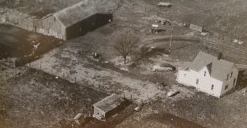 The farm in Lamar
Once recognized, I can let go and let the dragons, or angels, lead the way without intrusion. Declaring my freedom and turning aside all those things that betray my true path as I declare “free at last, free at last, thank God and the Tao I’m free at last”. Finally letting go of all that has gone before me, I can see the way leads to stillness as the knowing sage. As I let go, my true path is unveiled and my enthusiasm, my greatest attribute that opens the door for all others, becomes totally and completely apparent.

In returning to my roots, I have unconsciously re-discovered the stillness I knew at the beginning. Thereby allowing me to become shapeless once again. Knowing that the path now followed and the endeavors now cultivated can now prevail; I am reminded of my travels with Lieh Tzu.
I feel a great swoosh… As if a great gust of wind has picked me up and carried me closer to my ultimate destiny.
(Written in June 2000 during a trip home to Joplin, Missouri where I grew up. I lived there from the seventh grade through two years of college. 1964-1973).
Sung Ch’ang-Hsing say, “Emptiness is the Way of Heaven. Stillness is the way of Earth. There is nothing that is not endowed with these, and everything rises by means of them”.
Huang Yuan-Chi says, “Heaven has its fulcrum, people have their ancestors, plants have their roots. And where are these roots? When things begin but have not yet begun, namely, the Dark Gate. If you want to cultivate the Great Way, but you don’t know where this opening is, your efforts will be in vain.”

Te-Ch’ing says. “To know what truly endures is to know that Heaven and Earth share the same root, that the ten thousand things share one body, and that there is no difference between self and others. Those who cultivate this within themselves become sages, while those who practice this in the world become rulers. Rulers become rulers by following the Way of Heaven. And Heaven becomes Heaven by following the Tao. And the Tao becomes the Tao by lasting forever.”
Ho-Shang Kung says, “To know the unchanging course of the Way is to be free of passion and desire and to be all-embracing. To be all-embracing is to be free of self-interest. To be free of self-interest is to rule the world. To rule the world is to merge your virtue with that of Heaven. And to merge your virtue with that of Heaven is to be one with the Way. If you can do this, you will last as long as Heaven and Earth and live without trouble”.
Li Jung says, “The sage enjoys a life without limits.”
Verse 17 – Governing Wisely
Let your virtue lead the way with others convinced it is their own works that prevail. Lasting success can only occur when those who have looked to you for guidance conclude they have championed their own cause.

What the sage does to cultivate himself is what he does to govern the world. Your greatest virtue is to initiate no action that leave traces of your presence. So that when all goes well people can feel they are responsible.
As long as people think they have achieved greatness by themselves, they have no reason to love, praise or despise anyone.
Simply unveiling the truth and contradictions to virtue will allow others to come forward and for you to remain still. Instilling peace and harmony along the way you can prepare to take them to places they would otherwise forego. ##
Red Pine says, “The Chinese of Lao Tzu’s day believed their greatest age of peace and harmony occurred during the reigns of the Three Sovereigns and Five Emperors, or nearly five-thousand years ago. These early rulers exercised power so unobtrusively, the people hardy knew they were there, as we hear in a song handed down from that distant age: ‘Sunup we rise / sundown we rest / we dig wells to drink / we plough fields to eat / the emperor’s might / what is it to us?’” (Kushihyuan: I).

Mencius says, “When the ruler views his ministers as his hands and feet, they regard him as their heart and soul. When he views them as dirt and weeds, they regard him as an enemy and thief”.
Huang Yuan-Chi says, “What we do to cultivate ourselves is what we do to govern the world. And among the arts we cultivate, the subtler of all is honesty, which is the beginning and end of cultivation. When we embrace the truth, the world enjoys peace. When we turn our backs on the truth, the world suffers. From the time of the Three Sovereigns and Five Emperors, this has never varied.
Verse 18 – When Innocence prevailed and Formlessness endured
As you contemplate returning tomorrow to the place where it all began to attend a gathering of now distant relatives, you recall time spent on the farm.

Returning to the place you originally called home. Returning to the place where you first caught the attention of dragons as a small boy on the farm in Lamar. Back to the beginning, where innocence prevailed and formlessness endured. Before details could enter to cloud your way. You begin to wonder what drew you to the Tao and dragons that were searching for you even then.
You are reminded of the paradox that surrounded you. The beauty and comfort found in nature – found in an old farmhouse at the end of a long circle drive. Everything in nature finding its place. You were affected greatly by opposites that tore at your inner most being. Tearing away the self-identity as a small child that would reveal the formlessness of the sage. A difficult transition revealing inequities living seemingly always bring to the forefront. Living in a home with argument and distrust carrying the day, you were encouraged to find security and serenity deep within yourself.
Soon discovering an innate understanding that when names arise from discontent, we find distinctions like kindness, peace and harmony. Attributes formlessness can now find to spring forth and flourish. As such you have now become the conciliator, the mediator who can see through conflict brought forth by envy, ego, lack and mistrust. To those who are unsure of your identity a mystic, to those few who know, perhaps a prophet telling of things yet to come.
Opposites described above affecting you as if you were a blunt piece of metal being hammered into intricate form by blows coming from all sides.

Learning then to look away from good and bad and recognizing that both were the same. So that one day when the dragons would finally get your attention – to carry you to heights previously thought unattainable you would recognize their presence and acknowledge that they had been guiding you all along. Only waiting for the opportune time to show you the path you were to follow. Reminding you of your true identity and responsibility to the Tao.
Now that I have come full circle and returned, cognizant of the road I have traveled and the one before me that I am still to follow, I am assured and thankful that virtue will lead the way. ##
(Written in June 2000 during a trip back to Joplin and the farm in Lamar where I was a small child. I lived on the farm from 1952 through the third grade, the summer of 1961. We then moved to my grandma’s house for a year then into town (Lamar), and then to Joplin during the summer of 1964).
Su Ch’e says, “When the Great Way (the Tao) flourishes kindness and justice are at work, but people don’t realize it. Only after the Great Way disappears do kindness and justice become visible.”
Wang An-Shih says, “The Way hides in formlessness. Names arise from discontent. When the Way hides in formlessness, there isn’t any difference between great or small. When names arise from discontent, we get distinctions like kindness, justice, reason, and so forth.
Mencius says, “Kindness means dwelling in peace. Justice means taking the right road”.
Kongdan says, “To live as if an enigma. Somewhere between this world and another. Living and dying to be the one others break their own rocks against. And when they’re ready, perhaps show them the Way as well”.
Leave a Reply