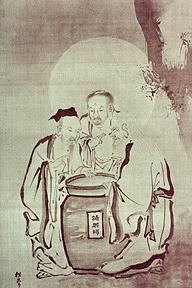
The picture above shows Confucius, Buddha, and Lao Tzu drinking from a vat of vinegar. It is said to have originated in 1000 A.D.
Unity as the diorama becoming whole.
Sit quietly for a moment and let the breath find its natural rhythm. There is no need to guide it or shape it. Breath knows where it wants to go, the way water finds its level without instruction. In this settling, imagine a simple jar like the one above is placed before you — unadorned, unassuming, a vessel holding the flavor of life itself. Nothing symbolic at first glance, nothing demanding interpretation. Just a large jar, waiting like in the picture above.
Around this jar stand four figures. Confucius steps forward first. He tastes the vinegar and his face tightens slightly. Life is sour, he says. It needs cultivation, refinement, the steady hand of ritual and order. His teaching is that harmony is shaped through discipline, through the careful tending of the human heart. Next comes Buddha. He tastes and closes his eyes. Life is bitter, he says. It contains suffering, and the path is compassion. His teaching is that awakening begins with seeing clearly, with acknowledging the ache that runs through all living beings.
Then Lao Tzu approaches. He tastes and smiles. Life is sweet, he says. It is exactly as it is meant to be. His teaching is that the Way is found in naturalness, in the quiet acceptance of things as they are. Nothing to resist, nothing to force, nothing to correct. The sweetness is not in the vinegar but in the one who tastes it.

And then Rumi enters the scene with his whirling dervishes — not from China, not from India, not from Persia, but from the field beyond all borders. Their turning is the movement of unity itself, the heart circling the Beloved. Rumi tastes the vinegar and his eyes soften. ‘This flavor is the Beloved,’ he says. ‘Every taste is a doorway.’” He tastes the vinegar and his eyes soften. This flavor is the Beloved, he says. Every taste is a doorway. His teaching is that the world is not sour, bitter, or sweet — it is one. The taste depends on the heart that receives it. Rumi dissolves the boundaries between the three interpretations. He does not argue with them. He does not correct them. He simply reveals that each taste is a path toward the same Source.
Now breathe again. Let the four tastes rise and fall within you: the desire to correct, the ache of suffering, the ease of acceptance, and the warmth of love. Unity is not choosing one taste over another. Unity is recognizing that all four are present in every moment, and that each taste is a teacher. Unity is the diorama becoming whole — the moment when the scene stops being three separate philosophies and becomes a single field of awareness. Unity is the jar revealing itself as your own life. Unity is the realization that the Way is not one path, but the meeting place of many.
Sit with this. Let the sour, the bitter, the sweet, and the beloved move through you like weather passing over a mountain. Nothing to resist. Nothing to cling to. Nothing to correct. Only tasting. Only awareness. Only the quiet recognition that all paths return to the same Source, and that the Source is tasting you as surely as you are tasting it.
When you are ready, open your eyes. Carry the four tastes with you. Walk gently.
Leave a Reply