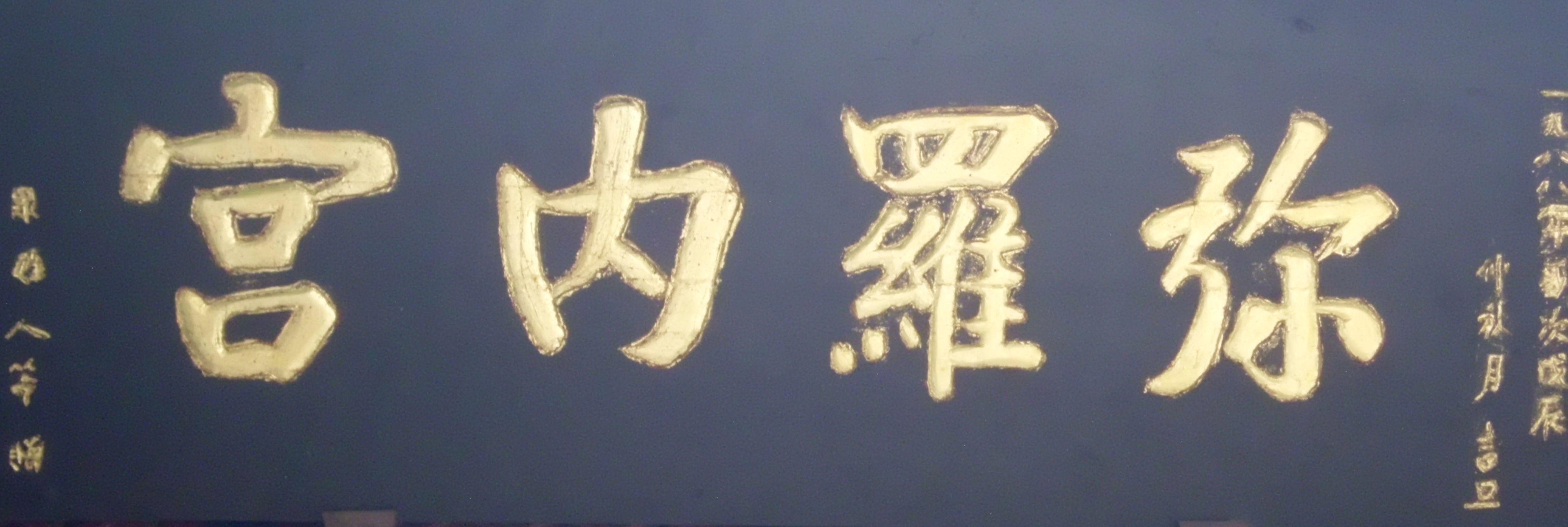
The Connection Between the Chinese Characters and Jung’s “Unknown”

The four Chinese characters on the plaque — 弥羅内宮, Miluo Inner Palace — name a chamber in Daoist (Taoist) cosmology associated with entering the unseen world. To the casual reader, the inscription is unfamiliar, even mysterious. But that unfamiliarity is precisely the point. The “inner palace” is the place where the heart/mind steps beyond ordinary perception and encounters what cannot be explained — the realm of subtle forces, the movement of spirit, the beginning of inner awakening.
Carl Jung described this same moment as the encounter with the numinous, the “wholly other” that operates beyond reason. He believed that such experiences were not psychological curiosities but essential movements of the continuing spirit — moments when the psyche opens itself to the unknown and recognizes a deeper presence within. What Daoism calls entering the inner palace, Jung called opening to the numinous. Both describe the same threshold: the crossing from the known self into the larger field of spirit.
By placing the Miluo Inner Palace plaque here, the reader sees the connection made visible. The unfamiliar Chinese characters become a symbol of the unknown Jung urged us to explore. The plaque marks the doorway into the inner chamber, just as Jung’s numinous marks the doorway into the continuing spirit. What is unknown in language becomes known in experience. What is foreign to the eye becomes familiar to the heart/mind. The spirit continues — and the journey begins within. (The Chinese characters appear on a plaque in the Qingyang Daoist Temple in Chengdu, China.)
Meditation — The Continuing Spirit
Sit quietly for a moment and let the mind soften, not by effort but by release. Allow the breath to settle into its natural rhythm, the way water finds its level without instruction. In this stillness, let a single awareness rise: the spirit continues. Beneath memory and identity, beneath the shifting surface of daily life, there is a movement that does not end. A presence that watches. A current that carries us forward even when we do not know its name.
This is what Carl Jung observed in the depths of the psyche — that the numinous arises from a place beyond reason, yet intimately within us. Taoism has spoken of this for centuries. Lao Tzu called it the Way. Lieh Tzu called it the returning spirit. The sages described it as entering the inner palace, the chamber where the heart/mind becomes whole. In this quiet, let your breath move into that chamber. Feel the widening there, the subtle presence that is not yours alone, yet lives within you.
This is the moment when the inner and outer worlds touch, when the unknown becomes a companion rather than a fear. Jung called it the wholly other. Taoism calls it the spirit returning to its source. Emerson spoke of it as the instant when the self becomes a “transparent eyeball,” dissolving into a larger presence and seeing with the spirit rather than the senses. Whatever name is given, the experience is the same: the awakening that begins within and opens toward something greater than the self. It is the doorway into the inner chamber, the threshold where the continuing spirit steps forward.
When you are ready, open your eyes. The spirit continues. It always has. It always will.
When you are ready, open your eyes. The spirit continues. It always has. It always will.
Leave a Reply