Number 53
May 1. 2018
Moving to a higher frequency away from the Herd
Simply by turning on the light, you can instantly destroy the darkness. Likewise, even a rather simple analysis of ego-clinging and afflictive emotions can make them collapse. —Dilgo Khyentse Rinpoche
What is it that distinguishes us but the consciousness we bring from the past. How is it that something springs forth from nothing, only to over time revert back to nothing again, and again like clouds floating on the wind. As if our DNA has imprinted our divine origins and it’s our job to re-discover and use to our and others advantage.


Could it be awareness of our own existence, sensations, thoughts, surroundings, etc., that stretches beyond the life we life today?
To as the Taoist would say,
“To stand with the divine integrity of all things. With none having dominion, or a more secure place than the next.”
For myself, the biggest challenge is to not “engage” in what seems to be the drama found in living with others present every day. If any trait is self-defining is that I abhor conflict. It seems the central tenet of meditation is that we find our own place setting. As if determining where we are making our contribution from… where is our heart in all this?
A place where only silence, and perhaps music, resides that seems the key to contentment. Taking us to places that move us as the Beatles or Beethoven would say. This has always been the paradox of the sage and why vistas found on mountain tops seem so appealing. But then we are brought back with the realization that there is something we are here to do. As if a tuning fork is guiding our way.


To move away from what may be called the herd mentality.
From that which clouds our inner vision of what defines us. Something we came into this world to grow with, to see, and perhaps to be, but get distracted or lost by attachments. I think at some point, we all look to faith in our higher destiny through consciousness and inner development, versus the paradox living brings each day.


To what is our “soul’s intent”. What seems to matter is connecting things to the past as a living tradition and conscious connection to our origins. Along with not being afraid of change and recognizing that it is the nature of all life to do so. What could be more in keeping with nature’s intent, than natural selection… where the ten thousand things subscribe to the idea of the most adaptable and strongest getting to go forward.
Finding the harmony meant where everything and everyone finds their place. With our consciousness in unison with nature, the universe, and the Tao (God), getting to make the final call. In other words, just as the shaman said thousands of years ago – we get to have a say in our fate and our world through both our decisions and our own conscious connections with the divine.
I guess it’s partly the way of explaining what I do here… attempting to rediscover the true meaning of the teachings of the past, primarily found in ancient China and other traditions. Moving things beyond simply beginnings and endings and a literal translation, to a practical transliteration or interpretation that applies today.


What is the responsibility of the storyteller? And can we do this only for ourselves or serve as inspiration and by example. Our own nothingness to be made into something, only to return to be made into nothing again, and again, and again.
Much of what we learn we accept as an “article of faith”, or just what we allow daily as routine must be acquired and brought back to life or resuscitated by those whose interest is piqued by the past. Just as things happen twice – first as a thought which comes as 

To what we call living true to ourselves, finding harmony and our divine mind. (Built in 223 AD, Wuhou Memorial Temple in Sichuan Province in Chengdu is the Emperor’s tomb integrated with his prime minister’s shrine in one temple. It is seen as the foremost museum of the Three Kingdoms Period. The above photos are believed to pre-date the date of the opening of the museum by several hundred years in antiquity. I have visited the museum several times over the years.)
My Grandmother’s Garden
She comes in peace knowing utmost harmony. Nurturing. Receptive and forgiving, restrained yet uncomplicated. The dragons flying through the sky disappear into the clouds retiring, once strong and assertive now retreating and finding a secure place.


Looking down Mother Earth comes into focus with new growth and new beginnings. Differences occur but a connectedness of all things with the seasons begins. Yang becomes yin.


Strong becomes weak, hard becomes soft, male becomes female in the oneness of Tao.
Leaving the clouds behind and finding the earth beneath my feet, I discover that I am here to find clarity, to focus, to listen and most importantly to learn. To find the ways of my garden. To know the earth as my grandmother taught me. To know beginnings and endings. Simply to know and remember what my grandmother taught me.
My Grandmother’s Garden is an original composition and interpretation of the Chinese Classic the I Ching (2 EARTH / Earth over Earth). 2/5/94. The above is found on the website at The I Ching / Voices of the Dragon.
Who is it that takes on the task of keeping alive the remembrances of the greatness of the spirit? Who tells the history of who we have been that serves to inspire us to continually build on or make something memorable? To add on to what is known in a new or different way? Many times, as I travel around China taking pictures in museums, Buddhist and Taoist temples, holy mountains, something I’ve written about, or simply something of historic interest, etc., I ask myself – am I simply a tour guide doing a travelogue, or framing things from personal experiences and impressions as if on a pilgrimage.


Favoring places off the well-worn or beaten path. Oftentimes differing or distinguishing from the norm as if not following a laid-out plan or itinerary with a fixed aim or a limited purpose.
On a whim where the path leads each day as if given a gift I am here to unwrap with my pictures and writing telling the story. The path carrying its own message, or meaning itself, just waiting to be told.
As if discoveries made on the wayside seem to be more important than what you thought you were looking for. With nothing on your agenda but simply to be present. Once found, it is as if an urge has brought you to a spontaneity that connects the outer environment with your innermost being or core. When the images you experience take on a life of their own as if just waiting for you and their own story to be told. As if there is no coincidence that you yourself are a part of an undying past.


It’s like when I was teaching at the university in Qufu to students who were going to be English tour guides at historic sites throughout China. I would tell them not to just learn or memorize the story by rote, but to know enough about the subject to in effect become the story as if re-living history.
We often see that here in USA in Branson at Silver Dollar City and in Orlando at Disney World. Becoming the person, or character that tells the story in such a way that you become the story as well. As if words and images can take on a life of their own, it’s what the storyteller does. As if you learn and can begin practicing how to internalize and personify yourself. We call it Nei-yeh – Inward Training. The Nei-yeh has been translated into English variously as: Inner Cultivation, Inward Training, Inner Enterprise or Inner Development.


Though less known than the Te Tao Ching and Chuang Tzu, it is increasingly being recognized and honored as a foundational text of early Taoism. It can be found here on my website. I am often reminded in my travels of how the ancient shaman was able to transcend themselves in an effort to bring everyone along for the ride. Back when sitting around the fire gazing at the stars, he or she would mesmerize their audience. Often music would be used as we brought a certain rhythm to the rhyme that would bring a sense to the meaning of life and how everything was connected. Why immersing in a greater truth and creating relationships in and for the whole clan was important. The same songs ring true today. Their purpose to tell a story and serving as a reminder of beginnings, endings, and most important the value of being present and staying in the moment. More than anything the shaman was the teacher and way shower. He serves as a reminder of everyone’s connection to and with the stars. Reminding us that we are one with them in eternity. That we and the stars will forever be connected as our destiny unfolds. Lest we forget.
In learning the true sense of basis of tai chi and meditation today, soon you forget going simply through the motions and live the movements and spontaneity that you become. Many say this is done in silence. But for me music serves as a guide and reminder of steps yet not taken. As if having a personal experience as you live the story itself. I think my dream job would be to teach English to students who were going to by tour guides in Chengdu in Sichuan Province. I have a friend who has a private school that teaches English there and who knows it may find its way onto my bucket list.
The Paradox
Some people go through their entire lives not knowing who they are, where they have been, or where they are going.


You are fortunate. You have a chance to see to know to understand where you are from, why you are here, and where you are going. To know who you are, who you have been, and you will be along the way.
However, you must know that to know is not to know, and to have is not to have. To see is not to be, and who you will be is not to see.
For whatever is useful by the world’s standards cannot be useful in finding the Tao. It is the eternal nature of the Tao and Te (the way of virtue) that is to be found. Reality becomes, is and will be the chance endeavor to find the Tao. 1/15/94
It is as though words have or can create a poetic vision that can take us to places we otherwise would never go. Or as described in The Way of the White Clouds by Lama Anagarika Govinda, as he relays that “what may appear as poetic imagination actually contain a deeper reality than any matter-of-fact description of outer events and situation could ever have conveyed, because these events and facts become meaningful only if seen against the background of inner experience”. In other words, what they mean to us. To what we are innately pulled to.
Thus, the pilgrimage described above, becomes or is actually a mirrored reflection of an inner movement, or awakening, directed towards an as yet unknown distant aim. As if we cross the horizons of both the familiar, as well as, the unknown. With the ultimate aim of finding the harmony that fits it all together as you find a greater life that connects you with the path you now follow.


To what many would say connecting or following our source and what could be defined as our ultimate destiny. The metaphor I use as the dragon floating on clouds in the sky is symbolic of reaching out to greater horizons, to what remains hidden from view. It is when the pilgrim abandons himself to the greater life that springs forth from within, that leads him beyond horizons as yet unseen to an aim which is already present within him.
To what Joseph Campbell in his book The Hero with a Thousand Faces would call the paradox of creation. Our Achilles heel as such, to find our point of limited existence, to shatter and pierce it. Thereby, transcending our limited existence and fully becoming who we are as the universe sees us.
Or as Campbell continues, “It will be always the one, shapeshifting yet marvelous constant story that we find, together with the challengingly persistent suggestion of more remaining to be experienced than will ever be known or told”. The only question remaining will be who is here to tell the story? As if, finding glimpses of ourselves away from the herd it all simply becomes clear.
As I continue to go through my own version of Lao Tzu’s Tao Te Ching that I wrote in 

A partial preview can be seen on the Lao Tzu and Taoism tab here on my website. Ultimately, it is what the sage has learned and then in turn taught others along the way that guides us. The commentaries below are meant to be read as a discussion between Lao Tzu and those interested who have thought deeply about the text itself. The quotes below and references to their authors are from Red Pine’s, Lao Tzu’s Taoteching.
Thoughts on becoming a Sage
Verse 44 – Staying focused within oneself
By knowing what is vital can one hold onto fame or health? If he has to choose would it be his health or riches, and in the end would he know which is more harmful, loss or gain. If something is loved, the more it costs, the bigger the treasure the greater the loss when it is gone.


The sage stays clear of that which lies outside him and focuses on enhancing his inner voice and virtue. Keeping clear of what lies outside his true nature.
Staying in tune with his own natural rhythm. While those who would shame him find nothing to shame. He remains aware of his limits and constantly in tune with the Tao. In keeping in sync with the Tao, all flows through him and finds its proper place.


Knowing when to stop is as important as knowing when to start. Knowing restraint contentment soon follows. Finding happiness and wealth within himself his spirit soars and cannot be exhausted. ##
Huang Mao-Ts’ai says,
“What the world calls fame is something external, and yet people abandon their bodies to fight for it. What the world calls riches are unpredictable, and yet people abandon their bodies to possess them. How can they know what is vital or precious? Even if they succeed, it’s at the cost of their health.”
Lu Hui-Ch’ing says,
“Heroes see fame and merchants seek riches, even at the point of giving up their lives. The one loves fame because he wants to glorify himself. But the more he loves fame, the more he loses what he would really glorify. Hence the cost is high. The other masses wealth because he wants to enrich himself. But the more wealth he amasses, the more he harms what he would truly enrich. Hence the loss is great. Meanwhile the man of virtue knows the most vital thing is within himself. Thus, he seeks no fame and suffers no disgrace. He knows the most precious thing is within himself. Thus, he seeks no riches and encounters no trouble. Hence, he lives long.”


Li His-Chai says,
“If we love something, the more we love it, the more it costs us. If we treasure something, the more we treasure it, the more it exhausts us. A little results in shame. A lot results in ruin. And regret comes too late. A wise person is not like this. He knows he has everything he needs within himself. Hence, he does not seek anything outside himself. Thus, those who would shame him find nothing to shame. He knows his own limits, and his limits are the Tao. Hence, he doesn’t act unless according to the Tao. Thus, those who would trouble him find nothing to trouble. Hence, he survives and, surviving, lives long”.
Verse 45 – Becoming Translucent
By not treating things as they are, but as they can be everything has an opportunity to complete its cycle and return empty. To treat what seems incomplete as great, what seems empty as full, what seems crooked as straight, what seems clumsy as clever is transcendent. To do all while seeming translucent, or still, is in keeping with your highest purpose and in keeping with your place in the ten thousand things.


The sage is content if the greatest thing is incomplete or the fullest thing is empty for the greatest thing never wears out and the fullest thing never runs dry. He understands that the greatest thing cannot be seen in its entirety hence it seems incomplete. That the fullest thing cannot be seen in its totality hence it seems empty. That the straightest thing cannot be seen in its completeness; hence it seems crooked. That the cleverest thing cannot be seen in its perfection, hence it seems clumsy.
It is when opposites complement each other that the highest order is maintained. When order is found and balance maintained we become perfectly still. When we become perfectly still the order of the universe becomes known and all becomes translucent, or clear. ##
Wu Ch’eng says,
“To treat the great as great, the full as full, the straight as straight, and the clever as clever is mundane. To treat what seems incomplete as great, what seems empty as full, what seems crooked as straight, what seems clumsy as clever, this is transcendent. This is the meaning of Lao Tzu’s entire book: opposites complement each other”.


Lu Nung-Shih says, “The greatest thing cannot be seen in its entirety; hence it seems incomplete. The fullest thing cannot be seen in its totality; hence it seems empty. The straightest thing cannot be seen in its completeness; hence it seems crooked. The cleverest thing cannot be seen in its perfection; hence it seems clumsy.”
Han Fei says,
“Ordinary people employ their spirit in activity. But activity means extravagance, and extravagance means wastefulness. The sage employs his spirit in stillness. Stillness means moderation, and moderation means frugality.”
Confucius says,
“Those who govern with virtue are like the North Star, which remains in its place, while the myriad stars revolve around it.”
Number 54
May 13, 2018
Explaining how life is about conjunctions and vibrations, or how it all began to make sense…
My ultimate wish is to return to my hometown to discuss the Analects of Confucius and debate with my dear friends Chuang, Lieh, and Lao Tzu… What a happy life indeed!
Adding to the discussion, Chuang Tzu would remind us,
“He who takes Heaven as his ancestor, virtue as his home, the Tao as his door and escapes change is 

Ah what bliss… to live a life escaping change and to be with old friends once again. To know you can be anyone. That you can do anything. It’s only a matter of going. And that you can always do it again. Thereby becoming the living manifestation of your own destiny.
Rather being in Springfield, Missouri and just writing about Qufu and China here on my blog at thekongdanfoundation.com or living it in Qufu and China. It is the above venue of living to express the virtues found in the past that fills my days. There may always be experiences found daily that fill my spare time, but time spent with my friends from the past is where I am most satisfied. It reminds me of Chuang Tzu’s admonition that we should not fear death, as we are simply returning again to experience what we have always known but may have forgotten.
Rain and Thunder, Stay Inside
Be careful the dragons are not watching. Mother Earth is busy being cleansed by rain and thunder.


Stay inside.
Protect yourself with strong defenses water over thunder means a time of retrenchment. Stay inside. Go slow it is not time to advance. Get sound advice from friends and neighbors. Stay inside.
There are times when the right impression is critical and go betweens are required. Be prepared and wait until the time is right. Stay inside.


Prepare carefully and know when to act. Find clarity and reality in the Tao and know thyself. Keep your vision of the Tao and be protected. Do not rush to judgement. Wait until you know what is not real and what is. Be careful, the dragons are not watching. Stay inside.
An original composition and interpretation of the Chinese Classic the I Ching (3 RETRENCHMENT / Water over Thunder). 2/6/94 The above is found on the website at The I Ching / Voices of the Dragon.
What is it that we fundamentally connect to that our consciousness is attracted to by the vibrations we ultimately follow, if and when we become awakened, and are we all looking for the same thing? It is when we come into alignment with this superior 

They learned that things happen as a direct response to an alternative action. That when acting in unison as complementary opposite’s things can naturally occur by themselves. This was the essence of Taoism. What was universal was the idea that there are not favorites. It was how to connect with this vibration that a name was needed. The Tao and the ten thousand things (everything imaginable) and God (the undefinable) were universal, and that God would be the entity that determines the ultimate outcome.
The ancient Chinese answer to this phenomenon was yin/yang, the I Ching. The I Ching was/has been developed and modified over a period of five thousand years and was a direct connection to the movement of the stars, the sun, moon and 


How did the I Ching begin and how could you measure what it meant as to how things were/are connected, and how do our own internal vibrations interact with it? For thousands of years the shaman had the answers. In about 200 AD the Emperor said every city must have temple and shrine to Confucius. The old shrines honoring the shaman were removed. The new world would continue to be about connections and vibrations, but modified to fit the norm, generally set by Confucius, now in place. Things set in place by time and tradition always set the stage. The power of observation was always the key to understanding events that were to come.
But, how was it all to begin? Looking to what we would call the universe to nature and how everything is connected we learn by observing the stars.


Can our own consciousness be, or remain singular, from our environment? Or do we enable cause and effect though our thoughts that originate in nothing. Can we empower the universe through our thoughts? The shaman knew that it was through our thoughts that begin as nothing, that something appears. But what could be the basis of this observation found in nature that could guide us? Understanding this premise allowed what could have been seen as nothing, but synthesized through the human mind could become something in what we now call consciousness.
Ancient traditions carried from generations over eons of time would serve to tell the story. It begins here:
The Hetu, Luoshu and Nine Palaces
The Hetu “Yellow River Chart” and the Luoshu “Inscription of the River Luo” 

This means they followed the stars, i.e., sun, moon, and planets. They knew something was moving through time. That the same constellations they saw today would re-appear a year later. This movement of the stars became known as the Great Unity of the Nine Palaces and were to be employed by both Taoists and Confucians and serve to explain the correlation of the hexagrams of the (I Ching) 

During the Han period (206 BC-220 AD) commentator Kong Anguo is the first who mention the Shangshu, one of the Five Classics of ancient Chinese literature. It is a collection of rhetorical prose attributed to figures of ancient China and served as the foundation of Chinese political philosophy for over 2,000 years. This, along with the legend of a dragon horse (longma) that emerged from the Yellow River and whose back was patterned with the shape of the eight trigrams. The longma was a fabled winged horse with dragon scales in Chinese mythology. Seeing a longma was an omen of a legendary sage-ruler.


Confucius would later complain that during his lifetime, the horse did not appear again, which was a bad portent of unlucky times. The Inscription of the River Luo is first mentioned in the book Guanzi, where it is said that a dragon turtle (longgui) left the waters of the River Luo, so that an inscription was seen on its back, actually also a pattern of the shell, that could be interpreted as the eight trigrams in a constellation different to that on the Hetu.


Both inscriptions are mentioned in the Xici commentary of the Yijing. The sage rulers read and interpreted the River Chart and the Luo Inscription and modelled their reign according to the evidence provided in the two diagrams. Yet the same text also says that Fu Xi invented the arrangement of the trigrams after observing the starry sky and all things on earth, without referring to the River Chart.


The story of the two diagrams as representative of a golden age is repeated in the Baihu tongyi of the Han period, and the scholar Liu Xin said that the “Inscription of the Luo” was found by Yu the Great when he tamed the floods. He interpreted this inscription and came to the conclusions made in the correlative cosmology described in the chapter Hongfan of the Shangshu. While the Hetu is connected with the eight trigrams, the Luoshu is related to the Five Processes.


Archeological findings from the Yangshao and Dawenkou cultures the Dawenkou were found in Shandong Province along the Yellow River and is an area I am very familiar with today have shown that the patterns to be found in the two charts and in the hexagrams date from the Neolithic age, dating from 10,000 to 3,000 BC – up to the Shang dynasty.
The distribution of the numbers is also identical to that found in the numbers in the chart on the prognostication dish of the Great Unity of the Nine Palaces (taiyi jiugong zhanpan) from the Warring States period (5th century-221 BC) found in Fuyang, Anhui.
As an explanation of the Great Unity of the Nine Palaces, this served as the original connection to the cosmos and universe. It often took on the personality of the shaman and how well he was able to communicate these “universal truths”. This created different resonances in divination, meditation, and medical context in what would later become Taoist traditions.


The Nine Palaces were the groupings of stars that were identified that traversed the heavens. After giving a name to these groupings (the Great Bear, also known as Ursa Major and the Milky Way for example), one could follow the movement of these stars over time and a “Great Unity” (the stars moving in unison) could be established. In turn, these “groupings” became a useful metaphor for other sacred spaces. As referred to above, the Hetu “Yellow River Chart” and the Luoshu “Inscription of the River Luo” are two cosmological diagrams used in ancient China. These were diagrams of the movement of the stars through the Nine Palaces described above.
As I continue to go through my own version of Lao Tzu’s Tao Te Ching that I wrote in May/June 2000 and my book, Thoughts on becoming a Sage, The Guidebook for 

A partial preview can be seen on the Lao Tzu and Taoism tab here on my website. Ultimately, it is what the sage has learned and then in turn taught others along the way that guides us. The commentaries below are meant to be read as a discussion between Lao Tzu and those interested who have thought deeply about the text itself. The quotes below and references to their authors are from Red Pine’s, Lao Tzu’s Taoteching.
Thoughts on becoming a Sage.
Verse 46 – Prevailing Contentment
How can we live within what the Tao teaches us, if we are never content with what 

Cultivating the Tao through meditation, thought, 


Finding that the Tao has come full circle and begun to prevail in the world, the sage can be on his way.
The three above landscapes are from the Chongqing Museum. If I become published in the future, appropriate credits will be given. If only for my enjoyment just acknowledging where all photographs originate is enough.
Wang Pi says,
“When the Tao prevails, contentment reigns. People don’t seek external things but cultivate themselves instead. Courier horses are sent home to manure fields. When people don’t control their desires, when they don’t cultivate themselves but seek external things instead, cavalry horses are bred on the borders.”
Li His-Chai says,
“When the ruler possesses the Tao, soldiers become farmers. When the ruler does not possess the Tao, farmers become soldiers. Someone who understands the Tao turns form into emptiness. Someone who does not understand the Tao turns emptiness into form. To yield to desire means to want. Not to know contentment leads to gasp. To get what you want means to possess. Want gives forth to grasping, and grasping gives forth to possessing, and there is no end to possessing. But once we know that we do not need to grasp anything outside ourselves, we know contentment. And once we know contentment, there is nothing with which we are not content.”
Lu His-Sheng says,
“When the mind sets something desirable and wants it, even though it does not accord with reason, there is no worse crime. When want knows no limit, and brings harm to others, there is no greater wrong. When every desire has to be satisfied, and the mind never stops burning, there is no crueler curse. We all have enough. When we are content with enough, we are content wherever we are.”
Lu Tung-Pin says,
“To know contentment means the Tao prevails. Not to know contentment means the Tao fails. What we know comes from our mind, which Lao Tzu represents as a horse. When we know contentment, our horse stays home. When we don’t know contentment, it guars the border. When the Tao prevails, we put the whip away.”
Hsuan-Tsung says,
“Material contentment is not contentment. Spiritual contentment is true contentment.”
Verse 47 – Becoming endowed by the Way.
When you are ready to come forth with a vision fully endowed by the way, you become the way. When you are ready to accept the mantle conferred by dragons by accepting Heaven as your ancestor, when virtue becomes your home and the Tao your door, only then can you begin to see beyond the limitation’s life brings each day 

“Enthusiasm Garden” or “Zhan Garden” of the first ruler of the Ming Dynasty, Hongwu
When you can remain above change, becoming a sage becomes clear.
When you can understand others by knowing yourself and understand other families by knowing your own, nothing more in the world is needed to be known. The sage does not need to ascend to the sky or descend into the depths to understand the way of heaven and earth.


Ho-Shang Kung says,
“The sage understands others by understanding himself. He understands other families by understanding his own family. Thus, he understands to whole world. Man, and Heaven are linked to each other. If the ruler is content, the breath of Heaven will be calm. If the ruler is greedy, Heaven’s breath will be unstable. The sage does not have to ascend into the sky or descend into the depths to understand Heaven and Earth.”
Wang Pi says,
“Events have a beginning. Things have a leader. Though roads diverge, they lead back together. Though thoughts multiply they all share one thing. The Way has one constant. Reason has one principle. Holding onto the ancient Way, we are able to master the present. Though we live today we can understand the distant past. We can understand without going outside. In we don’t understand, going further only leads us further away.”
Su Ch’e says,
“The reason the sages of the past understood everything without going anywhere was simply because they kept their natures whole. People let themselves be misled by things and allow their natures to be split into ears and eyes, body and mind. Their vision becomes limited to sights, and their hearing becomes limited to sounds.”
Li Hsi-Chai says, “Those who look for Heaven and Earth outside look for forms. But Heaven and Earth cannot be fathomed through form, only through reason. Once we realize reason is right here, it doesn’t matter if we close our door. For the sage, knowledge is not limited to form. Hence, he doesn’t have to go anywhere. Name is not limited to matter. Hence, he doesn’t have to look anywhere. Success is not limited to action. Hence, he doesn’t have to do anything.”
Number 55
May 24. 2018
What we choose to believe can become the birth or death of reason… I wonder.
Sailing with the wind with others in tow and alongside is difficult at best when their staying open to change falls by the wayside. Where does one begin and end with sincere values and virtue aimed at social justice for all? What example do we set, and where in our past do we look for answers that tell the way? It is as Bobby Kennedy once said “I don’t think any of us can be satisfied with suffering of our friends, our families, and our neighbors.”


With shouts of “we want justice” resonating today reminding us of times in our past when similar echoes told stories of inequality. He added “When each man strikes out against racial injustice, he sends out a tiny ripple of hope.” It’s a matter of connecting with different people and seeing all men and women as equal under the laws of a just society. This is what Bobby did. It was giving people hope that things could be changed for the better.


Sometimes I wonder why people are so afraid of equality and fear of giving others the opportunity to live a free and better life. I wonder. Just where can our beliefs fail us?
It is as the line “fools rush in where angels fear to tread” that was first written by Alexander Pope in his 1711 poem An Essay on Criticism.
The phrase alludes to inexperienced or rash people attempting things that more experienced people avoid. It has since entered the general English lexicon as an idiom. Alexander Pope was an 18th-century English poet. He is best known for his satirical verse, his translation of Homer and for his use of the heroic couplet. He is the second-most frequently quoted writer in The Oxford Dictionary of Quotations after Shakespeare.
Just as the saying… “he who gets there first doesn’t necessarily win”. History knows better and is never told less than fifty years after events have occurred. With eventual outcomes not in keeping with our own choosing, except as we ourselves have written in the stars…
This was always the dilemma of the ancient shaman. How can you teach someone else to become transcendent and universal? How does someone get to that vision seen at the mountaintop and know what it means and more importantly, that it is something they too should follow and to perhaps tell to others as well?


Or that seen in the American Indian ritual of the vision quest, as a required rite of passage. Seeing beyond who you think you are, to have a sense or come to know why you’re here and how you fit into the scheme of things in the present. And more important, what you should do about it.
That still small voice coming from within that transcends any human frailty that Bobby Kennedy, and so many others, have emulated and not only said… yes. But please come join us. Something I like to call “the plea of dragons”.
Perhaps this is in keeping with my own final call in becoming the storyteller. To make decisions without concern with who may benefit, or what may have been right or wrong, or to choose certain outcomes, as you live every moment within the Tao. Thusly, having no decisions left to make.


To see and know events that foretell the future, as you have seen and done it all before. As if simply on call to be ready when there is a story worthy of being told. Just as clouds over the distant horizon tell of the coming rain. Not quite sure though of nature’s intent, and where the rain will fall. As we sow the 

Or to as the Mongols, and Genghis Khan would say simply “to live under the laws of the blue sky.”
To be truly transparent seeing through to the source of all. Knowing that when floods come everyone must find higher ground. And why the teaching of filial piety and benevolence taught by Confucius became the essence of Chinese culture and society. It begins with respect of ourselves, our family, our community, and of nations. Just as nature knows no boundaries or borders in emulating the Tao neither can we.
There’s a great story about a singer/songwriter named Sixto Rodriguez from Detroit, who was never that popular in USA whose music was from the 1960’s. A tape of his music made its way to South Africa where a radio station played it and he became an overnight sensation while Nelson Mandela was still in prison and apartheid was still in full effect. His music resonated there, while he stayed in relative obscurity here in USA.


One of his songs was entitled… I Wonder, and a line that goes I wonder when this hatred ever ends. I wonder. Another song… You can’t get away from it. Then another song… I’ll Slip Away. Mending all my shattered dreams and not choosing to be like them. A movie was made about Rodriquez that I saw on a movie channel while I was teaching in China.
He went to South Africa and played before three sold out concerts. I love his albums and play them often. Amazing story and great music. It reminds us that we never know where our accolades may come from, or thoughts of others that might serve to try to diminish us. One of the first things I wrote seen below carried the theme that there can be no rush. I’ve often wondered what I meant by this…
Or in the words of John Lennon, Instant 

For Lennon, the idea of “not choosing to be like them”, resonated and living within his own skin was paramount. Just as with any artist or writer of any age. Just who can be the non-conformist in our midst and their ultimate purpose. I wonder.
There can be no Rush.
Trying to see dragons while looking over mountains and water into the sun can cause temporary blindness. You must see beyond ignorance. Beware of those who are not trustworthy. Pay attention they can lead you astray.
There can be no rush to judgment. Only the path to learning leaving childhood innocence behind.


Find a mentor and come to know peace and harmony. Learn to listen to your inner voice and know the Tao. All that there is to know is already here. In front, beside and behind. Beneath you instilled in the earth and above you in the sky.
There can be no rush to knowledge. Only preparation to see and know what is important when it arrives and letting your inner virtue define you.


Find and nurture patience and you can begin to look over mountains and over the sea. There can be no rush to find the symmetry to be found in the Tao. With vision you will become immortal and come to know dragons flying in the sky.
An original composition and interpretation of the Chinese Classic the I Ching (4 BLINDNESS / Mountains over Water). 2/6/94 The above is found on this website at The I Ching / Voices of the Dragon.
Becoming a thread that serves the Master Weaver
(Note: This is continuation of the thread I began with my last postdated May 13, 2018). Because of their enigmatic character, both charts were used by the apocryphal, or questioned, interpretation of the Confucian Classics that flourished during the Han period.


The imperial bibliography Suishu jingji zhi of the official dynastic history says that there were nine chapters of text about the Hetu and 6 chapters about the Luoshu. It lists a book Hetu with a length of 20 (including the Luoshu 24) Juan, written during the Liang period (502-557) and already lost during the early Tang period (618-907), as well as the books Hetu wei and Luoshu wei with a total length of together 45 chapters.


Other books parts of which have survived until today are the Hetu longwen, Hetu kuodi xiang, Hetu xiyao gou, Hetu kaoling yao or Luoshu lingzhun ting. Today, fragments of 120 Hetu books are preserved, and those of about 20 writings to the Luoshu.
Although the compilers of the Suishu purported that these books were compiled during the ages of the mythical rulers of the past, it is certain that they date from the Han period or somewhat later.
Tang period scholars were not very interested in the two charts, and they only gained prominence again during the Song period (960-1279). The Taoist scholar Chen Tuan is said to have received a dragon chart (longtu) from the Taoist Master Mayi and transmitted it to his own followers.
Another branch of disciples were Mu Xiu, Li Zhicai and the mathematician Shao Yong who was one of the early Song Neo-Confucians. The great Southern Song Period Neo-Confucian Zhu Xi took over Shao Yong’s transmitted shape of the two charts and used them for his interpretation of the I Ching (Yijing), known as the Zhouyi benyi.
Interestingly enough, Liu Mu’s two charts just had the opposite configuration of the trigrams as that of Shao Yong, so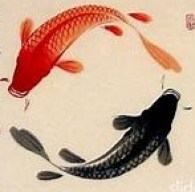

The Hetu 河圖 “Yellow River Chart” and the Luoshu 洛書 (also written 雒書) “Inscription of the River Luo” were two cosmological diagrams used in ancient China. They were employed by both Taoists and Confucians and served to explain the correlation of the hexagrams of the Yijing “Book of Changes” with the universe and human life. They are also used in geomancy (fengshui 風水).
The two diagrams are first mentioned in the chapter Guming 顧命 of the Confucian Classic Shangshu 尚書 “Book of Documents”, where it is said that the three precious jades and the hetu were stored in the Eastern Chamber. It can thus be assumed that the Hetu was a kind of jade stone, the texture of which was interpreted as the eight trigrams (bagua 八卦) of the Yijing.
The Han period 漢 (206 BCE-220 CE) scholar Kong Anguo 孔安國, author of a commentary on the Shangshu, was the first 
This depiction is located at the Confucius Temple in Qufu.
Its back was said to be patterned with the shape of the eight trigrams. The diagram on the back of the horse was the so-called “River Chart” that was fixed by the mythological emperorFu Xi 伏羲 and was preserved in the shape of the eight trigrams.
As an auspicious omen, the horse is reported to have regularly appeared during the reigns of the virtuous ruler Yao 堯, Shun 舜, and Yu 大禹. Confucius 孔子 lamented that during his lifetime, the miraculous horse (often translated as “unicorn”) did not appear again, which was a bad portent of unlucky times.
The “Inscription of the River Luo” is first mentioned in the book Guanzi 管子, where it is said that a dragon turtle (longgui 龍龜) left the waters of the River Luo, so that an inscription was seen on its back, actually also a pattern of the shell that could be interpreted as the eight trigrams in a constellation different to that on the Hetu. Similarly, to the dragon horse, the turtle appeared during lucky times when virtuous rulers reigned the empire and ceased to be seen when bad and selfish men governed the world.
Both inscriptions are mentioned in the Xici 繫辭 commentary of the Yijing. The sage rulers read and interpreted the “River Chart” and the “Luo Inscription” and modelled their reign according to the evidence provided in the two diagrams. Yet the same text also says that Fu Xi invented the arrangement of the trigrams after observing the starry sky and all things on earth, but it does not refer to the “River Chart”.
The story of the two diagrams as omina of a golden age is repeated in the book Baihu tongyi 白虎通義 of the Han period, and the scholar Liu Xin 劉歆 (d. 23 CE) said that the “Inscription of the Luo” was found by Yu the Great when he tamed the floods. He interpreted this inscription and came to conclusions about correlations between various elements in the universe. These are described in the chapter Hongfan 洪範 of the Shangshu. While the Hetu is connected with the eight trigrams, the Luoshu is in this narrative related to the Five Agents 五行.
The two fields are shaped in curves and creeping into each other to express the permanent fluctuation between Yin and Yang during the seasons. It is the much more famous of the trigram charts and is widely used in Taoist circles, where it became the symbol of Taoism. Zhu Xi’s version of the two charts can be seen in the illustrations above.
Numerological speculation was very common among the Neo-Confucians. Zhu Zhen’s book Zhouyi guatu says that the white circles in the Hetu chart sum up to an odd number (25), the black circles to an even number (20), with a total sum of 45.


The white circles in the Luoshu chart are 25, black circles 30, with a total sum of 55. While the Hetu symbolized the theory and substance (ti) behind all things, the congenital and innate (xiantian) nature of things, the Luoshu symbolized that practical aspect (yang) and the state of things how they are and live (houtian).
The main number of the Hetu is 10; 1 and 6 express the ancestral (zong, Celestial) nature, 2 and 7 the Way (tao), 3 and 8 friendships (peng), 4 and 9 mutual support (you), and 5 and 10 protection and safety (shou). The main number of the Luoshu in 9; head is 9, feet is 1, left is 3, right is 7, 2 and 4 are the shoulders, 6 and 8 the legs, and 5 is the number of the physical center. 

During the Qing period (1644-1911) Confucians like Huang Zongxi or Hu Wei contradicted the cosmological interpretation of the Neo-Confucians. In his inscription Wan Gongze muzhi ming, Huang Zongxi assumed that the Hetu and Luoshu were very crude geographical maps of ancient times.


Yet it is more probable that the charts served as a theoretical illustration of the universe for the purpose of prognostication, or to symbolize the elements of which the cosmos or the body were believed to consist. Why all of the above is important, is because it establishes the benchmark for how we got to the here and now. Using the system and numbers above correlate directly with a person’s place in the universe at any given moment. “Reading a person’s chart” meant understanding from where one came, ie, his beginnings, could have a direct correlation with where their journey would finish…. hence the I Ching was born. In practical terms, it means you can find the Tao through the pragmatism followed in understanding you life’s role. In popular culture we describe this as horoscopes, but in reality it is the measurement of where we are in our ultimate journey as we become in tune with the Tao.
As I continue to go through my own version of Lao Tzu’s Tao Te Ching that I wrote in May/June 2000 and my book, Thoughts on becoming a Sage, The Guidebook for 

A partial preview can be seen on the Lao Tzu and Taoism tab here on my website. Ultimately, it is what the sage has learned and then in turn taught others along the way that guides us.
The commentaries below are meant to be read as a discussion between Lao Tzu and those interested who have thought deeply about the text itself. The quotes below and references to their authors are from Red Pine’s, Lao Tzu’s Taoteching.
Thoughts on becoming a Sage
Verse 48 – Becoming the Master Weaver
In weaving the fabric of your surroundings together, seek only the Tao without the use of ears or eyes. It will only be by looking within yourself and following your inner nature that the answer (which incidentally you have always known), comes forth to greet you.


Be guided by the answer given by the sage when he is asked “do you think I learn in order to increase my knowledge”. The sage simply replies “no, I seek only that which brings everything together”.
As you liken yourself as the master weaver, you find yourself remaining as a clean slate with neither right nor wrong guiding your actions.


As you have become the natural extension of the universe – all things become possible. Opportunities otherwise overlooked or unknown come forth that have been waiting on cue to make their appearance. External knowledge becomes less important as the sage weaves all the pieces presented him into what becomes the natural extension of his own spirit.
Cultivating his body and spirit in the proper way the sage appears to have nothing to do. Having nothing to do leads to nothing not getting done. Having nothing better to do, the world simply finds itself coming along for the ride.
Confucius asked Tzu Kung, “Do you think I learn in order to increase my knowledge?” Tzu Kung answered, “Well, don’t you?” Confucius said, “No I only seek things that bring everything together.” (Lunyu 15.2)
Sung Ch’ang says,
“Those who seek the Tao don’t use their ears or eyes. They look within not without. They obey their natures, not their desires. They don’t value knowledge. They consider gaining as losing and losing as gaining.”
Wang Pi says,
“Those who seek learning seek to improve their ability or to increase their mastery, while those who seek the Tao seek to return to emptiness and nothingness. When something is done, something is left out. When nothing is done, nothing is not done.”
Te-Ch’ing says,
“He who seeks the Tao begins by using wisdom to eliminate desires. Thus, he loses. Once his desires are gone he eliminates wisdom. Thus, he loses again. And he goes on like this until the mind and the world are both forgotten, until selfish desires are completely eliminated, and he reaches the state of doing nothing. And while he does nothing, the people transform themselves. Thus, by doing nothing, the sage can do great thing things. Hence those who would rule the world should know the value of not being busy.”
Verse 49 – Remaining True to Form
Retreat into the emptiness brought forth by the ten thousand things as if you have no mind of your own.


Taking on the mind of all those around you and treating them as the same you become immersed in nothing.
Mindless, you convey the hopes, dreams and fears of all around you and embrace neither side of any argument.
To the good the sage is good and to the bad as well. He supports the bad like he is good until they see the bad for what it has brought them and become good. He illuminates like the sun and transforms the spirit. To what is true he is true and to what is false he is true until they too become true to the Tao.
It is by seeing the real in the false and the false in the real the sage’s wisdom is different from others. By remaining empty, the sage’s mind can merge with the mind of others. Because his mind is still, he can respond accordingly. While he may appear withdrawn from the world, he moves all in the direction they should take.
Always humble, he remains transparent while letting others seemingly find their own way. xx
Su Ch’e says, “Emptiness has no form. It takes on the form of the ten thousand things.


If emptiness had its own form it could not form anything else. Thus, the sage has no mind of his own. He takes on the minds of the people and treats everyone the same.”
Yen Tsun says,
“A mindless mind is the chief of all minds. The sage, therefore, has no mind of his own but embraces the mind of the people. Free of love and hate, he is not the enemy of evil or the friend of good. He is not the protector of truth or the attacker of falsehood. He supports like the earth and covers the sky. He illuminates like the sun and transforms like the spirit.”
Confucius says,
“In his dealings with the world, the great man is neither for or against anyone. He follows whatever is right.” (Lunyu: 4-10)
Hsuan-Tsung says,
”The sage covers up the tracks of his mind by blending in with others.”
Ch’eng Hsuan-Ying says, “Stop the eyes and the ears, and the other senses follow.”