Number 82
Oct 14 – 17, 2018 / Tibet and Tibetan Buddhism
The feeling I get in Chengdu is the same as what others have found elsewhere. I don’t want anyone reading this to feel they have to drop everything and rush off to China 

It’s where all paths are universally respected and equal. For me it’s living in convergence with all others in common practice. It’s where spiritually directed people can see themselves and others in the same way. Finding the place that speaks to the sanctuary from within and going there. Dropping the pretense that your way is the only way to God.
I have been blessed here in Lhasa by a guide. Not just someone who takes our group through two days of monasteries and temples (a talent for which he has few peers), but Tashi Delek, has agreed to augment my limited knowledge with his wisdom. After the tour was over and I returned to USA, Tashi agreed to review his notes and over the next few weeks we will amend. So on to Tibet… and Tibetan Buddhism. Nothing here is meant to have or relay any political overtones. It is simply to relay it’s importance to history and provide an overview… my own.
We will break it down into five sections below. First, a very brief overview of what you find when you arrive and history of Lhasa. And second, the highlights of the 

This will have an on-going “growth and change”, as additional information is added. For myself, it continues with the thought of developing mindfulness, that what and when I write it is from both my head and heart – that are listening to my soul’s eternal journey and my own steps into eternity. My heart tells me to be true to my own intrinsic essence towards Taoism, my head tells me that the Way will be made clearer with my serving, or being a conduit for others transformation, not simply my own. Wisdom becomes universal when it is shared by all.
Lhasa Overview
So, I’m up at 4:20 AM Sunday morning for an hour taxi ride and two-hour check-in for 8 AM flight from Chengdu to Lhasa. I left my notebook in carry-on so all my ideas 

Scene from a shop in Old Town
Anyway, I arrived in Lhasa two hours later and make it to the Lhasa Gang -Gyan Hotel on Beijing Road, where I will be for three nights (Sun/Mon/Tues), then leave Wednesday morning for Beijing and Missouri. Sunday after checking in was a free day and I did some shopping for Marie and Katie. The tour begins tomorrow. Lhasa has a unique history unlike almost any other city. It’s been at the crossroads of human travel and has served as the spiritual mecca for what was to be known as Tibetan Buddhism for thousands of years. Most of its late history was shaped by the influence of the Mongols and connection with Mongolia. The Mongols recognized Buddhism early and how the Dali Lama’s influence shaped the entire region.
Coming here is one the most humbling experiences I have ever encountered. The breadth of commitment over the centuries to mindfulness, self-awareness, and what are considered to be universal truths, (in Buddhism routinely called the four noble 

Tibetan Buddhism here in Lhasa, is all encompassing. It contains and is the fabric of all who have come before and permeates the local culture in the most positive way imaginable. It’s not something you do… it defines who you are. You can see this in the locals who take what can be called “ritual walks” around the city that is kind of ingrained in Tibetan culture, and without it and early morning rituals by pilgrimages to Jokhang Temple among others, the Tibetan flavor would be lost.
Another example is the yearly painting of the exterior of the Potala Palace that was to occur a few weeks here after our visit. Everyone either volunteers to help to paint or provides food and money to help with the community effort.
You can’t get much closer to God physically, than here high in the Himalayas. Lhasa has an elevation of about 3,600 m (11,800 ft) and lies in the center of the Tibetan Plateau with the surrounding mountains rising to 5,500 m (18,000 ft).
The only thing I felt in the change in elevation was a severe headache the second morning after arriving. I think it was the lack of oxygen to my brain. After a couple cups of coffee and walking around outside I was fine. I was also helped by my having gone up and down Songshan and Huashan mountains in China in the weeks prior to coming to 

One of the best explanations of the spinning wheel you see 

By spinning the wheel, bits and pieces of the sutras (sutras are comparable to Bible verses) are released to you… the person doing the spinning. As you focus on your highest endeavor and possible destiny, you hope to be noticed by your devout sincerity and compassion towards others on your own journey.
The four monasteries and temples below give a representative overview as to what that means to history and what Tibet has become today. There is ample additional information on all four on the internet. I asked Tashi to give me some specific details that may not be all that is considered “common knowledge”.
Drepung Monastery
The tour began Monday morning at Drepung Monastery. Drepung is the largest of all Tibetan monasteries and is located on the Gambo Utse mountain, not far from the 

It was the home of the Dalai Lamas before the Potala Palace was built in the 17th century.
There were ten people in our group, plus our tour guide, Tashi. The plan is to visit two monastery/temples today (Drepung and Sera) and then two more tomorrow, the Potala Palace and Jokhang Temple. The rest of the group is going to a base camp hours away from Lhasa and will be here seven to ten days. My tour is for four days and I leave the group Wednesday morning and head for Beijing and home.
Drepung Monastery, also called Tashi-Megyur-Chahju-Ling, is one of the largest monasteries of the Gelupa Sect. It was built in 1416. It had more than 10,000 monks in the 1940’s… I think the mindset you should have is the pictures tell the story of what you see, the narrative from Tashi will be from the inside out. Pictures from Lhasa are below:




Sera Monastery
After lunch at a local restaurant (yak dumplings and yak butter tea) we went to Sera 


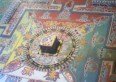
The second was the Circle of Life, or Wheel of Life, depicted here that describes Tibetan Buddhist philosophy. Tashi would add…
The Wheel of Life can be interpreted on several levels. The six major sections represent the Six Realms. These realms can be understood as forms of existence, or states of mind, into which beings are born according to their karma. The realms also can be viewed as situations in life or even personality types—hungry ghosts are addicts; devas are privileged; hell beings have anger issues.
In each of the realms the Bodhisattva Avalokiteshvara appears to show the way to liberation from the Wheel. (A Bodhisattva is a person who has attained prajna, or enlightenment, but who has postponed Nirvana in order to help others attain enlightenment). But liberation is possible only in the human realm. From there, those who realize enlightenment find their way out of the Wheel to Nirvana.
The Wheel of Life is one of the most common subjects of Buddhist art. Mandalas are 

The detailed symbolism of the Wheel can be interpreted on many levels. The Wheel of Life (called the Bhavachakra in Sanskrit) represents the cycle of birth and rebirth and existence in samsara. In Buddhism, samsara is the process of coming into existence as a differentiated, mortal creature. Whereas, in Hinduism, it is considered the endless series of births, deaths, and rebirths to which all beings are subject.
Tashi explained the different parts of the Wheel and what they mean. The main sections are the hub and the six “pie wedges” depicting the Six Realms. Many Buddhists understand the Wheel in an allegorical, not literal, way. As you examine the parts of the wheel you might find yourself relating to some of it personally or recognizing people you know as Jealous Gods or Hell Beings or Hungry Ghosts.
The outer circle of the Wheel is the Paticca Samuppada. (Sanskrit, meaning the 

The above explanation helps to understand in a brief way, the underlying concepts of the history of 

O




On Tuesday we first went to Potala Palace, then after lunch we went to Jokhang Temple. Pictures were limited to outside both locations.
Potala Palace
The Potala Palace (presently a museum as well as a World Heritage Site), situated

Going through the museum is a

The palace, founded in the 7th-century, is an iconic structure that represents the role of Tibetan Buddhism in the administration of Tibet. It had been named after the Mt. Potalaka, which is believed to be the dwelling of the bodhisattva Avalokitesvara. The Heritage Site also comprises the Jokhang Temple, that I will be this afternoon.
The historic structure has been constructed over a palace that was erected on the 


After seeing Potala Palace, we had lunch in Old Town, then continued to the Jokhang Temple.
Jokhang Temple
Jokhang Temple is considered to be the spiritual heart and holiest Buddhist site in Tibet. We visited on a Tuesday afternoon on my last full day before leaving the next morning for Beijing and home.
Situated in the heart of the Old Town and 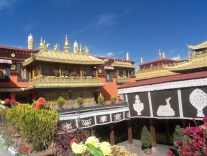


Most Tibetans go to Buddhist Temples in the morning hours, as tourists fill the sites in the afternoon. Another thing of interest is that the number of people going through the Potala Palace must be limited each day.
The thousands of people streaming through the ancient corridors have caused them to be concerned about the structure’s ability to carry so much weight. Tickets to enter are measured and limited by the hour. Our time was scheduled for 12:45 (about noon) and our guide (Tashi) had to make sure we entered and left at the right time. One reason pictures are not allowed inside the monasteries and temples is that some people attempt to use photos to make copies of what they see inside and then try to sell. They frown on this.
Another interesting note was watching the local people walking around the city, the ring roads, and the prayer path around the bottom of the Potala Palace. There you will find Tibetans from all walks of life, Lhasa folk and pilgrims, doing what many of them do every day or as often as they can, circling the Potala, praying for the long life and good health and return of His Holiness the Dalai Lama, and for all sentient beings. If I had more time, walking around the city on the paths taken for centuries by the local citizens would have been a must, just to get a better feel for Lhasa and it’s history.
Notes on the aspects of the “Ritual Walks” in Lhasa
At the Jokhang Temple and around Lhasa, all Tibetans take the statue of Sakyamuni as the core for the ritual walks, and any believer walking around Jokhang Temple clockwise can be viewed as following the center track. Tradition says you take the ritual walks in and around the Jokhang Temple three times. First, they walk the inner ring around the statue of Sakyamuni, founder of Buddhism, in the Jokhang Temple; second, they walk the middle ring along Barkor Street, skirting the temple; and third, they walk the outer ring around the Potala Palace, the Jokhang Temple, the Yaowangshan Mountain and other parts of Lhasa.
While taking these group ritual walks in the clockwise direction, they count rosaries in their hands, spin prayer tubes, and chant the Six Syllable Prayer. As they recite OM MANI PADME HUM, the six negative emotions, which are the cause of the six realms of samsara, are purified. This is how reciting the six syllables prevents rebirth in each of the six realms, and also dispels the suffering inherent in each realm. (discussed above at the Sera Monastery as the Wheel of Life).
Generally speaking, other names are referred to walking the outer ring, called “lingkor,” early in the morning, and they will walk the middle ring called “Barkor” in the evening. During the traditional Grand Summons Ceremony, which takes place in the first Tibetan month and during the Sagya Dawa Festival in the fourth Tibetan month, taking ritual walks is said to have a much better effect; as a result, many more people take ritual walks at those times.