Number 67
September 17, 2018
The Journey Continues…
As I begin this trip to China, I am reminded that the practice of self-reflection is not a result of intellectual analysis or complex theories. Our challenge is to just see reality as it is… 

“You will continue to suffer if you have an emotional reaction to everything that is said to you. True power is sitting back and observing things with logic. True power is restraint. If words control you that means everyone else can control you. Breathe and let everything pass.”
Controlling and managing our breath, or chi (qi), as it is referred to in China… learning to breathe as if all-encompassing from the soles of our feet, not simply our abdomen or stomach, the secret to finding inner peace. Setting the stage so that our mind and body follow the flow of who we are meant to be. Meshing the outer world with our inner selves while finding comfort in the details and rhythm that takes us there. As if tuning in means adapting only to what is considered to be our “highest endeavor and destiny”.
Always setting the stage and tone for what must unknowingly come next. Letting go of any perceived idea of what outcomes may occur. Simply following what the universe and the Tao tells you along the way and to go where my writing takes me.
I am reminded of William James and his work of metaphysics and especially Emerson who spoke of “the wise silence, the universal beauty, to which every part and particle is equally related to the eternal One. And to Walt Whitman who said that no God could be found “more divine than yourself.”


In the end we must transcend our fear of meaninglessness. I’ve got a feeling this is going to be a great trip. I hope you will want to tag along here on my blog.
In my previous post I mentioned this trip to China was a sabbatical. What is a sabbatical some may ask? By definition it is considered any extended period of leave from one’s customary work, especially for rest, to acquire new skills or training, etc. Writing and maintaining this website and Facebook page for my foundation is my work, further clarifying what is/should be my role would be my job description. That’s a great question. What is our life’s job description? How do we as Master Oogway says, become the “master of our 

As with the I Ching, you must know what comes at the beginning in order to find a rightful end. With everything in between occurring simply through cause and effect. It’s funny, after all these years of traveling to China, it is as if I live two lives. Here in USA I am simply known as Dan. In China, my friends and colleagues call me Kongdan. Amazing, one of the first things I wrote that serves as the preface of my unpublished book “My travels with Lieh Tzu” is as follows:
Beginnings
It is said that each of us is granted two lives, the life we learn with and the life we live after that. To perchance awaken midstream in our lives, as if we have been re‑born; given an opportunity to find and follow our true destiny and endeavor. That our ultimate task is not only to discover who we are, but where we belong in history. Is not this the ultimate challenge? To simply rise up, traveling as one with the prevailing winds. Becoming one with the angels, or dragons, as they manifest before us. Letting our spirit soar. Freeing our mind, heart, and soul to go where few dare to wonder.


I know my task as a writer will be complete when my writing is as indefinable as my subject. Just as I know my task as an individual, as I exist in the here and now, will be to simply tell the stories that I have learned along the way. That we each have a story to tell. As we free ourselves of attachments and ego and baggage we have clung to as we try to find our way. That the ultimate travel is the travel of our spirit and that the ultimate giving is to share our gift with others.
To become one with the ages. To bring forth the stories, myths and legends that tell the way. To stay interested in life, as I am in reality here only for an instant before moving on. My task only to look for constant renewal. Finally, true expression of self 

That all true learning is self-learning of who we ultimately are to become. That once we have awakened so that we can see beyond ourselves, then have not we found our spirits traveling the winds through eternity. This being so, could there be a more ultimate way of travel than to be found traveling with Lieh Tzu? 1/21/96
Yes, I wrote the above twenty-two years ago. Almost six months before going to China the first time in May 1997 to adopt my daughter Katie in Maoming, in Guangdong Province. So, considering the above, I could say this trip to China, a sabbatical as such, is one in keeping with an eternal desire for “constant renewal”. As if even now letting the dragons lead the way forward.
Finally, in wrapping my head around my upcoming journey, I like to think about the Lotus Sutra from Buddhism and begin with a koan and frame of mind in what may include a trip to Tibet.


A koan is a nonsensical or paradoxical question from a teacher to his student for which an answer is required. If one is meditating on the question the answer can be very illuminating. In Buddhism we can choose to take refuge in the way, or sanity of enlightenment, the Buddha; trust the process of the path, the Dharma; and rely on the experience of those who guide us along the path, the Sangha. These three are often called “the three jewels”. In the Lotus Sutra the story “Manjushri Enters the Gate”, the first case from the classic collection The Iron Flute appears. In Buddhist mythology, the bodhisattva Manjushri is the embodiment of wisdom, and a statue of him sits atop the main altar in Zen 

He is saying he does not discriminate between inside the gate and outside. But still he chooses not to enter. Maybe he should accept the Buddha’s invitation to enter the temple. Truly entering the gate—truly connecting to the Buddha’s teaching—is to directly experience that there is no inside and outside. This is not just an idea: you can’t understand it from the outside. Having entered though, don’t think you are inside and others are still outside. Everyone enters with you.
Entering the gate means entering your life. Entering the Lotus Sutra means entering your life. This is a part of Buddhist practice. Practice means allowing the Lotus Sutra to enter you. To practice this way is to risk having your understanding of things overturned, again and again. This takes faith, faith enough to risk faith itself. So, we have a choice. We can complacently watch life from the sidelines, or we can risk our pride, our ideas, and whatever else we use to separate ourselves from others and leap fully into our life. Take that leap and you will find the Lotus Sutra wherever you go. ##
The key for me, in appreciating this story, is that there is there is a gate for each of us to open and that there is no separation between you, others, and all that is found in 

The Vinegar Tasters… Lao Tzu, Confucius, and the Buddha
Going forward in what comes over the coming month it’s easy to see the juxtaposition, how Buddhism, Taoism, and Confucius have existed closely together almost side by side for thousands of years in China. I hope to explore and write about this “connection”. That all life and that found in nature is sacred. From the smallest bee pollinating a flower to the largest galaxy with stars far beyond the horizon. That we are ultimately here to alleviate suffering not create more. I hope you will join me in this endeavor.
Oncoming Immortality
Remaining pretentious and keeping to ostentation in one’s actions brings unwanted attention.
Simplify! Simplify! When leaving one’s house and shutting the door to visit friends and neighbors it is important to wear and show the proper countenance about oneself. But first you must know without knowing to succeed.


Strive to be of no account and be truly accounted for by all you encounter. Others will seek your favor as you are soon noted for your wise counsel, knowledge of events and as a good teacher. Remain unpretentious and find sincerity and kindness knowing that if you forget today’s lesson the only thing you’ll meet is scorn.
Propriety well placed will be received modestly by all. Making your goals and ambitions the goals and ambitions of all will bring everyone to your doorstep seeking comfort in your shadow. But first you must know without knowing to succeed.


Know humility and restraint. Know how to become unassuming and know constraint. Refrain from entering the fray on the side of self interest and know your true self. Enjoy a reputation and retreat into the peacefulness of all things.
An original composition and interpretation of the Chinese Classic the I Ching (15 MODESTY / Earth over Heaven). 2/12/94
As I continue to go through my own version of Lao Tzu’s Tao Te Ching that I wrote in May/June 2000 and my book, Thoughts on becoming a Sage, The Guidebook for leading a virtuous Life, I am asked to tell… just who was this Lao Tzu and why is 

A partial preview can be seen on the Lao Tzu and Taoism tab here on my website. Ultimately, it is what the sage has learned and then in turn taught others along the way that guides us. The commentaries below are meant to be read as a discussion between Lao Tzu and those interested who have thought deeply about the text itself. The quotes below and references to their authors are from Red Pine’s, Lao Tzu’s Taoteching.
Thoughts on becoming a Sage
Verse 72 – Understanding one’s own affliction
What can it possibly mean to say we understand something when there can be no understanding as our attachments and afflictions keep coming forward for all to see? As we spend all our time thinking we don’t understand, when what we need has been before us trying to get our attention that brings us to understanding.


How can we understand when understanding depends on things independent of each other coming together for their own sake? What can there be to understanding when the answers seem to lie beyond us?
Can we understand our true place in the universe once we know we are only here to come to know our spirit’s true affliction? Treating our affliction, or hardship, as a result our of lack of ability to see ourselves as who we ultimately are to become? If we cannot see beyond our transitory ego and self, how can we come to know why we are here?


Or if as we say someone can awaken midstream to understand his or her place in the universe, as if suddenly seeing the light, can that understanding be understood?
Just as trying to understand the Tao through reasoning when there is no door or entrance that defines what remains indefinable. When often tried, the sage is seen as having an affliction. When in reality the sage is not afflicted, he simply remains above understanding so that hardship or difficulty cannot find him. xx


Wang P’ang says,
“When people are simple and their lives are good, they fear authority. But when those above lose the Way and enact all sorts of measures to restrict the livelihood of those below, people respond with deceit and are no longer subdued by authority. When this happens, natural calamities occur and misfortune arise.”

Wang Pi says,
“In tranquility and peace is where is where we should dwell. Humble and empty is where we should live. But when we forsake tranquility to pursue desires and abandon humility for authority, creatures are disturbed, and people are distressed. When authority cannot restore the world. severed, and natural calamities occur.”
Ho-Shang Kung says,
“He knows what he has and what he doesn’t have. He doesn’t display his virtue outside but keeps it hidden inside. He loves his body and protects his essence and breath. He doesn’t exalt or glorify himself before the world.”
Verse 73 – Staying out of the way of our own Enlightenment.
For the sage that is fully engaged, keeping ego at arm’s length is his reminder of how far he has yet to travel. As he steps back for a moment to review the road map that illustrates the starting point of his journey, the road he has traveled thus far and what he hopes to learn about himself in the days ahead. Letting go and letting his friends, the dragons, lead the way.

Two Famous Dragons London Museum
His journey through the Tao Te Ching is now almost complete. He’s come far enough to know that keeping his virtue intact requires his simply knowing himself and remaining hidden from view as he leads the way.
Scoffing at the paradox that authority always brings to the table. That those who fear authority are usually better off than those who have authority to fear. Knowing that if there are no restrictions where people live and we don’t repress how they want to live, people won’t protest. If they don’t protest, there is nothing to fear. Thus, the sage is mindful of his role. Careful to keep his ego in check as he knows his ultimate success will only be measured by what is left behind as he remains unattached to things outside himself. 

Dragon wine decanter from Yongle and Xuande reign (1403-35) made at kilns in Jingdezhen London Museum
He focuses only his own journey letting events propel him forward to destinations as yet unknown.
His only challenge to stay out of the way of his own enlightenment. xx
Li His-Chai says,
“Everyone knows about daring to act but not about daring not to act. Those who dare to act walk on the edge of a knife. Those who dare not to act walk down the middle of the path. Comparing these two, walking on a knife-edge is harmful, but people ignore the harm. Walking down the middle of the path is beneficial, but people are not aware of the benefit. Thus it is said, ‘People can walk on the edge of a knife but not down the middle of a path’” (Chungyung:9).
Wu Ch’eng says,
“Because the sage does not lightly kill others, evildoers slip through his net, but not the Net of Heaven. Heaven does not use is strength to fight against evildoers as Man does, and yet it always triumphs. It does not speak with a mouth as Man does, and yet it answers faster than an echo. It does not have to be summoned but arrives on its own. Evil has its evil reward. Even the clever cannot escape. Heaven is unconcerned and unmindful, but its retribution is ingenious and beyond the reach of human plans. It never lets an evildoer slip through its net. The sage does not have to kill him. Heaven will do it for him.”
Wang An-Shih says,
“Yin and Yang take turns, the four seasons come and go, the moon waxes and wanes. All things have their time. They don’t have to be summoned to come.”
Number 68
September 18 – 20, 2018 / Beijing
On Tuesday September 18 I arrived in Beijing about 2 PM went through customs at the airport, got my luggage and took a taxi to Chinese Box Courtyard Hostel where I will spend two nights before leaving on Thursday for Qufu. I spent the evening arranging my meeting with my publisher here in Beijing tomorrow to get paid for editing a book that was published was year. I also finished inserting pictures for my last post. I always seem to be both tour guide and working on my own self-awareness. My focus today is on awareness. My “practice” is serenity, discipline, and patience. Accepting things as they are always seems to be the challenge.
Three things I must try do today (9/19): go by South Train Station to pick up my ticket to go to Qufu tomorrow night, second go by publisher’s office, and third, make my way to the National Museum (I didn’t make it to the museum… maybe tomorrow). This morning I’m listening to Cardinals game against Atlanta. When games begin at 7 PM in USA… they begin at 7 AM here… GO CARDS! They won 9-1. If time, I want to make my way to Beihai Park this afternoon. It seems half my time when I am in Beijing is either waiting for or riding in a taxi. Traffic here is awful… too many cars. On my way back to USA in mid-October, I hope to have time to go to the White Cloud Taoist Temple here in Beijing. I went with friends in 2005 but would like to make a return visit.
What I want to do in my full day here in Beijing is try to focus on acknowledging that both inside and outside are to same. I think that’s the serenity part and coincides with ‘inner peace”. The point of this is we will go there. That the outer is simply a reflection of our inner selves and how that is implemented through being in touch with our environment is known as feng shui… One place I especially like is adjacent to the Forbidden City called Beihai Park. It is one of the oldest, largest and best-preserved ancient imperial gardens in China. Beihai Park is said to be built according to a traditional Chinese legend.
The story is that once upon a time there were three magic mountains called ‘Penglai’, ‘Yingzhou’ and ‘Fangzhang’ located to the east of China. Gods in those mountains had a kind of herbal medicine which would help humans gain immortality. Many emperors succumbed to this desire to remain in power as long as possible. Some spent many sleepless nights pacing around the lake in Beihai Park hoping the elixir would soon be discovered. After all, the emperor was considered to be the “son of heaven”, the representative of the deity here on earth responsible for all around him.
Lessons in Feng Shui. It was believed that different mountain-water combinations in ancient Chinese architecture led to totally different effects. So, from then on almost every emperor during succeeding dynasties would build a royal garden with “a one pool with three hills’ layout” near his palace. Beihai Park was built after this tradition

To the northwest in the park is the Nine-Dragon Wall, which is the only screen 


I have this thing about Chinese dragons. Every time I see this depiction of dragons, I think of Chinese history about the sage who embodies heavenly qualities. Adjacent to both the Forbidden City and Tienanmen, the park is extremely popular… When I am in Beijing and have an afternoon free, I like coming to Beihai. In Spring you can almost feel the immortality they were seeking in the air.
National Museum in Beijing
Opposite Tienanmen and the Forbidden City is the National Museum. This morning I begin here. Thursday (9/20) was primarily spent at the National Museum. I had forgotten that more than ten years ago I regularly visited a friend whose government office was in the restricted access area adjacent to the museum. I was most impressed with the Buddhist collection and ancient roll paintings.
Beijing’s premier museum is housed in an immense 1950’s Soviet-style building on the eastern side of Tienanmen Square and claims to be the largest in the world by display space. You could easily spend a couple of hours in the outstanding Ancient China exhibition alone, with priceless artifacts displayed in modern, low-lit exhibition halls, including ceramics, calligraphy, jade and bronze pieces dating from prehistoric China through to the late Qing dynasty. You’ll need your passport to gain entry. The museum is located adjacent to Tienanmen Square. The hours are from 9 am to 5 pm Tue-Sun, last entry 4 pm.
What first got my attention today is the 2000-year-old jade burial suit in the basement exhibition. I believe this is the same jade suit that I saw at the Nelson Gallery in Kansas City in Spring 1975 when it was a part of the traveling exhibit from China. It was made for the Western Han dynasty king Liu Xiu. Many highlights including the life-sized bronze acupuncture statue dating from the 15th century. A 2000-year-old rhino-shaped bronze zūn (wine vessel) is another standout.


Song Dynasty (960–1279)
The Ancient Chinese Money exhibition on the top floor, and the Bronze Art and Buddhist Sculpture galleries, one floor below, are what I especially liked.
The museum was established in 2003 by the merging of the two separate museums that had occupied the same building since 1959: the Museum of the Chinese Revolution in the northern wing (originating in the Office of the National Museum of the Revolution founded in 1950 to preserve the legacy of the 1949 revolution) and the National Museum of Chinese History in the southern wing (with origins in both the Beijing National History Museum, founded in 1949, and the Preliminary Office of the National History Museum, founded in 1912, tasked to safeguard China’s larger historical legacy).
The building was completed in 1959 as one of the Ten Great Buildings celebrating the ten-year anniversary of the founding of the People’s Republic of China. It complements the Great Hall of the People that was built at the same time. The structure sits on 16 acres and has a frontal length of 1,027 feet, a height of four stories totaling 130 ft, and a width of 489 feet. The front displays ten square pillars at its center.
After four years of renovation, the museum reopened on March 17, 2011, with 28 new exhibition halls, more than triple the previous exhibition space, and state of the art exhibition and storage facilities. It has a total floor space of nearly 200,000 square feet of display.
The museum, covering Chinese history from the Yuanmou Man of 1.7 million years ago to the end of the Qing Dynasty (the last imperial dynasty in Chinese history), and has a permanent collection of over a million items, with many precious and rare artifacts not to be found in museums anywhere else in China or the rest of the world.
Among the most important items in the National Museum of China are the “Simuwa Ding” from the Shang Dynasty, the square shaped Shang Dynasty bronze zun decorated with four sheep heads, a large and rare inscribed Western Zhou Dynasty. The bronze water pan, a gold-inlaid Qin Dynasty bronze tally in the shape of a tiger, Han Dynasty jade burial suits sewn with gold thread (mentioned above), and a comprehensive collection of Tang Dynasty tri-colored glazed sancai and Song Dynasty ceramics. They are depicted below.
-
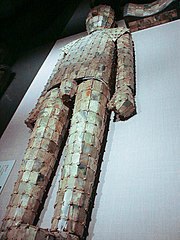
A Han Dynasty jade Burial suit laced with gold thread at the National Museum of China
-

A pastel pierced porcelain vase, from the Qianlong era of the Qing Dynasty.
-
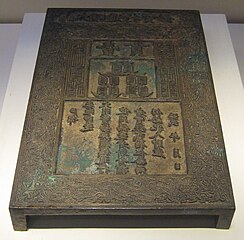
Copperplate for printing the Great Ming one string banknote
-

Stone carving from the Eastern Han Dynasty, with depiction of a waterside pavilion overlooking a lake full of fish, turtles, and waterfowl
-

Bronze two-part pass (paizi) with a four character Tangut inscription inlaid in silver, from the Western Xia
-

A bronze vessel in the shape of a bat, from the tomb of Lady Fu Hao, from the Shang Dynasty, 13th century BC
-

Pottery roof tile ends from the Western Han Dynasty
-

Painted stone relief depicting a warrior from the Later Liang Dynasty
-

A Western Han Dynasty jade pillow from the tomb of the Prince of Chu in Shizishan, Xuzhou, and Jiangsu province
-

A bronze seal dated to the 12th year of the Dading era (1172) of the Jin Dynasty
-

Red lacquer box from the Qing Dynasty
-
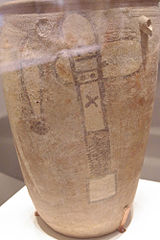
Painted pottery of neolithic Yangshao culture, with depiction of a stork catching a fish and a stone axe on the side
-
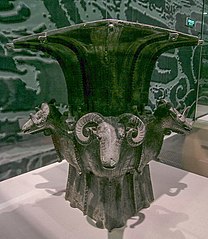
Square zun with four sheep from late period of the Shang Dynasty
-

Bronze tallies with inscriptions inlaid in gold from the Chu State during the Warring States period.
-

Brick relief depicting two scholars and two maids, from the Southern Dynasties.
-
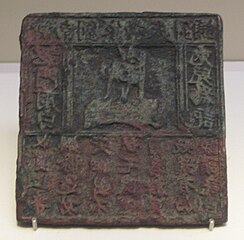
Bronze plate for printing an advertisement for the Liu family needle shop at Jinan. Song Dynasty. The earliest extant example of a commercial advertisement
-

Bronze cannon with inscription dated the 3rd year of the Zhiyuan Era (1332), Yuan Dynasty.
-
Large bronze basin of Guo Ji Zi Bai, from the Western Zhou.

-
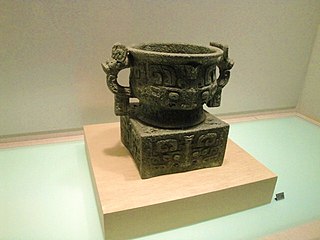
Li gui, the earliest Zhou Dynasty bronze vessel to be discovered, and the only epigraphic evidence of the day of the Zhou conquest of the Shang.

Simumu Ding, the largest piece of bronze work found in the world so far. It was made in the late Shang Dynasty at Anyang where I will be next week.
-
-

Eagle-shaped pottery of neolithic Yangshao culture
-
A Song Dynasty copy of the Portraits of Periodic Offering of Liang, dated to the 6th century, depicting ambassadors from various tributary states.
Lama Temple
Since visiting the Lama Temple last year here in Beijing, I have gained a better appreciation of its importance. Nature seems to be the focus where this connecting the inner with outer where roofs, frescoes, arches, tapestries, Tibetan


When you arrive, you are handed incense and are encouraged to use it. This is considered the most renowned Tibetan Buddhist temple outside Tibet. The Lama Temple was converted to a lamasery in 1744 after serving as the former residence of Emperor Yong Zheng.
I have often talked about the influence of Confucius, Taoism and Buddhism,

We all live in one world. When on the path, it becomes a thoughtful world acting as if vibrations of energy. Our words we speak serve as a blanket for those people around us. As if saying words of loving kindness through the power of our tongue. It is important that as we give right speech, we remember the good and harm we can cause by thinking first. Think – Is it true, helpful, important, kind, and necessary. That we travel on a journey not concerned with the destination. With this we walk in a centered way. It is important

How do we do this, through right action. By doing no harm and understanding the laws of karma, i.e., the measure we give is what we get. It is not enough to know the truth; you have to begin by having control over your dominion. Staying aware as if called to a higher path and practicing consciousness. We make the right choices as if witnessing our own actions. We do this through service to others. We find ourselves in the right livelihood that helps to train us to be in conscious awareness and live through loving kindness.
I leave this evening to go to Qufu. My friend Maria will meet me at the airport.
As I continue to go through my own version of Lao Tzu’s Tao Te Ching that I wrote in May/June 2000 and my book, Thoughts on becoming a Sage, The Guidebook for leading a virtuous Life, I am asked to tell… just who was this Lao Tzu and why is
A partial preview can be seen on the Lao Tzu and Taoism tab here on my website. Ultimately, it is what the sage has learned and then in turn taught others along the way that guides us. The commentaries below are meant to be read as a discussion between Lao Tzu and those interested who have thought deeply about the text itself. The quotes below and references to their authors are from Red Pine’s, Lao Tzu’s Taoteching.
Thoughts on becoming a Sage.
Verse 74 – Acceding to the will of Heaven.
Everything under the sun must take its turn. Impatience and ego the only deterrent from our recognizing our good when heaven comes forth to greet us. It is in daring to act without virtue that we fail when keeping still defines who will benefit and who will be harmed.

Who can know the will of heaven? Can only those who accept the path to enlightenment who live under the auspices of the Tao come closer than any other? It is as if two people are confronted with the same choice.
One will follow the instincts of heaven and the other the instincts of self-interest. Why does one see the way beginning within himself ultimately leads to virtue and the will of heaven through detachment from the world. While the other cannot see beyond himself and the material world he covets. The sage knows that all things under heaven eventually come to pass to find each one of us. It is what we grab onto that determines our way.


That is why cause and effect and yin and yang of everything imaginable must occur. Light must become dark, just as the four season’s change. All things have their time that leads to their ultimate unfolding. This underlying truth is the path to reason. The way of heaven wins easily without a fight because it already knows the outcome and will see things through to their end.
It answers with a word as the natural progression of cause and effect, comes quickly without a summons protecting those who, with grace, follow the way and plans ingeniously without a thought as the natural extension of the Tao. Its net is all embracing and nothing escapes it.

Each beginning must follow with its rightful end just as every end is simply the beginning of something else. Death following life and life following death as we continually leave our spirit to find its own ultimate endeavor and destiny.
Tin Wen says,
“Lao Tzu says if people are not afraid to die, what good is threatening to kill then? If people are not afraid to die, it is because punishments are excessive. When punishments are excessive, people don’t care about life. When they don’t care about life, the rulers might means nothing to them. When punishments are moderate, people are afraid to die. They are afraid to die because they enjoy life. When you know they enjoy life, you can threaten them with death”.
Li Hsi-Chai says,
“This implies that punishments cannot be relied upon for governing. If people are not afraid of death, what use is threatening them with execution? And if they are afraid of death, and we catch someone who breaks the law, and we execute them, by killing one person we should be able to govern the rest. But the more people we kill, the ore break the law. Thus punishment is not the answer.”
Ming T’ai -Tzu says,
“When I first ascended the throne, the people were unruly, and officials corrupt. If ten people were rescued in the morning, a hundred were breaking the same law by evening. Being ignorant of the Way of the ancient sage kings, I turned to the Tao Te Ching. When I read: ‘If the people no longer fear death / we do we threaten to kill them,’ I decided to do away with capital punishment and put people to work instead.”
Verse 75 – Finding our Place in Heaven
For those who have not taken up their personal journey; for those who have not awakened midstream to find themselves embracing something beyond themselves that cannot be explained but makes perfect sense; for those who fail to pass judgment on themselves and all around them, yet see clearly, does not the final answer come forward with how they perceive their own death and innate fear of losing what life they have until they figure it out.

Throughout the ages and passed along from each generation and centuries too numerous to mention has not this overriding question of immortality and the efforts to embrace it been the endeavor of even the most devout sage with thoughts of death and destiny and questioning who are we to judge the will of heaven.

The sage is guided by the knowledge that as long as people fear death, forces close by will always be near to do them in. If we in turn substitute the will of heaven for our own, are we ourselves likely to meet our own untimely end?
If as stated earlier, the net of heaven is all-embracing its mesh remaining wide so that nothing escapes it, then does not everything eventually find its rightful place under heaven? xx
Li Hsi-Chai says,
“If those above take too much, those below will be impoverished. If those above use too much force, those below will rebel.This is a matter of course. When someone thinks his own life is more important, and he disregards the lives of others, why should others not treat death lightly. The sage doesn’t think about life unless he is forces to.”
Ho-Shang Kung says,
“Only those who do nothing to say alive, who aren’t moved by

Ten Tsun says,
“The Natural Way always turns things upside down. What has no body lives. What has a body dies. To be alive and to seek advantages is the beginning of death. Not to be alive and to get rid of advantages is the beginning of life. Those who don’t work to live long.”
Number 69
September 21 – 23, 2018 / Qufu
As a preface for continuing my journey, I am first directed back to the Beijing Museum and my thoughts going forward. There was an immense presence from the Buddhist statues and spirit of Chinese antiquity. I asked about my pilgrimage to connect Buddhist/ Confucius/Taoist thought with the world and asked “who am I supposed to be” the answer was to simply be who I am supposed to be. Simplify to nothing and continue on your way.
It is through sincerity and compassion that your

Continue to be inspired letting the dragons take you to new heights and know that they are pleased. Sincerity, discipline, and patience; your “work” is only these three and keep to the path as you were told in the beginning. Have faith and let your grace and goodness be your guide – love and you will be loved. From here, continue on your retreat and be filled with who you are yet to become letting go of all other things.
Keep to the open road as you are living in dolpo – in the middle – when it is time to go one way or another you will know, and the path will be made clear. Don’t despair or get caught up in your daydreams. Just share your goodness through your writing. This way the message to others and yourself will be evident. Follow the path you have laid out all these year ago. There can be no rush. There is nothing to rush to – just acknowledge who you are and go there.

When I am in Qufu it is as if I walk on sacred ground. It is as Ekhart Toll, the great English philosopher said… “We are one with the universe and the universe is one with us, or better said I am one with God, and God is one with me”. It is as though we are living history when we can accept our role and to become one with it.
The dragons, or sages, all came through here. Ji Dan, the Duke of Zhou in 1000 BC, was here five hundred years before Confucius came in 500 BC, and the Yellow Emperor, Huandi, the great shaman and instigator of what would become the I Ching one day more than a thousand years earlier in 2700 BC. All were from Qufu.
How am I to add to what has already been said and written? Maybe it to transcend the limitations of language. I am reminded again of the three things I need to work on – sincerity, discipline, and patience. But then, I am blessed to have many friends and acquaintances I have made as a teacher and my activities in the almost twenty years I have been coming to Qufu.
Today was a day for catching up with old friends and making travel arrangements. I met with the headmaster of the Confucius College, Mr. Buan Yan Ping on Friday

I then went to visit the Confucius College where they asked me to teach a couple classes and have lunch with the students.
As we got ready to have lunch, the students all rose and said the following:
感恩词(Grateful words)
感恩父母的养育之恩 Thank parents for their upbringing.
感恩老师的辛勤教导 Thank teachers for their teaching.
感谢同学的帮助与关心 Thank classmates for their help and concern.
感谢农民的辛苦劳作和所有付出的人 Thank farmers for their hard work and all those who give.
对饮食,勿拣择 Don’t pick up the food.
食适可,勿过则 Don’t overeat.
或饮食,或坐走,长者先,幼者后 Eat or sit, the elder first.
一粥一饭当思来之不易 Food is hard to come by.
食不语,请老师先吃 Eat quietly. Teachers first.


Later, after lunch, I met Chris and his wife Vicky at the Shangri La Hotel where they both work and with another friend Maria who helped me to book my train tickets for Luoyang for Sunday evening. Later I spoke to my friend Jenny who is a teacher. Jenny did the translation from English to Chinese for the Daily Words which we published here in Western Shandong Province in 2006 and 07.
Finally, I spoke to Yak in Chengdu about my travel arrangements to go to Tibet, especially getting to Lhasa and the best dates for the tour. I am to send copies of my passport and visa information tomorrow to begin the paperwork. (We sent over Andy’s phone). My plans later changed because of holiday. I was not able to get a return train ticket to Qufu to see Jenny and her family on this trip.
There is a naturalness here. I felt it the first time I came almost twenty years ago.

It seems I have always been a living embodiment of an anomaly never really fitting in or caring as if there is someplace else, I am meant to be.
Rarely satisfied with the way things are, always seeing through to what can or should be. It seems as though the more I attempt to have the outer world be a reflection of my inner self – the less the outer world caught up with the status quo and “outer stuff” appeals or relates to me.
In Qufu, it is connecting with your inner spirit that makes you “attractive” to others on a similar journey. A feeling that is universal to not just Qufu. As if I don’t have to detail the history here of Confucius because it is on the face of all you meet. Over half of the more than 80,000 people here have the last name Kong. Confucius family name and are descendants. Hence, here I am simply Kongdan. Over the centuries it doesn’t matter where

Just being here in Qufu with old friends is enough. On Saturday morning (9/22), I do what I always do in Qufu and that is to walk. I found myself at a tea shop I often visited with the owner Mei. We had lunch over a bottle of wine and I bought a dragon/phoenix tea holder. We will have dinner again after I return from Luoyang over the holiday. ( As stated above, I was unable to return to Qufu on this trip. I asked Andy to convey my disappointment to Mei).
That in following the Tao we have no plans. We learn to go with the flow of life and do what comes naturally in unison with our essence, or soul.

Lunyubeiyuan Park in Qufu That being present is always enough. What I like about Qufu is the is no pre-supposition as to what outcome will occur – just be yourself and the universe comes to greet you – those you see, and meet are on a similar path – you are here for them, and they are here for you.
Where you find yourself, you can’t stay there for long. As if fleeting your light travels fast and shadow never lingers. Your essence only left behind for those to ponder their own fate and what can be seen as important in where they see

In every circumstance you are present for only an instant before moving on. The status quo is not for you to bother. Others caught up in their day dream must come to the light within and wake up mid stream in their own life. That everyone is coming from the same place. It it not necessary to expand further on Confucius or others just now, because

There is a symmetry, a certain flow of or lives we all seek. A sense of connection to what appears as universal that answers who we are and what it is we seek. Something all great artists, philosophers and writers have found to some degree.
What Monet and DaVinci found and knew, what Edison,

It’s what I was returning to the instant I knew I found, or re-discovered it, on my first

Yes, it was represented in a place, but it only serves to remind me of what I am here to do. For years everyone has wanted to know why I keep coming to Qufu (especially the security bureau and police. It was this trip and just a couple days here spent in Qufu that the sense staying in flow of where I have been takes me to my next step… to Luoyang via fast train. Tonight I arrive in Luoyang for my next step in my journey.
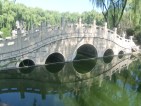
Pictures from this trip to Qufu…






As I continue to go through my own version of Lao Tzu’s Tao Te Ching that I wrote in May/June 2000 and my book, Thoughts on becoming a Sage, The Guidebook for leading a virtuous Life, I am asked to tell… just who was this Lao Tzu and why is
I know I spoke of this last time, but some may have missed so it bears repeating. Lao Tzu’s Tao Te Ching was the culmination of thousands of years of philosophical thought of what was to become Taoism thanks in part to copies found in tombs of those who were buried with copies of it in China. There are eighty-one verses in the Tao Te Ching. Verses 76 and 77 appear below. Verses 1 through 75 were seen here on my most recent posts. The balance will be seen here over the coming weeks. Hopefully, I can complete this journey through Lao Tzu on this trip to China.
A partial preview can be seen on the Lao Tzu and Taoism tab here on my website. Ultimately, it is what the sage has learned and then in turn taught others along the way that guides us. The commentaries below are meant to be read as a discussion between Lao Tzu and those interested who have thought deeply about the text itself. The quotes below and references to their authors are from Red Pine’s, Lao Tzu’s Taoteching.
Thoughts on becoming a Sage.
Verse 76 – In death the Tao acknowledges the Sage.
Before there was considered to be a force in the universe that would be known as God there was the Tao. Before there existed the myriad of shamans, saints, priests and holy men considered to be here to lead the way, there was the Tao.

As the ten thousand things came forth from antiquity to manifest and begin the cycle of being born, dying and being born again continually as the natural extension of the way, the sage ultimately came forth as one protected by dragons. The dragons, but those who have been chosen to impart simple virtue as those who follow the correct path or way of heaven.

The sage coming forward to find that the reason there is suffering or hunger for life is that others impose too many restrictions on how we should live, therefore people remain unfulfilled.
That the reason people are hard to get along with is that those who would lead the way have forgotten the path in which all should follow. However, when death follows as the natural course of events after everything has passed through him and acknowledges his ultimate place in the universe, the loving life becomes secondary as eternal life comes forth to greet the great sage.
Loving God and what He and the Tao teaches, he simply lets his enthusiasm come naturally as the centuries have shown him the proper way.
Ho-Shang Kung says,
“When people are born, they contain breath and spirit. This is why they are soft. When they die, their breath ceases and their spirit disappears. This is why they are hard”.
Lao Tzu says, “The weak conquer the strong.”
Wang P’ang says,
“In terms of yin and yang, yin comes before, and yang comes after. In terms of Heaven and Earth, Heaven is exalted, and Earh is humble. In terms of Virtue, the soft and the weak overcome the hard and the strong. But in terms of material things, the hard and the strong control the soft and the weak. The people of this world only see things. They don’t understand Virtue.”

Verse 77 – Letting your Enthusiasm open every door.
Fortunate again to be born into weakness, we are soon caught up in what may be perceived as making us strong.
Lieh Tzu, my friend and mentor, tells the world that the path to victory is weakness. As the hard and strong lead people away from the Tao, they do so with great effort. Confused into thinking that our strength is needed to help us find our way when just the opposite, our weakness, will bring us victory.
Bringing weakness along for the Ride Shaanxi Museum Xian They refuse to remain still letting events come to them. Convinced that controlling what occurs they will find their direction. Remaining oblivious to what remains effortless may just appear as weakness.
Observing the simple, letting everything play out to its own conclusion, the sage appears soft and seemingly weak. When things become hard and stiff, they can only be close to their end. Remaining supple and bending with the wind the soft and weak can stay in tune with life.

Staying within the confines of his own virtue, the sage easily converses with his mentors bringing nothing hard and fast to the table. He confines himself to his humble beginnings letting the Tao lead the way. Letting his enthusiasm remain his signature that softens every encounter he is not bound by things seemingly apparent in the world as he opens every door that finds him.
Kao Heng says,
“In attaching the string to a bow, we pull the bow down to attach the string to the top. We lift the bow up to attach it to the bottom. If the string is too long, we make it shorter. If the string is too short, we make it longer. This is exactly the Way of Heaven.” (this is based on the Shuowen, which says, “Chang means to attach a string to a bow.”
Lu Hui-Ching says,
“The Way of Heaven does not intentionally pull down the high and lift up the low. It does nothing and relies instead on the nature of things. Things that are high and long cannot avoid being pulled down and shortened. Things that are low and short cannot avoid being lifted up and lengthened. The full suffer loss. The humble experience gain.”.
Wang P’ang says,
“The Way in Heaven is based on the natural order. Hence it is fair. The Way of Man is based on desire. Hence it is not fair. Those who possess the Way follow the same Way of Heaven”.
Number 70
Sept 24 – Oct 1, 2018, in Luoyang…
I am posting my tentative schedule so we can book the train schedule and airfare between cities. Maria is trying to help with the fast train tickets. Very hard over the holiday.
Currently I am staying at the Luoyang Anximen Hostel until Thursday (9/27) then the Luoyang Heartland Hostel until Monday, October 1st. I would travel from Luoyang to Xian on Monday 10/1 and stay at the Xian Hentang House until Friday, October 5th. First thing I learned in all the years I have traveled here in China is you must be flexible. Second, I should stop coming during holiday when travel is difficult.
Everything changed for the balance of my trip this afternoon (Tuesday 9/25). Travel to Tibet was moved from October 10th-13th to 14th-17th. I checked flights and I can get a flight from Lhasa to Beijing on the 17th.
All of the dates are tentative due to difficulty in getting tickets, summary: 10/1 Luoyang to Xian and hotel there is all that is confirmed for now. I need to cancel Chengdu Flipflop booking and reschedule for later in the month if needed. Airplane tickets summary: 10/14 Need to be in Lhasa; 10/17 Lhasa to Beijing and 10/18 Beijing to USA.
Luoyang was home and capital of thirteen dynasties, until the Northern Song dynasty moved it east to Kaifeng in the 10th century. Both the Tang and Sui dynasties were centered here in what was considered the height of Buddhist influence and demonstrate how the connection between Luoyang and early Buddhism became so important. At one point there were 1300 Buddhist temples here. Luoyang was home to many emperors and had lasting importance to early Chinese history.
Luoyang was the capital city for the longest period, the most dynasties, and the earliest time compared with the other ancient capital cities. Luoyang lies in the Central Plain surrounded by mountains, which were natural barriers against invasions. Apart from its favorable geographical location, Luoyang had an agricultural advantage as several rivers flow through it. Therefore, 105 emperors of 13 dynasties set their capitals in Luoyang during China’s history.
Luoyang was the center of politics, economy, and culture in China for 1,500 years. Since the Xia Dynasty (2070–1600 BC), Luoyang had begun its history as a capital city. In the Western Han Dynasty, Luoyang was not chosen as the capital, but the ruler still attached great importance to the city. There is so much history here that I want to come back to Luoyang for further study. It is said Lao Tzu lived here for a while and Taoism got it’s beginnings of Mount Song where I will visit while I am here.


On Monday (9/24) I went with three students by bus to the Buddhist White Horse Temple. I took several pictures until my battery stopped then I used my phone camera for a few more. Many I encounter think I am brave to travel alone where I can’t speak the language. But I counter that I generally know them by their history than they know themselves. After seeing my writing, they mostly agree.
What struck me was the continuing presence as if the joining or coming together of history with one’s natural environment and connecting this with the universe, or divine spirit within us and that which surrounds us as well. To be treated as if you are coming home to visit something that is innately a part of yourself.
Something you have always known, but simply needing to be reminded. This seems to be the motive behind all these ancient “temples”. What we in the west today would describe as “

They bring a sense of longevity and simplicity to it all spanning thousands of years and being reminded that both the inner and outer are the same reality we each choose to live every day.
The Buddhist White Horse Temple on the outskirts of Luoyang has always been on my bucket list here in China. It’s influence in the spread of Buddhism over the

Keeping things simple means there are fewer doors that need to be opened as well. As if “becoming simple minded” is a good thing.
Two other overreaching influences from Buddhism to China was that Luoyang was the start of the Silk Road that headed back to Venice in Italy. It was by way of the Silk Road (and elephants going through Tibet to Xian), that Buddhism came to China. By the time Marco Polo came here with his father and uncle in 1270 AD on their way to visit Kublai Khan in Beijing, the Silk Road had been a functioning means of transportation of goods and culture between east and west for almost

The White Horse Temple and the Long man Grottoes have had the most lasting historical presence in this area of China. We will visit both later in the week.
What Buddhism brought was a sense of permanence and presence that people could see as their own connection to what we would now call “becoming universal”. That you were more than your body, and a good life could lead to better things, as yet unknown, in the future.
That we are one and there is no separation between the world we live in and what we might find for ourselves afterwards. This connection was what the Taoist Chuang Tzu expressed so well in

There seems to be a progression in my travels, first to Beijing and the Llama Temple, then the opening of the gate with Confucius in Qufu.
Finally, for now, coming the famous White Horse Temple and Long Man Grottoes. Like steppingstones to greater appreciation, understanding, and hopefully wisdom of my own origins in Chinese history. As if midway – later heading back to Xian and Chengdu before ultimately going to Tibet. With more than a week in between to discover new mountain vistas and clouds waiting to rise above.
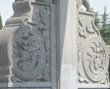
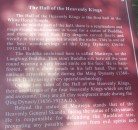
The White Horse Temple, one of the oldest temples in China, is located about 6 miles from the city of Luoyang in eastern China’s Henan Province. It is a place that disciples of the Buddha school recognize as the palace of Buddhist ancestors and the place where Buddhist theory was taught. It was built by Emperor

The scholar Fu Yi told the emperor after his dream:
“Your subject has heard it said that in there is somebody who has attained the Dao and who is called Buddha; he flies in the air, his body had the brilliance of the sun; this must be that god.”
According to the historical book of records that after a dream, Emperor Ming sent an envoy to Tianzhu in southern India to inquire about the teachings of the Buddha. Buddhist scriptures were said to have been returned to China on the backs of white horses, after which White Horse Temple was named.








Early History of the White Horse Temple
The two senior monks She Moteng and Zhu Falan, preached at White Horse Temple and jointly completed the translation of the 42 chapter Sutra, the first Chinese version of Buddhist scriptures. After She Moteng passed away, Zhu Falan continued to translate a number of scriptures. Their translations of the scriptures were all treasured in the Main Hall for the monks to worship.
It was said that in the Northern Wei Dynasty (386 A.D.– 534 A.D.), when the Buddhist monks worshiped the scriptures, the scripture suddenly glowed with colored lights and lit up the Main Hall.
During the reign of Tang Dynasty Empress Wu Ze Tian (624 A.D.–705 A.D.), the White

This is the way I like to travel. I have a week here in Luoyang to explore the area. Hopefully it will stop raining. Two main things I want to see are the Long Man Grottoes and the Shaolin Temple. Not having google is a serious detriment to my travels. I still need to try to fix my Chinese camera, or more batteries for my little canon camera. It takes excellent pictures. Almost all pictures here on my website are one’s I have taken with the canon camera.
Tuesday (9/25) appears to a day to stay inside here in Luoyang and update my blog. It looks like it will rain all day and the Cardinals are on my computer this morning. Maria got my train ticket for next Monday to Xian. (thanks Maria) It sounds like my getting to Tibet prior to October 14th will work. It seems I am alone here in Luoyang. I guess that’s what one does on a retreat to seek inner meaning to what comes next. Plus the rain makes for staying inside. I did go to the bank next door to see if they can help me to send via WeChat money for the Tibet tour. They can help. Hopefully we can do that tomorrow. Next will be confirming airfare to Lhasa and Lhasa to Beijing afterwards. Just go with the flow and what needs to occur always does…
Everything regarding the balance of the trip changed this afternoon. Due to holiday the four-day tour I was about to pay for has been delayed to October 14 to October 17. I still want to do the tour, but first I must confirm I can get a flight from Lhasa to Beijing on the 17th, as I fly back to USA on the 18th. I still stay in Luoyang until next Monday, October 1st and go to Xian. I had planned to go to Chengdu on the 5th, but now there is no hurry.
As I continue to go through my own version of Lao Tzu’s Tao Te Ching that I wrote in May/June 2000 and my book, Thoughts on becoming a Sage, The Guidebook for leading a virtuous Life, I am asked to tell… just who was this Lao Tzu and why is
Ultimately, it is what the sage has learned and then in turn taught others along the way that guides us. The commentaries below are meant to be read as a discussion between Lao Tzu and those interested who have thought deeply about the text itself. The quotes below and references to their authors are from Red Pine’s, Lao Tzu’s Taoteching.
Thoughts on becoming a Sage.
Verse 78 – Following the way of Heaven.
The sage endeavors to follow the way of heaven while only revealing everything for its true and natural place. Pulling down the high while lifting the low he stays on an even keel finding the natural balance of all around him.

Continually moving forward unsure or unconcerned if what he does is ultimately good or bad as long as the natural order of things are followed and are allowed to take their places. Moving without presumption or staking claim to what may be perceived as personal achievement. Choosing to remain in the background and not displaying his skills, nothing can deter or get in his way. His burden to keep his virtue to himself and not revealed to those who continually come running to his doorstep.
Modeling his actions after the way of heaven, the sage takes from the long and gives to the short so that the ten thousand things naturally find their places. For all things under heaven to find their place, it is best for heaven to sit back and do nothing. Allowing the nature of all things to come forward unimpeded fulfilling its ultimate endeavor and finding its true identity and destiny.
Hsung-Tsung says,
“The nature of water is to stay low, not to struggle, and to take on the shape of its container. Thus nothing is weaker. But despite such weakness, it can bore through rocks, while rocks cannot wear down water.”
Li Hung-Fu says,
“The soft and the weak do not expect to overcome the hard and the strong. They simply do.”
Chuang Tzu says,
“Everyone wants to be first, while I alone want to be last; which means to endure the world’s disgrace.” (33.5). Mencius says. “If the ruler of the state is not kind, he cannot protect the spirits of the soil and grain” (4A.3).
Su Ch’e says
“Upright words agree with the Tao and contradict the world. The world considers enduring grace shameful and enduring misfortune a calamity.”
Li Jung says,
“The world sees disgrace and innocence, fortune and misfortune. The Taoist sees them all as empty.”
Verse 79 – Being Present at Destiny’s Table
The sage is reminded of the words of an old friend who once told him that the true nature of one who follows the Tao is like water. It is the nature of water to stay low, not to struggle and to take on the shape of its container thus appearing to be weak.

Is this not the way of the sage? Appearing weak, but in reality, able to cut through any obstacle as he ultimately finds his true path.
What is perceived as weakness often wins through persistence while what appears to be hard easily become brittle unable to withstand the pressure of determination.
Should not we follow the ways of Chuang Tzu who decried that everyone wants to be first, while he alone waits, wanting to be last enduring to the end so that he may be

Emulating Chuang Tzu’s perfected man cannot the sage by following the Tao and the way of heaven ultimately turn everything upside down thereby betraying conventional wisdom at every turn.
In looking beyond the present and reminding himself of what’s to come, does not the sage simply prepare to return to find this place confident that the stage has been set and his place at the table assured.
Su Ch’e says,
“If we content ourselves with trimming the branches and don’t pull out the roots, things might look fine on the outside, but not on the inside. Disputes come from delusion, and delusions are the products of our nature. Those who understand their nature encounter no delusion, much less disputes.”
Sung Ch’ang-Hsing says,
“Seeking to make peace with others is the Way of Man. Not seeking to make peace but letting things make peace by themselves is the Way of Heaven. Despite the expenditure of energy and action, energy and action seldom bring peace. Thus the sage holds the left marker because he relies on inaction and the subtlety of letting things be.”


