Number 74
Sept 28 – 29, 2018 Shaolin Temple and return to Luoyang
Friday, September 29 we went to the Shaolin Temple and Buddha Forest at the base of the mountain and then on Saturday I took the bus back to Luoyang and Lin headed for Shanghai. I’m reminded of the old TV series with Keith Carradine about the Shaolin Temple and Kung Fu. How he traveled the old west rescuing people from trouble and things they had gotten themselves into. Flashbacks of his time back in China at the Shaolin Temple and his mentor referring to him as “grasshopper”. We were walking in front 

Christiane Francois and I came to Qufu to facilitate donating two hundred wheelchairs from The Wheelchair Foundation and the Boynton Beach Sister City Committee. It was quite a surprise. The first wheelchair I had seen in more than ten years. It was in great 

Shaolin Temple, in the region of Songshan Mountain in Dengfeng, Henan Province, is reputed to be ‘the Number One Temple under Heaven’. Shaolin Temple history can date back to Northern Wei Dynasty (386 – 534), and it played an important role on the development of the Buddhism in China. Upon entering you first see Shanmen Hall. Hung on its top is a tablet reading ‘Shaolin Temple’. The tablet was inscribed by the Emperor Kangxi (1622 – 1723) during the Qing Dynasty (1644 – 1911).
Under the stairs of the hall crouches two stone lions made in the Ming Dynasty (1368-1644). The hall enshrines the Maitreya Buddha. Two sides of the corridor behind the hall’s gate are paved with inscriptions on stone steles made during several different dynasties. Sometimes the less said the better to let the reader use pictures and their own imagination to take you there.
Shaolin Temple Wushu (Martial Arts) Training Center
The Shaolin Temple Wushu (Martial Arts) Training Center comes after you have 

Shaolin monks have been practicing Kung Fu for over 1,500 years. The system was invented to teach the monks basic methods to improve their health and defend themselves. The martial art performance shows (which I attended), illustrate the true Chinese Shaolin Temple Kung Fu. For example, Tong Zi Gong, performed by teenagers, is a kind of martial art to train one’s flexibility and strength. Shaolin Kung Fu has a great tradition in China. Today, there are more than 50,000 students here in facilities across from the Shaolin Temple.
The Shaolin Temple has two main legacies: Chan, which refers to Chan Buddhism, the religion of Shaolin, and Quan, which refers to the martial arts of Shaolin. In Shaolin, these are not separate disciplines and monks have always pursued the philosophy of the unification of Chan and Quan. In a deeper point of view, Quan is considered part of Chan. As late Shaolin monk Suxi said in the last moments of his life, “Shaolin is Chan, not Quan.”
On the Quan (martial) side, the contents are abundant. A usual classification of contents are:
- Basic skills (基本功; jīběn gōng): These include stamina, flexibility, and balance, which improve the body abilities in doing martial maneuvers. In Shaolin kung fu, flexibility and balance skills are known as “childish skill” (tóngzǐ gōng), which have been classified into 18 postures.
- Power skills (气功; qigong): These include: Qigong meditation: Qigong meditation itself has two types, internal (nèi), which is stationary meditation, and external (外; wài), which is dynamic meditation methods like Shaolin four-part exercise (si duan gong), eight-section brocade; bā duàn jǐn), Shaolin muscle-changing scripture (yì jīn jīng), and others.
- The 72 arts: These Include 36 soft and 36 hard exercises, which are known as soft and hard qigong.
- Combat skills (quanfa “skills”): These include various barehanded, weapon, and barehanded vs. weapon routines or styles and their combat (sàndǎ) methods.
In practice, beyond the martial arts aspects of Shaolin, was that the essence of enlightenment came to be identified with the interaction between masters and students. It was through Chan Buddhism that whatever insight, or dhyana, would occur as a series of cultivated states of mind which leads to a “state of perfect equanimity and awareness,” commonly translated as meditation, that would serve as one’s verification.
In effect, enlightenment came to be understood not so much as an insight, but as a way of acting in the world with other people present. Shaolin was the result of both purification of both body and mind. (some of the above from Wikipedia)


The Pagoda Forest
The Pagoda Forest, next to the Shaolin Temple, serves as a graveyard for Buddhist dignitaries through the ages. On average, the pagodas are about 50 feet high. The layer and the shape of a pagoda depend on many factors, such as one’s status, attainment and prestige during his lifetime. The Pagoda Forest here is the largest of China’s pagoda complexes.


Ancestor’s Monastery & the Second Ancestor’s Monastery
Outside the Shaolin Temple to the northwest, are two monasteries, named the 

Number 75
Sept 30 – Oct 1, 2018 Longman Grottoes and on to Xian
I think the trip is catching up with me… in more ways than one. I seem to have eaten something that didn’t sit well, or not eating enough. Today is Sunday, September 30th and I’m heading by taxi to the Longman Grottoes, although I’m not sure how long I’ll last. Hopefully not too much walking today. There is lots of information on the internet as to history, and I will add more later when I feel better. It didn’t dawn on me until the next day that I may have been experiencing a far greater hunger than just filling my stomach.
For now, I’m just going to try to add a few pictures I took along with some of my thoughts:
As I look at the side of the mountain and think of those who might have carved out of stone 


OM MANI PODME HUM
These words can be translated and have a universal meaning:
OM – The Jewel in the Heart of the LOTUS! The deep resonate OM is all sound and silence throughout time, the roar of eternity and also the great stillness of pure being; when intoned with the prescribed vibrations, it evokes the ALL that is otherwise inexpressible.
The MANI is the “adamantine diamond” of the Void – the primordial, pure and 

PADME – In the lotus – is the world of phenomena, samsara, unfolding with spiritual progress to reveal beneath the leaves of delusion the mani-jewel of nirvana, that lies not apart from daily life but at its heart.
HUM has no literal meaning, and is variously interpreted perhaps simply as a 

For myself, I am especially attracted to the mythical embodiment of the Buddha, called a Bodhisattva known as Avalokita Ishuara – who is seen as “The Lord that looked down in compassion”. He represents “the divine within” sought by mystics and has been called “The Lord that is seen within”.


Am I becoming a Buddhist? I don’t know. I still am a Taoist at heart. But I can see how the two became intertwined in Chinese history, religion, and culture. I still have those two things called discipline and patience to work on – and a sense that I still have a way to go yet. For myself, it has always been about the freedom to breathe. Perhaps an anomaly – always the outlier. But maybe not – maybe it is the sense of ultimate freedom yet to be found – I’m just not there yet. Maybe I’ll find it on this trip. Perhaps I will look for Avalokita when I get to Lhasa in a couple weeks. Or maybe I should just ask the stone carvers here at the Longman Grottoes. They obviously knew the answer. (with excerpts from Peter Matthiessen’s The Snow Leopard).


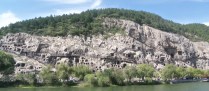


On Monday I had recovered somewhat and spent most of the day updating my blog. I need to leave by taxi at three for the fast train station to pick up my ticket for a 5 PM departure. (I did find a KFC at the train station in Luoyang, I’m better now). I arrived in Xian about 7:30 PM and took a long taxi ride to the Han Tang Hostel.
Number 76
Oct 2 – 3, 2018 Xian
I’ve been here before in June, 2014 for just three days. I only had time for a day trip 

It seems as though leaving Xian is a real problem due to holiday travel. Or maybe it’s something from long ago that needs my attention. Much of this trip was to be like leaving the world behind and now I’m pulled again to the past and can’t get away from it. Xi’an is one of the world’s great ancient cities, being most famous for its role as the starting point of the Silk Road. In the past, it was previously known as Chang’an. Xi’an is widely regarded as one of the greatest cities in Chinese history. During imperial dynasties such as the Zhou, Qin, Han and Tang, this was the 

Xian was not the place to be as a scholar during the time of Emperor Qin when he had his terra cotta army built to protect him in immortality. Many of my friends died here, made to dig a hole and throw all the great literary works in – set them aflame – then forced to jump or be pushed in themselves… Anything representing “old” was destroyed. Many great literary works were burned and scholars killed by Emperor Qin. I think this is why when I come to Xian I walk the streets in sadness. Visiting the ancient sites that were 

Regardless of the time of year I am here there seems to be a chill in the air and the rain I feel is but the tears streaming down my cheeks. Sometimes I think our purpose is simply to pay tribute. Remembering both the good and the bad lest we forget, as we praise those who meant so much. As if in remembrance, returning to hear their sweet voices again, and have a place to contemplate as my voice, my writing and I gain strength from their eternal memory. Interesting hostel is playing Nora Jones “Come away with me… draggin down the road alone. You’ll be on my mind forever”. In retrospect, we are really never alone.
So, I checked with Maria, and I would need to take a two-hour bus to Huayin for the mountain. There is no train from Huayin to Chengdu so I would probably have to return here to Xian to then go to Chengdu. I can’t get a train to Qufu until October 9th. Maybe I could go to Qufu on the 9th and go to Chengdu on the 12th. Four stops before returning to USA. First Hauyin, then Qufu or return to Xian, Chengdu, Lhasa, then Beijing and home. Okay five. Whatever I’m going to do, time and space are of the essence.
The next time I even remotely suggest to myself or otherwise, that I come to China 

I told staff at hostel that I wanted to go to Hua Mountain (today is October 2nd – I compromised, I plan to go on the 5th). They suggested I wait until after holiday and go on October 8th. Actually, I was hoping to be at the top of Hua Mountain on October 8th, my 66th birthday. I hope to spend it with Lao Tzu and complete my new version of the Tao Te Ching that I have been working on for a year now.
Wednesday, October, 3… Too hard to do Qufu so I will first get my fast train ticket from Xian to Chengdu hopefully on late afternoon or evening of October 9th this morning. Then book Flipflop Hostel Oct 9 – 14th for departure to Tibet Sunday, Oct 14th. (I already have my plane ticket from Chengdu to Lhasa). Once done I will go ahead and book my return flight from Lhasa to Beijing for October 17th to arrive at Beijing airport for fight back to USA October 18th. After this is done, I will go to bus station here in Xian and purchase bus ticket for Huayin for Friday, Oct 5 and return to Xian, Tuesday morning , October, 9th so I can make my way to train station and Chengdu. And this trip is supposed to be about simplifying my life… Oh, and I need to do laundry today. Well, I got a ticket on fast train next Tuesday from Xian to Chengdu, secured reservation at Flipflop Hostel, after great effort was able to book ticket for 17th from Lhasa to Beijing, and will get bus tickets at station for Huayin on Friday.
All the great scholars and the sage ever wanted was the freedom to fill in the details of their own blank page. What it was that contributed meaning to their own path along the Way, or Tao. To have their say “for eternity’s sake”. Why climbing mountains following the way of nature has always been the closest observance of dragons, their predecessors. As if endeavoring to get their attention and steps they should follow. They remind me now not to find sorrow in their passage here in Xian all those centuries ago. That tears to be shed, should be tears of joy, as they were simply returning home. That as the sage, you should find comfort in not always “fitting in”. As your place too will always be seen with dragons.
I wrote the below story in March 1995. It could easily have been simply an essay meant to honor old friends.
Filling in the Details
Delight in knowing that you have always been on the edge and will remain there. Finding comfort in what would otherwise be considered chaos by others who will never travel to find their true destiny. If you have found true peace of mind, how can hardship enter the picture? What comfort can be found in everyday events seen by others as needed to have some fleeting sense of contentment? Remain as the first word to be written on the next blank page waiting to be filled with what must come forth in truth, sincerity, and compassion.
Appreciating nature, both your own inner nature and that surrounds you. Your garden being wherever you are. Where trees grow leaves, where flowers attract bees and butterflies. Where wisps of clouds float between heaven and earth. Coming forward to know the happiness of all things nature provides and knowing where you fit in will always be present.
As all things change from instant to instant, is not remaining on the edge prepared to capture the new rays of each day’s sun, the ultimate that can ever be – now and forever. Not found to be clinging to life’s fortunes. Knowing happiness can only be followed by sadness. That everything ebbs and flows in the balance of all things.
The ultimate that can be. Simply to be blown along with the winds of one’s life. Never knowing the outcome, only savoring the details found along the wayside. Find a place of quiet solitude where there can be no contention present. With everything around you at peace and harmony with its environment. As you come forward through your writing to fill the blank page with little or no concern for the time of your ultimate arrival.
Remaining free to continue on your way with Lieh Tzu and your old friends. Ready to begin anew the journey that you must begin again and again and again. 3/11/95
Karma can be a tough thing. Less than an hour and a half away from where I now sit is the site of Emperor Qin’s terra cotta warriors and his mausoleum. In what was seen as “fitting” by many, after the emperor’s death, his terra cotta was covered first by a wooden roof and then an earthen mound, the wooden roof was later set on fire. The roof fell onto the terra cotta and broke his precious army into a million pieces. His Grand Library where all history was to begin with him, was also destroyed by fire ten years after his death. His legacy was not as he intended.
(I have several pictures to add here, but the internet signal is not strong enough where I am at. Once I get to another place where the signal is stronger… I will add them. I sometimes lose my entire content of a blog trying to add pictures. I’ve complained back in USA to WordPress and they say it’s the connection here in China, not their software. I find their explanation not too helpful though).
As I complete my own version of Lao Tzu’s Tao Te Ching that I wrote in May/June 2000 and my book, Thoughts on becoming a Sage, The Guidebook for leading a virtuous Life, on this journey, I am asked to tell… just who was this Lao Tzu and why is 

Ultimately, it is what the sage has learned and then in turn taught others along the way that guides us. The commentaries below are meant to be read as a discussion between Lao Tzu and those interested who have thought deeply about the text itself. The quotes below and references to their authors are from Red Pine’s, Lao Tzu’s Taoteching.
Thoughts on becoming a Sage
Verse 80 – Staying in Step with the Tao
Cultivating ourselves while holding a marker as if attached and only concerned with the way of heaven.
The world is looking for the sage to come forward full of enthusiasm and direction to lead in the spirit of dragons and to show others their highest endeavor and destiny. The world is looking to the sage once he has accepted the mantle as one enmeshed with the Tao. Making no claims on others while making demands only on ourselves as disputes come and go as if they are riding the wind. Here now only to test our direction and how far along we’ve come on our journey.
Once he has accepted his place in the scheme of things to come, nothing can stand in his way. As he simply embodies the Tao in his every thought, action and deed his every step continues to become second nature…
Ho Shang Kung says,
“Although the sage governs a great state,he thinks of it as a small state and is frugal in the use of its resources. Although the people are many, he thinks of them as few and is careful not to exhaust them.”
Wang An-Shih says,
“When the people are content with their lot, they don’t concern themselves with moving far away or going to war.”
Wu Ch’eng says,
“People who are satisfied with their food and pleased with their clothes cherish their lives and don’t temp death. People who are content with their homes and happy with their customs don’t move far away. They old old and die where they were born.”
Ch’eng Hsuan says,
“They are satisfied with their food because they taste the Tao. They are please with their clothing because they are adorned with virtue. They are content with their homes because they are content everywhere. And they are happy with their customs because they soften the glare of the world.”